
Response to commentary on “An efficient crossover design for thorough QT studies” by Chen & Weng
Arne Ring 1,2Rachid El Galta 2
1 University of the Free State, Bloemfontein, South Africa
2 Hexal (Sandoz), Holzkirchen, Germany
Letter to the editor
We appreciate the interest in our work and thank Weng & Chen for the thoughtful commentary [1] on the article, “An efficient crossover design for thorough QT studies” [2]. We welcome the opportunity to clarify our approach and address the points Weng & Chen have raised. We would like to respond first by theoretical considerations, and would then add some data-driven statements.
The original article had been written at a time when thorough QT trials according to ICH E14 had often been performed in parallel to phase III as a separate clinical pharmacology trial, instead of being imbedded into the phase I development as it is mostly done today. We aimed to provide an example of statistical research leading to cost reductions with carefully selected study design and analysis. While typically the four treatments requested by ICH E14 (placebo, moxifloxacin, low and high dose of the new drug) were tested in a 4-period crossover, we proposed a more efficient 5-period design with two placebo periods, because the confirmatory hypotheses all involve the contrasts against placebo.
We understand that the key argument in the commentary is that “the two treatments being compared are uncorrelated … is not realistic”. While we agree with the calculations stated by Chen & Weng [1], we note a subtle issue when selecting the numerical values of the correlations between the treatment periods.
The statistical model to analyse (heart rate corrected) QTc-data using the saturated repeated measures cross-over model formula (4) was given in [2], [3]:

The outcomes for a subject i are correlated through the random effects sik, m-th period (with j-th treatment) at the k-th repeated measures time point, while the error terms eikm(j) are mutually independent and follow a normal distribution with mean zero and variance  .
.
Because the test and placebo observations for a subject share the same subject-level random effect, comparing the test observation with the subject’s average placebo response results in the subject random effect appearing identically in both terms and therefore cancelling exactly. Consequently, the variance of the test–placebo contrast depends only on the residual within-subject variability and not on the between-subject variability  .
.
When there are two placebo observations per subject, the variance of the test–placebo contrast is  . When there is only one placebo observation per subject, the variance is
  . Subsequently, the ratio of the variances of the treatment contrasts of the 5- and the 4-period design is
  , as originally stated.
In addition, the correlations between two treatments T and Pn (n=1 or 2 for the first and second placebo period) are given by:

However, this equation does not hold for  . Instead, this correlation can be derived (see Appendix (Attachment 1 [Att. 1])) as:
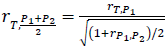
Hence, when  , the correlation with the average-placebo treatment is
  , and for
  it derives to
 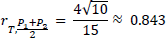 .
.
Subsequently, the ratio of the variances of the treatment contrasts of the 5- and the 4-period design can be simplified to:

See also Appendix (Attachment 1 [Att. 1]) for the analytical derivation. Hence, also our sample size calculation and the total cost efficiency are correct.
Additionally, we would like to refer to the article by Julious [4], which was published independently of our article. Among other useful study designs, it described the same crossover design in section 2.1.2, related to replicate design trials in bioequivalence.
We would also like to mention that Table 1 in [2] already provided data-driven evidence for formula (4) using simulations from 4-period QT trials.
The 5-period QT trial was implemented at the time of the publication of the original article. The results – in particular those with respect to the assay sensitivity comparison between placebo and moxifloxacin – showed the expected outcome (i.e. the width of the 90% CI of the treatment contrast) despite the reduced sample size from 40 to 30 with the double placebo design [5].
Finally, we would like to emphasise that the main scientific achievement of the original article [2] was the proposal of the treatment sequences for a 5-period double-placebo design. It was shown that only very specific designs of the treatment sequences fully maintain the overall blinding (when moxifloxacin is given open-label), under the side condition that placebo is not given in two subsequent periods.
We thank the commentators for their engagement with our work and look forward to further scientific discussion within the community.
Notes
Authors’ ORCIDs
- Arne Ring: 0000-0002-4324-5820
- Rachid El Galta: 0009-0009-5563-9497
Competing interests
The authors declare that they have no competing interests.
References
[1] Chen L, Weng YT. Commentary on “An efficient crossover design for thorough QT studies” by Ring et al. GMS Med Inform Biom Epidemiol. 2026;22:Doc08. DOI: 10.3205/mibe000306[2] Ring A, Walter B, Larbalestier A, Chanter D. An efficient crossover design for thorough QT studies. GMS Med Inform Biom Epidemiol. 2010;6(1):Doc05. DOI: 10.3205/mibe000105
[3] Schall R, Ring A. Mixed models for data from thorough QT studies: part 1. assessment of marginal QT prolongation. Pharm Stat. 2011;10(3):265-76. DOI: 10.1002/pst.463
[4] Julious SA. Seven useful designs. Pharm Stat. 2012;11(1):24-31. DOI: 10.1002/pst.485
[5] Ring A, Brand T, Macha S, Breithaupt-Groegler K, Simons G, Walter B, Woerle HJ, Broedl UC. The sodium glucose cotransporter 2 inhibitor empagliflozin does not prolong QT interval in a thorough QT (TQT) study. Cardiovasc Diabetol. 2013 Apr;12:70. DOI: 10.1186/1475-2840-12-70
Attachments
| Attachment 1 | Appendix (Attachment1_mibe000308.pdf, application/pdf, 108.86 KBytes) |