[Ambulante parenterale Antibiotikatherapie in der Pädiatrie: Eine wichtige Option für Kinderkliniken in Deutschland]
Jennifer Neubert 1Yeliz Akarsu 2
Rachel Manier 2
Ulrich von Both 3
Miriam Stegemann 4
Arne Simon 2
TeleKasper Project
1 Praxis für Kinder- und Jugendmedizin, KIJU Praxis Neuss, Neuss, Germany
2 Pediatric Oncology and Hematology Children’s Hospital Medical Center University Clinics, Homburg, Germany
3 Pädiatrische Infektiologie, Universitätskinderklinik, LMU Klinikum, von Haunersches Kinderspital München, Munich, Germany
4 DTMH Standortleitung Infektiologie Campus Virchow-Klinikum, Klinik für Infektiologie und Intensivmedizin, Campus Charité Mitte (CCM), Berlin, Germany
Zusammenfassung
Die ambulante parenterale Antibiotikatherapie (APAT) ist bei Kindern und Jugendlichen mit Cystischer Fibrose seit Jahrzehnten etabliert. Heutzutage ist durch den vermehrten Einsatz einer oralen Sequenztherapie mit gut resorbierbaren Antibiotika eine prolongierte intravenöse Behandlung seltener erforderlich. Wenn sie in besonderen Situationen jedoch gebraucht wird, kann die pädiatrische APAT aus verschiedenen Gründen (v.a. Lebensqualität, begrenzte stationäre Ressourcen, Behandlungskosten) eine nützliche und sichere Alternative darstellen. In diesem Beitrag wird ein kritischer Blick auf den aktuellen Stellenwert der APAT bei Kindern und Jugendlichen (pAPAT) in Deutschland geworfen, um diese zu fördern und im Gesamtkonzept der pädiatrischen Infektiologie besser einzubinden.
Schlüsselwörter
ambulante parenterale Antibiotikatherapie, Kinder, orale Sequenztherapie, Antimicrobial Stewardship
Introduction
Outpatient parenteral antibiotic therapy (OPAT) has been known for several decades but its use in Germany has been marginal and limited to the treatment of complicated infections requiring prolonged intravenous antibiotic therapy (ABT). In OPAT, children and adolescents are receiving antibiotics not in the inpatient but in the outpatient setting, i.e. in their home environment or in a paediatrician’s office. The aim is to provide relief to the family and prioritize the patient’s quality of life (without accepting an unacceptable risk of complications).
OPAT also relieves inpatient treatment units, which in some regions can hardly meet the demand for hospital beds in acute care due to a shortage of qualified nursing staff. Of course, qualified nursing staff is also needed for paediatric OPAT (pOPAT), but the well-planned working hours during the day in an outpatient care environment make this option particularly attractive.
This article, based on a narrative review of the available literature concerning pOPAT, represents a consented addendum to the German Guideline S1-Leitlinie “Ambulante parenterale Antiinfektivatherapie (APAT)” of the AWMF (Working Group of Scientific Medical Societies), which has been release online on July 09, 2024 [1].
Primacy of IV therapy?
Many paediatricians and adolescent-medicine specialists believe that intravenous (IV) ABT is safer and, above all, more effective than oral therapy in achieving the therapeutic goal [2], [3], [4]. This assessment is indeed accurate according to current knowledge of initial therapy for severe systemic infections, where the antibiotic concentration in systemic circulation must be particularly high to achieve sufficient exposure at the site of infection, especially in cases with a high pathogen load or difficult-to-reach compartments (e.g., CNS, bones, intraperitoneal or endocarditic vegetations). Prioritizing IV treatment also applies to anti-infectives with poor oral bioavailability (e.g., ampicillin, flucloxacillin, cefuroxime) or patients who, for various reasons, cannot take (or absorb) oral antibiotics.
Prolonged intravenous therapy: inpatient or outpatient
Some infections require prolonged intravenous ABT. If such treatment is necessary due to the lack of an alternative oral sequential therapy, ABT can be administered either in the hospital or as outpatient intravenous therapy, depending on a number of criteria (see below). OPAT is defined as parenteral (in nearly all cases intravenous) ABT without hospitalization [5], [6], [7], [8]. When it involves children and adolescents, it is referred to as paediatric OPAT (pOPAT). The following treatment situations are distinguished in this context [8]:
First-line pOPAT (without full inpatient admission)
- in the emergency department (or day clinic, or outpatient clinic) of a hospital [9]
- in the offices of specialist physicians in private practice
- in the home environment (Hospital at Home program) [8], [10], [11], [12], [13]
Second-line pOPAT
- to shorten a hospital stay under the three above-mentioned structural-organizational/construction-functional framework conditions
On purely quantitative terms, first-line pOPAT offers by far the greatest potential for reducing inpatient days [8], [14], [15], [16].
History of OPAT, significance of formal OPAT structures and Antibiotic Stewardship (ABS)
OPAT was first used in 1974 in children with cystic fibrosis [17] and is standard of care in the USA and several other countries (including the UK, Australia, Canada, Brazil) [18], [19], [20], [21]. In the United Kingdom, recommendations from professional societies regarding OPAT for adults and children were first published in 2012 and last revised in 2019 [6]. In practical implementation, there are significant regional variations depending on healthcare structures and available resources [22].
An ongoing focus on ensuring patient safety in pOPAT programs has highlighted the importance of a formally defined structure of standardized processes [6], [23]. In recent years, well-established pOPAT programs have also integrated aspects of Antibiotic Stewardship at key control points [24].
Objectives of pOPAT
The objectives of pOPAT are:
- provision of treatment that complies with guidelines regarding indication, antibiotic choice, dosage, duration, and regimen of administration, ensuring effectiveness and safety of the chosen treatment [24], [25], [26], [27];
- avoidance or reduction of hospitalization (also aiming for a minimal rate of secondary admissions if pOPAT fails);
- reduction of the risk of nosocomial infections associated with hospital stays (especially nosocomial respiratory and gastrointestinal virus infections);
- improvement of patients' quality of life and that of close contacts in their home environments through medical treatment in day clinics, practices, or entirely at home [28], [29], [30], [31], [32], [33];
- reduction of burden on caregiving family members who are concurrently employed part-time or full-time, eliminating the need to accompany their child to the hospital and potentially allowing them to care for other children at home;
- relief of paediatric hospital departments amidst an ongoing shortage of specialized nursing staff and subsequent bed closures. This includes maintaining emergency capacities for treating critically ill children and adolescents, as well as those definitively requiring inpatient treatment (e.g., surgeries, chemotherapy);
- cost savings across various levels.
pOPAT is generally indicated only when no oral treatment alternative is available or patients are unable to take such treatment.
pOPAT in children and adolescents with cystic fibrosis (CF)
Before the introduction of CFTR modulators, ABT played a significant role in the treatment of patients with cystic fibrosis, being administered orally, via inhalation, or intravenously depending on the indication [34], [35]. pOPAT has been established for several decades in patients with CF [17], [36], [37], [38], [39], [40], [41] and is included in the current treatment guidelines of the AWMF [34], [35].
pOPAT allows patients with CF to continue their daily lives with minimal interruption during exacerbations [42]. OPAT has the potential to reduce the transmission risk of key pathogens (e.g., Pseudomonas aeruginosa) among cystic fibrosis patients in hospitals [43], [44], reducing the need for single-room accommodation in hospitals (“CF rooms”) [43], [44]. The advantages of intravenously administered ABT in a hospital setting include better patient monitoring (especially in cases of advanced lung disease) and intensified physiotherapy/inhalation therapy. Data on the safety and effectiveness of OPAT and pOPAT compared to inpatient intravenous therapy are limited (no randomized studies) and show conflicting results [39], [41], [45], [46]. However, randomized studies would be challenging to conduct because patients and their families predominantly prefer the pOPAT option when available [39]. Such a study would also need to ensure comparability with other aspects of acute CF exacerbation management (e.g., inhalation therapy, physiotherapy, nutritional counselling, etc.) between the two groups [42]. With careful patient selection and interdisciplinary therapy including home-based interventions (physiotherapy, nutritional counseling), pOPAT is safe and effective.
For severely ill children (excluding those in palliative care settings) and those whose families face precarious living conditions, intravenous ABT in an inpatient setting should be preferred [37].
The AWMF guideline [34] states: “Patients with severe pulmonary exacerbations should be treated as inpatients. This also applies to patients with a history of medication intolerance, as well as patients requiring further diagnostic measures and therapy adjustments (e.g., management of diabetes mellitus, optimization of nutritional status, ventilation settings, endoscopies). For all patients, especially children, the home and social situation should be critically assessed to ensure that outpatient therapy is effective and safe; in cases of doubt, inpatient admission is recommended much more generously.”
Infections that can be eligible for pOPAT
Skin and soft tissue infections
Patients with preseptal cellulitis (a skin and soft tissue infection of the face) or erysipelas can be successfully treated with pOPAT [47], [48] if oral therapy is not possible [49], [50], [51]. Intravenous therapy may be necessary in cases of rapidly progressing findings, reduced general condition, or if symptoms worsen under ABT [52]. The working group led by Leila F. Ibrahim from the Royal Children’s Hospital in Melbourne has developed and validated a simple clinical score to facilitate the decision for or against intravenous ABT; a score of ≥4 suggests intravenous ABT [53].
The same working group conducted the prospective randomized (monocentric and non-blinded) CHOICE study. In this study, the daily administration of ceftriaxone (once 50 mg/kg/day; pOPAT) was compared with the parenteral administration of flucloxacillin (200 mg/kg/day in 4 doses; hospital group) in children over 5 months of age with cellulitis [54], [55], [56], [57], [58]. Randomization was performed in the emergency department aiming to avoid hospitalization as much as possible in the pOPAT group. Children with orbital involvement, immunosuppression, and significant signs of a systemic inflammatory response, suspected fasciitis, or abscesses were excluded (primarily hospitalized and treated intravenously). The primary endpoint was treatment failure after 48 hours, and the rate in the pOPAT group (home treatment; n=93) was not to exceed the hospital therapy group (n=95) by more than 15%. Oral sequential therapy was possible at the discretion of the physician, with cephalexin (100 mg/kg/day in 4 doses) as the standard antibiotic. The total duration of antibiotic therapy was the same in both groups and relatively long [59] (8.1 days pOPAT vs. 8.3 days hospital), and the mean duration of intravenous therapy differed by only 0.5 days (2.2 days pOPAT vs. 1.7 days hospital group; P=0.045). Treatment failures in the first 48 hours occurred more frequently in the hospital group (7% vs. 2%; risk difference –5.2%; CI 95% –11.3 to 0.8, p=0.088). No advantage could be demonstrated in the pOPAT group regarding recolonization with MRSA, MRGN, or C. difficile (up to 3 months later) [57].
Unfortunately, the study compared two different antibiotic treatment regimens. Due to the significantly narrower antimicrobial spectrum of flucloxacillin (effective against S. aureus and usually also against GAS), an intravenous therapy with ampicillin/sulbactam, cefuroxime, or even ceftriaxone might have been more appropriate in the hospital group.
The Australian working group also conducted an economic analysis of their results, finding that the median cost per case in the pOPAT group was 1,965 AUD versus 3,775 AUD in the hospital group (p<0.0001). For 89 children in the pOPAT group treated per protocol, this amounted to a difference of 161,000 AUD (approximately 97,000 EUR). In summary, the authors recommend pOPAT as the new standard [58]. The small difference in the duration of intravenous antibiotic therapy between the two groups also indicates that a significant portion of children initially treated parenterally would qualify for a rapid oral switch. For 1–2 days, the organizational effort of pOPAT at home seems so great that a single daily dose of ceftriaxone in a day clinic or practice is more appropriate (post-hospital treatment?).
However, this example also shows that, for practical reasons, ceftriaxone (once daily!) is often used more frequently in pOPAT, though less broad-spectrum antibiotics would also be effective and thus a better choice form an AMS point of view.
Osteomyelitis, septic arthritis
In children with osteomyelitis (OM) and septic arthritis, there are treatment situations where the localization and extent of OM prevent an early oral switch or require surgical interventions [60]. This can be the case, for example, with spondylodiscitis with paravertebral abscess or sequestration of inflamed bone [61], [62], [63], [64], [65]. Additionally, not all children are able to take the high-dose oral sequential therapy required in such cases consistently. In Patel’s study, 45% (n=58) of the cases were osteoarticular infections, while in Fernández-Polo’s (Barcelona) study, 9.4% of the pOPAT cases were osteoarticular infections [66].
The proportion of children with osteomyelitis or septic arthritis requiring continuation of parenteral treatment is unknown. Ceftriaxone is not the first choice for severe infections caused by S. aureus. Particularly in the case of spondylodiscitis, several weeks of parenteral therapy may be required. Having the option of pOPAT in this case would be advantageous.
In acute mastoiditis, initial intravenous therapy is the accepted standard. Today, most children with acute mastoiditis are treated conservatively (without surgery) with parenteral antibiotics [67]. Typically, depending on severity, the total duration of therapy ranges from 14 to 21 days. With favourable progress and under medical supervision, pOPAT (e.g., with Ceftriaxone) is a feasible option in acute mastoiditis, provided there are no central nervous system complications [68].
Complicated, initially severe or very severe, community-acquired pneumonia
Children with complicated pleuropneumonia must be initially hospitalized, treated with intravenous antibiotics, and possibly relieved with pleural puncture or drainage [69], [70], [71], [72]. Most of these children fully recover even after extensive parapneumonic effusion/empyema, but only with prolonged antibiotic therapy lasting between 14 and 28 days.
However, there are valid concerns by German expert groups [69], [70] highlighting that most children with complicated pleuropneumonia, who cannot tolerate oral antibiotic sequential therapy, are often still too ill for outpatient treatment and/or still have pleural drains [71]. It is also unclear how many children would benefit from pOPAT in this situation.
Complicated pyelonephritis
For children with complicated pyelonephritis without signs of severe systemic infection, pOPAT can be a treatment option without hospitalization [73], [74]. In Fernández-Polo’s study (Barcelona), 7.5% of pOPAT cases involved complicated urinary tract infections [66], whereas among the 130 documented pOPAT cycles in Patel et al., there were no urinary tract infections [16].
CNS Infections
For children under 8 years old with neuroborreliosis, intravenous therapy with ceftriaxone for 14 days is recommended [75]. For children and adolescents who cannot take oral doxycycline and do not have other reasons for hospitalization, pOPAT is a sensible treatment option.
In some children with meningitis who require prolonged intravenous antibiotic therapy (e.g., meningitis caused by B-streptococcus, E. coli, Enterobacter spp.) pOPAT at home has been successful after the children were stabilized and afebrile [74]. Children with brain abscess often recover completely after successful neurosurgical intervention once increased intracerebral pressure has subsided. Nevertheless, they sometimes need to be treated with parenteral antibiotics for 28 days or longer. Guidelines of the European professional societies consider a treatment duration of 4 weeks to be the shorter option in cases of favourable progress [76]. An oral sequential therapy has not been sufficiently studied in neither adults nor children [77].
Complicated intra-abdominal infections
After adequate removal of the intra-abdominal inflammatory focus (complicated appendicitis), a 5-day ABT is sufficient for children and adolescents in good general condition, provided that oral food intake has been successfully established and no persistent leukocytosis is present [78]. In cases of a complicated clinical course of acute appendicitis in childhood, a prolonged intravenous treatment may be required, which can be administered as pOPAT [79].
Usually, this treatment involves Ceftriaxone/Metronidazole or Piperacillin/Tazobactam; however, the latter does not appear to be advantageous without evidence of P. aeruginosa (or without immunosuppression) [80]. After a complicated intra-abdominal infection, children require close clinical monitoring (focal or systemic signs of inflammation, constipation, ileus, adequate intake of food and fluids, pain management). Even with prolonged ABT, there remains a significant probability (5–15%) of complications (e.g., secondary abscesses). Therefore, pOPAT does not eliminate the need to examine such a child at least twice a week and as needed clinically (and if necessary, by sonography).
Fever in neutropenic cancer patients
If appropriate outpatient care structures are available, OPAT is an option for stable paediatric cancer patients with fever during neutropenia [13], as long as they are not at increased risk for complications. However, according to the German AWMF guideline Reg. No. 048/014 (Version 2024), the minimum duration of therapy is only 72 hours (only 48 hours if granulocytes recover earlier) [81], [82] so OPAT might be more suitable for targeted therapy of BSI (with identified pathogens) in this patient population. An example of this is the in situ treatment of a CVAD-associated bacteraemia caused by coagulase-negative staphylococci (CoNS) with teicoplanin (once daily from the fourth dose for a total of 7 days) [83], [84] or daptomycin [85], [86], [87], [88].
The only prospective randomized study included in the systematic review by Bryant et al. 2018 [89] on OPAT was a study on the treatment of FN in the home setting [90].
Haeussler et al. report that patients and their families view early discharge and continuation of parenteral ABT at home as a significant advantage [12] and would generally choose this option again once they have experienced it [28], [29], [91]. The “There is no place like home” pOPAT program in Melbourne [13] was meticulously planned, implemented, and supervised [92]. Treating pediatric oncologists see the clear structural, organizational, and personnel allocation of resources as a prerequisite for allowing children with FN and a low risk of complications (e.g., sterile blood culture after 24 hours, no continuing fever, good general condition, no severe mucositis) to leave the hospital earlier [12]. Interestingly, the Hospital at Home program saw a significant rise during the pandemic due to patients and their families fearing nosocomial SARS-CoV-2 infections. Telemedical interventions can also play a role here. Hospital at home initiatives exist in various pediatric oncology centers for less intensive parenteral chemotherapy (e.g., intravenous bolus doses of vinblastine or cytarabine) [93], [94], [95], [96].
This could be relevant for pOPAT due to synergies with the resources allocated for outpatient care. An online discussion between the authors and participants of the DGPI OPAT survey revealed that most clinics currently lack the structural, organizational, and personnel prerequisites for pOPAT in pediatric oncology patients. On the other hand, there are recent reports [97] of promising pilot projects, such as “KIKHomeCare – Outreach outpatient care for children and adolescents with cancer” (http://brueckenteam.org/) in a relatively densely populated region with several pediatric oncology centers (Cologne, Essen, Dortmund, and the pediatric research network).
Expert consultation
At the beginning of pOPAT and throughout its course, paediatric infectious disease specialists should be consulted. Ideally, they would be members of the pOPAT team [10], [24], [25], [98]. Such consultations can also occur within the framework of cooperation between different paediatric hospitals, for which regional paediatric infectious disease networks provide the structural and organizational framework.
They show that, before initiating pOPAT, both the indication for continuing ABT and the indication for its parenteral administration should be expertly reviewed (discharge stewardship) [26], [27].
In the study by Xu et al., there was an initial possibility for oral sequential therapy in 24% (75 out of 317) of all index cases, and during follow-up, in 28% (213 out of 749) of subsequent consultations [9].
Knackstedt et al. [99] defined eight categories of ABS intervention when reviewing pOPAT cycles:
- discontinuation of ABT,
- oral sequential therapy,
- treatment duration,
- reduction of individual doses (change in administration schedule),
- antibiotic switch,
- termination of combination therapies,
- dose modification, and
- laboratory monitoring.
In a retrospective analysis of 401 pOPAT cycles in 301 children and adolescents, 45% had received a pediatric infectious disease consultation. For cycles without a consultation, the ID service would have definitely recommended a change or suggested considering one in 78% of the cases. In 40%, there was either no indication to continue ABT or there was an option for oral sequential therapy.
Prerequisites for OPAT in children
In principle, it is always advisable to involve a pediatric infectious disease specialist when deciding for or against pOPAT and in detailed planning (selection of the antibiotic, dosage, duration of therapy, etc.). This refers to a physician who holds the additional designation of infectious disease specialist. Clinics that lack this expertise should contact a treatment center with pediatric infectious disease specialization within their region through regional cross-sectoral antimicrobial stewardship networks.
pOPAT is just one potential area for such cooperation, the specifics of which should be outlined in a cooperation agreement. This approach ensures that expertise is brought to the patient.
The inclusion criteria for pOPAT at the University Children’s Hospital in Barcelona [66] are well-suited as a guide, and are briefly outlined as follows:
- There is no suitable oral treatment option for this condition and these patients.
- Patients are clinically stable (suitable for outpatient treatment) and have appropriate vascular access.
- Adult caregivers (home caregivers) feel (and are) capable of performing pOPAT; they can acquire the necessary knowledge/skills in the short term.
- Communication with the family should be possible at all times without specific barriers (accessibility, language).
- Adequate training of patients and their close contacts in the home environment should be ensured.
- Follow-up appointments for clinical monitoring (including blood sampling, if necessary) must be strictly adhered to by the family. Reliability and trust should therefore be established on both sides.
Ideally, a pharmacist should be a member of the pOPAT team. When the antibiotic to be administered during pOPAT is professionally reconstituted by a pharmacy [100], delivery (potentially including the infusion set with a peripheral back-check valve) can be arranged for several consecutive days. The physical-chemical stability of the reconstituted solution is crucial in this process [101], [102], [103], [104]. Subsequently, only flushing the vascular access with sterile saline solution, preferably using pre-packaged sterile saline flush syringes, and changing the infusion bag on-site are required.
We do not consider it appropriate for parents to reconstitute antibiotics themselves before administration because the necessary minimum infection prevention standards cannot be reliably maintained [105], [106].
Obviously, patients should not have any allergies to the antibiotics used in OPAT [107], [108].
In a retrospective study (January 2016 to April 2019), Elizabeth Townsley and her pediatric infectious disease team at Vanderbilt University Medical Center (Nashville, Tennessee) analyzed risk factors for complications during pOPAT based on data from 181 pOPAT cycles. In 39% of cases, an adverse event occurred (significantly less frequently in rural compared to urban regions). Medication errors (e.g., incorrect dosage) accounted for 16.6% of these incidents. Problems with vascular access occurred in 26% of all cycles. Each additional day of pOPAT increased the risk of vascular catheter complications by 4%. Complications necessitating hospital admission occurred in only 20 out of 181 cycles (11%) [109].
Regarding individual family circumstances, the decision for or against pOPAT can be complex, with a risk of discrimination against children from socioeconomically disadvantaged families, who may not be offered pOPAT [110]. The success of this approach hinges on the actual presence and tested efficacy of safety nets, particularly related to the conditions of the outpatient care structure [111].
Selection of antibiotics for OPAT in children
For a pOPAT regimen to be successful, the antibiotic should be effective and safe. Additionally, administration should be straightforward and practical for everyday use.
Before prescribing an antibiotic for pOPAT, the following questions should be addressed:
- What vascular access is available (e.g., MLC, PICC, CVAD)?
- Where will the pOPAT be administered (e.g., day clinic, practice, home therapy)?
- Who will administer the antibiotic during home therapy (family member, caregiver, health care worker), and how frequently must the antibiotic be administered?
- Who will perform quality- & maintenance care of the vascular access (flushing, aseptic dressing changes), and who will train the family members if necessary? Are there training materials available (handouts)?
- What method of administration will be used (gravity-fed short infusion, IV bolus, elastomeric pump, Perfusor™)?
- What costs will be covered by health insurance (is approval for pOPAT granted)?
- What are the pharmaceutical properties, especially the physical-chemical stability after reconstitution and at room temperature?
- What side effects can be expected, and what monitoring is necessary?
- Are there potential interactions with other medications taken by the patient?
Particularly when antibiotics are delivered and stored in the patient’s home, the stability of the drug after reconstitution is critical. In a day clinic, reconstitution is usually performed immediately before administering the drug by medical professionals, and this typically involves short infusions. If reconstitution is not done in a pharmacy under cleanroom conditions as per the professional information, the ABT must be connected to the vascular access within one hour (“one-hour rule”). However, if a licensed pharmacy provides the ABT, pharmacists can determine the shelf life; in this case, the one-hour rule does not apply. Stability data after reconstitution for pharmacists can be found partly in the professional information and in the Extended Stability for Parenteral Drugs handbook by the American Society of Health-System Pharmacists (7th edition, August 2022). The updated UK guidelines (2019) specifically highlight the lack of stability data for many antibiotics, including in elastomeric pumps [6]. The British Society for Antimicrobial Chemotherapy operates its own Drug Stability Testing Program to generate reliable data on the stability of antibiotics in the OPAT setting.
The IDSA Guidelines and the e-handbook on OPAT also provide detailed information on the antibiotics commonly used in OPAT (Norris et al. CID 2019, Handbook of Outpatient Parenteral Antimicrobial Therapy for Infectious Diseases, 3rd Edition 2016). Since 2019, several excellent overviews on this topic have been published [101], [102], [103], [104], [112].
Antibiotics with long physical-chemical stability (24 hours at room temperature) include Benzylpenicillin G, Flucloxacillin, Piperacillin/Tazobactam, Cefazolin, Cefepime, and Ceftaroline [102], [103], [113].
Medications such as Ampicillin, Ampicillin/Sulbactam, Meropenem, or Imipenem/Cilastin exhibit only limited stability at room temperature and are therefore poorly suited for continuous infusions. These antibiotics need to be administered multiple times a day. The stability of the antibiotic significantly depends on the solvent and the application system, as well as the ambient temperature (close to the body vs. away from the body). For example, the stability of Meropenem in an elastomeric pump is limited [114]. For children, programmable pumps for multiple daily administrations are more compatible with daily life than continuous infusions. However, there are also safe infusion pumps for the latter, where the antibiotic is delivered in a bag that is carried along with the infusion pump in a backpack. Such applications are used in pediatric oncology for therapeutic monoclonal antibodies that are administered as continuous infusions over days to weeks (e.g., Blinatumomab, Dinutuximab). These pumps can be rented from a central distributor, so technical issues are primarily handled through an emergency phone line provided by the company.
The Good Practice Recommendations for Paediatric Outpatient Parenteral Therapy from 2015 and the update from 2019 list the antibiotics most commonly used in OPAT, along with their indications, methods of administration (infusion duration, frequency, etc.), potential side effects, and necessary monitoring [6], [7].
Monitoring of laboratory values during pOPAT
Systematic prospective studies on the benefits of laboratory monitoring during pOPAT are not available. Nevertheless, laboratory tests are recommended, particularly:
- in cases of impaired kidney function, and when fluctuations of renal function are expected;
- when the antibiotic used is likely to cause adverse effects of body functions and thus monitoring of laboratory parameters is warranted (such as leukocyte or neutrophikl counts, liver enzymes, serum creatinine levels).
In the 2018 study by Patel et al. [16], tests were conducted at least weekly, including a complete blood count with differential, liver and kidney function tests, C-reactive protein, and creatine kinase in children and adolescents treated with daptomycin (n=5; 3.8%). For these tests, patients had to visit the responsible pediatric clinic on an outpatient basis once a week.
Specific considerations for children
Children and adolescents typically cannot administer parenteral antibiotics themselves. The general condition of a child receiving OPAT and the state of the vascular access must be competently monitored. To a certain extend, this can be managed by adequately instructed (and practically trained) adult caregivers living in the same household.
However, even adult caregivers (parents, guardians) are not always able to acquire the necessary knowledge and skills in a short period of time.
Not all parents feel comfortable taking on more complex medical tasks in monitoring and caring for their child [66], [115], and pOPAT should not overwhelm the family. In the UK, there are pediatric community nurses who collaborate closely with the relevant pediatric departments and can be involved in monitoring pOPAT [16]. Similar structures are also part of the Australian pOPAT program [92], [116]. In the KIKHomeCare pilot project, oncology-trained nursing staff provide home care [97].
The side-effect profile of ABT can differ between children and adults. For example, blood sampling to monitor blood counts and other laboratory values [117] can be more challenging and may require more personnel in children compared to adults.
Similarly, the same applies to the higher effort involved when a peripheral venous catheter (PVC) or another vascular access needs to be newly inserted in a child [118], [119], [120], [121], [122]. On the other hand, children often have fewer comorbidities (kidney function, liver function) and accompanying medications, which reduces the likelihood of adverse effects from ABT.
In children, the most commonly used antibiotics for pOPAT include Piperacillin/Tazobactam, Ceftriaxone, Ceftazidime, Meropenem, and Teicoplanin, with this distribution significantly influenced by the proportion of patients undergoing pOPAT for cystic fibrosis [66].
In the study by Patel et al., Ceftriaxone predominated (79%), while Piperacillin/Tazobactam, Flucloxacillin, Teicoplanin, and Daptomycin were used less frequently.
Delayed antibiotic adverse reactions (e.g., rash, leukopenia, liver enzyme elevations) have been reported in children undergoing pOPAT, but with appropriate monitoring, these are not arguments against its use [16].
In the study by Fernández-Polo et al. (Barcelona) [66] pOPAT was primarily successful in 75.4% of cases (n=79 cycles). In the remaining 27 cases (25.5%), it was either switched prematurely or discontinued in favor of inpatient therapy. Among these 27 cycles (100%), the reasons leading to discontinuation of pOPAT included inadequate infection response in 37%, the need for adjustment of antibiotic therapy for optimization in 29.6%, catheter occlusions in 22%, and adverse effects in 11%. In the study by Patel et al., the proportion of unsuccessful or prematurely terminated pOPAT cycles was 3.9% (5 out of 130).
Proactively limit the duration of therapy
The pOPAT must not prolong the duration of therapy for structural or organizational reasons (e.g., waiting until the next scheduled outpatient appointment) [16]. It is an important task of the accompanying AMS team/pediatric infectious disease specialists to proactively limit the duration of therapy. To avoid jeopardizing individual patients with an undifferentiated stopping rule, each pOPAT should conclude with a clinical cessation consultation.
Vascular catheters for pOPAT in children
Although there is no longer a fixed time interval for changing a functioning peripheral venous catheter (PVC) with a painless insertion site in children today [123], a PVC inserted in mobile (non-sedated) children frequently does not last for more than 2 to 3 days [124].
This holds true even in departments where a standardized maintenance care protocol is implemented [125]. Therefore, PVCs are generally not suitable vascular accesses for pOPAT, which typically lasts at least 4 days.
As a practical alternative with a lower risk of phlebitis or dislocation, midline catheters (MLCs) have been established [119], [126]. These are 5–10 cm long vascular catheters, typically inserted via the Seldinger technique into the brachiocephalic vein and advanced so that the tip lies near the junction with the axillary vein. Unlike central venous catheters (CVCs), a chest X-ray is not required to confirm catheter placement. However, MLCs should not be used for infusions requiring central catheter tip placement, such as total parenteral nutrition. In a randomized study involving 127 patients, MLCs showed lower complication and replacement rates compared to PVCs and had a significantly longer dwell time (median 66.9 hours; P<.001). This resulted in higher patient and parent satisfaction with treatment, along with lower overall costs in the MLC group [126]. Studies by other research groups have demonstrated similar outcomes [118], [127]. Often, an appropriate vein is identified using ultrasound or a vein scanner before puncturing to place a MLC [126], [128]. However, a MLC can also lead to venous thrombosis [127]. One group utilizes adult arterial catheters as MLCs in children [118].
Fläring et al. recently published a retrospective analysis of monocentric data on the use of MLCs in the context of pOPAT at the Karolinska University Hospital in Stockholm [129]. A total of 41 MLC placements in children with a mean age of 5.9 years were included. Twenty percent of the patients were younger than 12 months. Placement was performed by pediatric anesthesiologists. In 76% of cases, pOPAT was successfully administered exclusively at home by community-based nursing staff, overseen by a designated ‘Hospital in the Home physician’.
The median duration of pOPAT was 7 (5–10) days, with Ceftriaxone being the most frequently prescribed antibiotic. MLC-related complications occurred in 34% (n=14) of cases, with insertion site pain being the most common (24%), leading to catheter removal. There was one MLC-associated venous thrombosis (2.4%). The authors consider the use of MLCs a viable option in the context of pOPAT, noting that the saphenous vein may be less suitable as an insertion site.
Another option is the peripherally inserted central catheter (PICC), which is inserted through a peripheral vein but with its tip in a central vein [130]. The PICC is a central venous catheter, and strict aseptic precautions should be observed during insertion [106], [131].
In a comparative study from 2007, the ‘survival time’ of CVCs and PICCs far exceeded the duration typically required for OPAT (61 days for CVCs and 41 days for PICCs) [122].
At Fernández-Polo’s clinic in Barcelona, most children undergoing OPAT had a MLC or a PICC [66]. In Patel et al.’s study [16], there were 10 children and adolescents with Broviac catheters (7.6%), while most others received OPAT via a PICC (81%); PVCs were rarely used (11.5%).
Wang et al. [130] examined the complication rates of PICCs and indicated that uncomplicated insertion and absence of bleeding from the insertion site immediately after placement reduce the risk of complications. Kleidon et al. [119] compared PICCs and midline catheters (MICLs) in a randomized study involving 110 children and adolescents (mostly with CF) [119]. MICL placement required anesthesia less frequently (10% vs. 69%). There was a higher incidence of MICLs requiring replacement compared to PICCs (18.1 vs. 5.5 events per 1,000 catheter-days); however, this difference appears to have leveled out over the course of the study due to a training effect.
Kovacich et al. [120] from Johns Hopkins Children’s Center investigated the use of PICCs between 2003 and 2013 (14,565 catheters in 955 children and adolescents). 8% of all catheters required early removal or replacement (4.6 events per 1,000 catheter-days). Interestingly, children transferred to nursing facilities had a higher risk of complications. Younger children, those from less socially privileged families (insurance status as a proxy), and those with non-central PICC tip placement also faced higher complication risks. Remarkably, 32% of children with PICC-related complications did not actually require pOPAT after discharge from the hospital. Another U.S. study by van Winkle et al. [121] (2003–2006) described the course of 39 PICCs in 34 children and adolescents undergoing pOPAT at a smaller regional pediatric hospital. The mean catheter dwell time was 20.5 ±13.9 days. 97% of all children successfully completed pOPAT at home, with 82% requiring only one catheter placement. Even then, pOPAT led to a daily cost savings of approximately $1,000 USD [121].
In summary, the available data for pOPAT supports the use of MLCs or PICCs, unless the child already has a permanent implanted central venous access device like a Hickman/Broviac or Port (CVAD). The insertion of MLCs or PICCs should be performed by well-trained medical personnel. Whether analgosedation of the child is necessary to ensure stress-free insertion under optimal aseptic conditions is decided on a case-by-case basis in consultation with the caregivers.
Results of a survey on the practice of pOPAT in German pediatric clinics
A web-based survey on established pOPAT practices was conducted in October 2023. Participants were invited via the email distribution list of the German Society for Pediatric Infectious Diseases (DGPI). In total, employees from 45 paediatric hospitals participated, including 5 specialists, 27 senior physicians, and 13 chief physicians.
67% (30/45) of the clinics have a pediatric ABS team, with 63% (19/30) having at least one on-site physician with additional qualifications in clinical infectiology, and 61% (n=27/44; the question was skipped by 1 participant) having pharmacists with specialized knowledge and experience in pediatric pharmaceutical issues (responsible for the pediatric clinic).
Only 29% (n=13/45) fulfill all three structural features for an adequately staffed pediatric ABS team. Half of the respondents (n=22/44) indicated that their clinics offer pOPAT.
Most pOPATs were administered at home (n=19/22, 86%) or in a day clinic (n=13/22, 59%). The most common indications for pOPAT were antibiotic therapy for patients with cystic fibrosis, neuroborreliosis, and osteomyelitis (Table 1 [Tab. 1]).
Table 1: Most common indications for pOPAT in the pOPAT survey of the DGPI (2023)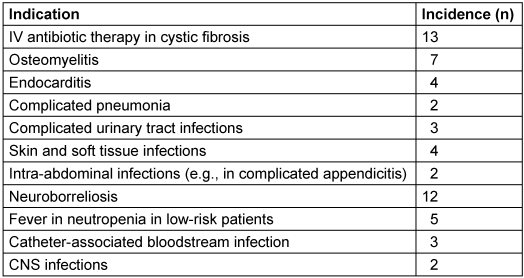
In the survey, participants from hospitals without established pOPAT were asked whether they generally consider it useful to establish and create the structural, organizational, and personnel prerequisites for pOPAT so that children can continue antibiotic treatment in an outpatient setting, if necessary. Participants from a total of n=22 hospitals responded as follows: n=9/22 (40.9%) fully agree, n=11/22 (50.0%) agree, n=1/22 (4.6%) neither agree nor disagree, and n=1/22 (4.6%) disagree. Nineteen out of 22 clinics with an established pOPAT program expressed interest in participating in an online exchange on this topic.
Supplementary notes on oral sequential therapy in childhood
For many infections, adequately dosed oral antibiotic therapy with an appropriate antibiotic is not inferior to intravenous treatment [132]; therefore, oral treatment can be initiated a priori or switched to oral sequential therapy as early as possible [133], [134]. Oral sequential therapy can shorten the duration of hospital stay, improve quality of life for patients and their families, reduce the risk of nosocomial infections, and significantly lower treatment costs. The potential of oral sequential therapy is likely not fully utilized [135].
Early oral switch in children with osteomyelitis (OM) and septic arthritis (SA) showing favorable outcomes under initial parenteral antibiotic therapy (uncomplicated OM or SA) has been investigated in scientific studies over the past 10 years and has proven effective [136], [137], [138], [139], [140], [141].
A prerequisite is defervescence, a significant reduction in pain, and (if initially elevated) a halving of the CRP value or a decrease below 20 mg/L [142], [143]. Although this has been demonstrated primarily for MSSA, it also applies to uncomplicated cases of MRSA; Clindamycin is an appropriate oral antibiotic for this group of patients with community-acquired MRSA (caMRSA).
In cases of acute mastoiditis without CNS complications, cohort studies have shown successful treatment of children following surgical intervention with exclusively orally administered sequential therapy [144]. Therefore, in most cases with a favorable outcome, an oral switch is possible after 7 days [144].
In many cases of complicated community-acquired pneumonia with pleural empyema, it is possible to continue targeted oral treatment in children once the pathogen is identified, the pleural empyema no longer requires drainage, and they have responded well to initial parenteral antibiotics [145], [146], [147]. In Shah et al., the median hospital stay in both groups (oral vs. pOPAT) was 7 and 9 days, respectively, which is significantly shorter than the median hospital stay reported in a registry study from Germany [17 days (IQR 13–24 days)] [70]. Patients received antibiotics for an additional 14 days, with only 5% requiring continued treatment for 21 days or more after discharge.
In pediatric complicated pyelonephritis, the duration of IV antibiotic therapy is not decisive for treatment success [148], [149]. This applies even if the pathogen was initially detected in the blood culture as well [149], [150]. When the pathogen is known, targeted oral antibiotic therapy is possible in most cases. Whether early oral sequential therapy is also a safe treatment strategy for a renal abscess (originating from pyelonephritis) or a renal carbuncle (following hematogenous septic spread) has not been specifically studied under controlled conditions. The AWMF (Association of the Scientific Medical Societies in Germany) guideline on urinary tract infections in childhood recommends a “three-week, parenterally initiated antibacterial therapy with an antibiotic tested as sensitive” in these cases [151].
In children aged 8 years and above, oral doxycycline (duration of therapy 14–21 days) is the treatment of choice for neuroborreliosis or Lyme arthritis [75].
If patients with perforated appendicitis are able to take oral antibiotics, oral sequential therapy (e.g., with amoxicillin-clavulanate after 3 days of IV therapy) is as effective and safe as IV therapy (in the hospital or as pOPAT) [79], [152], [153]. Complications associated with the use of a vascular catheter are eliminated with oral therapy [154].
Controlled, evidence-based studies on the optimal duration of therapy for bloodstream infections (BSI) in children and adolescents are largely lacking [139]. However, there is no reason to assume that outcomes in children are more complicated than those in adults. Therefore, for uncomplicated BSI, a shortened antibiotic therapy duration of 7 days is indicated [155]. (For Staphylococcus aureus infections, a minimum of 14 days is still recommended, with discussions ongoing regarding the optimal timing to transition to oral sequential therapy) [156], [157].
Notes
Authors’ ORCIDs
- Neubert J: https://orcid.org/0009-0000-2456-225X
- Akarsu Y: https://orcid.org/0009-0009-4057-562X
- ManierR: https://orcid.org/0000-0003-0562-2901
- von Both U: https://orcid.org/0000-0001-8411-1071
- Stegemann M: https://orcid.org/0000-0002-7968-0429
- Simon A: https://orcid.org/0000-0001-9558-3330
Funding
None.
Acknowledgments
We would like to thank the working group of the AWMF guideline on OPAT for their collaboration, and Janina Soler Wenglein, Markus Knuf, Johannes Forster, Luise Martin, Tobias Tenenbaum, and Nicole Töpfner from the DGPI board for critically reviewing the manuscript draft.
Competing interests
Arne Simon and Ulrich von Both are members of the Antibiotic Stewardship Working Group of the DGPI and the extended DGPI board. Both, along with Jennifer Neubert, are members of the Working Group on Outpatient Pediatric Antibiotic Stewardship of the DGPI. Miriam Stegemann coordinates the Working Group of the OPAT Guideline of the S1 Guideline Registry Number 092-004 “Ambulatory Parenteral Antimicrobial Therapy (OPAT)”. Yeliz Akarsu, Rachel Müller, Arne Simon, and Ulrich von Both are researchers in the TeleKasper Project (GBA Innovation Committee Funding Code 01NVF19009). Ulrich von Both is a member of the ESPID/ESCMID pediatric antimicrobial stewardship Network.
References
[1] Stegemann M, Leisse C, Trost U, Jürgens L, Achterberg S, Arenz L, Audebert F, Bickel M, Dolff S, Draenert R, Ewering S, Fischer J, Friedrichs A, Hagel S, Hennigs A, Horn D, Isner C, Khatamzas E, Lanckohr C, Lang H, Matthews H, Müller B, Neubert J, Schmiedel S, Simon A, Tepasse PR, Waldeck F, Lehmann C. S1-Leitlinie Ambulante parenterale Antiinfektivatherapie (APAT). Version 1.21. Marburg: Arbeitsgemeinschaft der Wissenschaftlichen Medizinischen Fachgesellschaften (AWMF); 2024. Available from: https://register.awmf.org/assets/guidelines/092-004l_S1_Ambulante-parenterale-Antiinfektivatherapie-APAT_2024-11.pdf[2] Broom A, Broom J, Kirby E. Cultures of resistance? A Bourdieusian analysis of doctors' antibiotic prescribing. Soc Sci Med. 2014 Jun;110:81-8. DOI: 10.1016/j.socscimed.2014.03.030
[3] Broom A, Kirby E, Gibson AF, Post JJ, Broom J. Myth, Manners, and Medical Ritual: Defensive Medicine and the Fetish of Antibiotics. Qual Health Res. 2017 Nov;27(13):1994-2005. DOI: 10.1177/1049732317721478
[4] Broom J, Broom A, Adams K, Plage S. What prevents the intravenous to oral antibiotic switch? A qualitative study of hospital doctors' accounts of what influences their clinical practice. J Antimicrob Chemother. 2016 Aug;71(8):2295-9. DOI: 10.1093/jac/dkw129
[5] Norris AH, Shrestha NK, Allison GM, Keller SC, Bhavan KP, Zurlo JJ, Hersh AL, Gorski LA, Bosso JA, Rathore MH, Arrieta A, Petrak RM, Shah A, Brown RB, Knight SL, Umscheid CA. 2018 Infectious Diseases Society of America Clinical Practice Guideline for the Management of Outpatient Parenteral Antimicrobial Therapy. Clin Infect Dis. 2019 Jan;68(1):e1-e35. DOI: 10.1093/cid/ciy745
[6] Chapman ALN, Patel S, Horner C, Green H, Guleri A, Hedderwick S, Snape S, Statham J, Wilson E, Gilchrist M, Seaton RA. Updated good practice recommendations for outpatient parenteral antimicrobial therapy (OPAT) in adults and children in the UK. JAC Antimicrob Resist. 2019 Sep;1(2):dlz026. DOI: 10.1093/jacamr/dlz026
[7] Patel S, Abrahamson E, Goldring S, Green H, Wickens H, Laundy M. Good practice recommendations for paediatric outpatient parenteral antibiotic therapy (p-OPAT) in the UK: a consensus statement. J Antimicrob Chemother. 2015 Feb;70(2):360-73. DOI: 10.1093/jac/dku401
[8] Patel S, Green H. Outpatient Parenteral Antimicrobial Therapy in Children. Curr Infect Dis Rep. 2019 Apr;21(5):17. DOI: 10.1007/s11908-019-0669-6
[9] Xu M, Doan Q. Outpatient Parenteral Antimicrobial Therapy and Judicious Use of Pediatric Emergency Resources. Pediatr Emerg Care. 2020 May;36(5):e247-e253. DOI: 10.1097/PEC.0000000000001215
[10] Huynh J, Hodgson KA, Boyce S, Ibrahim LF, Bryant PA. Impact of expanding a paediatric OPAT programme with an antimicrobial stewardship intervention. Arch Dis Child. 2020 Dec;105(12):1220-8. DOI: 10.1136/archdischild-2019-318091
[11] Raimbault SC, Domenech C, Fuhrmann C, Bertrand A. Central-line-associated bloodstream infections in a pediatric oncology and hematology hospital at home program. Infect Control Hosp Epidemiol. 2023 May;44(5):780-5. DOI: 10.1017/ice.2022.184
[12] Haeusler GM, De Abreu Lourenco R, Bakos C, O'Brien T, Slavin MA, Clark JE, McMullan B, Borland ML, Babl FE, Krishnasamy M, Vanevski M, Thursky KA, Hall L. Managing low-risk febrile neutropenia in children in the time of COVID-19: What matters to parents and clinicians. J Paediatr Child Health. 2021 Jun;57(6):826-34. DOI: 10.1111/jpc.15330
[13] Haeusler GM, Gaynor L, Teh B, Babl FE, Orme LM, Segal A, Mechinaud F, Bryant PA, Phillips B, Lourenco RA, Slavin MA, Thursky KA. Home-based care of low-risk febrile neutropenia in children-an implementation study in a tertiary paediatric hospital. Support Care Cancer. 2021 Mar;29(3):1609-17. DOI: 10.1007/s00520-020-05654-z
[14] Krah NM, Bardsley T, Nelson R, Esquibel L, Crosby M, Byington CL, Pavia AT, Hersh AL. Economic Burden of Home Antimicrobial Therapy: OPAT Versus Oral Therapy. Hosp Pediatr. 2019 Apr;9(4):234-40. DOI: 10.1542/hpeds.2018-0193
[15] Krah NM, Hersh AL. OPAT for avoidance of hospitalisation in children. Lancet Infect Dis. 2019 May;19(5):450-1. DOI: 10.1016/S1473-3099(19)30043-X
[16] Patel S, Burzio V, Green H, Rees S, Tebruegge M, Jones C, Faust SN. The Impact of Pediatric Outpatient Parenteral Antibiotic Therapy Implementation at a Tertiary Children's Hospital in the United Kingdom. Pediatr Infect Dis J. 2018 Dec;37(12):e292-e297. DOI: 10.1097/INF.0000000000002031
[17] Rucker RW, Harrison GM. Outpatient intravenous medications in the management of cystic fibrosis. Pediatrics. 1974 Sep;54(3):358-60.
[18] Norris AH, Shrestha NK, Allison GM, Keller SC, Bhavan KP, Zurlo JJ, Hersh AL, Gorski LA, Bosso JA, Rathore MH, Arrieta A, Petrak RM, Shah A, Brown RB, Knight SL, Umscheid CA. 2018 Infectious Diseases Society of America Clinical Practice Guideline for the Management of Outpatient Parenteral Antimicrobial Therapy. Clin Infect Dis. 2019 Jan;68(1):1-4. DOI: 10.1093/cid/ciy867
[19] Esposito S, Noviello S, Leone S, Tice A, Seibold G, Nathwani D, Scaglione F; International OPAT Registry. Outpatient parenteral antibiotic therapy (OPAT) in different countries: a comparison. Int J Antimicrob Agents. 2004 Nov;24(5):473-8. DOI: 10.1016/j.ijantimicag.2004.06.004
[20] Lai T, Thiele H, Rogers BA, Hillock N, Adhikari S, McNamara A, Rawlins M. Exploring the advancements of Australian OPAT. Ther Adv Infect Dis. 2023;10:20499361231199582. DOI: 10.1177/20499361231199582
[21] Oliveira PR, Carvalho VC, Cimerman S, Lima ALM; Diretrizes Brasileiras para Terapia Antimicrobiana Parenteral Ambulatorial group. Recommendations for outpatient parenteral antimicrobial therapy in Brazil. Braz J Infect Dis. 2017;21(6):648-55. DOI: 10.1016/j.bjid.2017.06.006
[22] Vaz LE, Felder KK, Newland JG, Hersh AL, Rajapakse NS, Willis ZI, Banerjee R, Gerber JS, Schwenk HT, Wang ME. A National Survey of Outpatient Parenteral Antibiotic Therapy Practices. J Pediatric Infect Dis Soc. 2022 Mar;11(3):115-8. DOI: 10.1093/jpids/piab127
[23] Horner C, Cunney R, Demirjian A, Doherty C, Green H, Mathai M, McMaster P, Munro A, Paulus S, Roland D, Patel S. Paediatric Common Infections Pathways: improving antimicrobial stewardship and promoting ambulation for children presenting with common infections to hospitals in the UK and Ireland. JAC Antimicrob Resist. 2021 Mar;3(1):dlab029. DOI: 10.1093/jacamr/dlab029
[24] Hersh AL, Olson J, Stockmann C, Thorell EA, Knackstedt ED, Esquibel L, Sanderson S, Pavia AT. Impact of Antimicrobial Stewardship for Pediatric Outpatient Parenteral Antibiotic Therapy. J Pediatric Infect Dis Soc. 2018 May;7(2):e34-e36. DOI: 10.1093/jpids/pix038
[25] Hersh AL, Newland JG, Gerber JS. Pediatric Antimicrobial Discharge Stewardship: An Unmet Need. JAMA Pediatr. 2016 Mar;170(3):191-2. DOI: 10.1001/jamapediatrics.2015.3369
[26] Vaughn VM, Hersh AL, Spivak ES. Antibiotic Overuse and Stewardship at Hospital Discharge: The Reducing Overuse of Antibiotics at Discharge Home Framework. Clin Infect Dis. 2022 May;74(9):1696-1702. DOI: 10.1093/cid/ciab842
[27] Vaughn VM, Ratz D, Greene MT, Flanders SA, Gandhi TN, Petty LA, Huls S, Feng X, White AT, Hersh AL. Antibiotic Stewardship Strategies and Their Association With Antibiotic Overuse After Hospital Discharge: An Analysis of the Reducing Overuse of Antibiotics at Discharge (Road) Home Framework. Clin Infect Dis. 2022 Sep;75(6):1063-72. DOI: 10.1093/cid/ciac104
[28] Carter B, Fisher-Smith D, Porter D, Lane S, Peak M, Taylor-Robinson D, Bracken L, Carrol E. Being 'at-home' on outpatient parenteral antimicrobial therapy (OPAT): a qualitative study of parents' experiences of paediatric OPAT. Arch Dis Child. 2020 Mar;105(3):276-81. DOI: 10.1136/archdischild-2019-317629
[29] Carter B, Fisher-Smith D, Porter D, Lane S, Peak M, Taylor-Robinson D, Bracken L, Carrol ED. Paediatric Outpatient Parenteral Antimicrobial Therapy (OPAT): An e-survey of the experiences of parents and clinicians. PLoS One. 2021;16(4):e0249514. DOI: 10.1371/journal.pone.0249514
[30] Castor C, Landgren K, Hansson H, Kristensson Hallström I. A possibility for strengthening family life and health: Family members' lived experience when a sick child receives home care in Sweden. Health Soc Care Community. 2018 Mar;26(2):224-31. DOI: 10.1111/hsc.12512
[31] Morgan JE, Cleminson J, Stewart LA, Phillips RS, Atkin K. Meta-ethnography of experiences of early discharge, with a focus on paediatric febrile neutropenia. Support Care Cancer. 2018 Apr;26(4):1039-50. DOI: 10.1007/s00520-017-3983-2
[32] Morgan JE, Phillips B, Stewart LA, Atkin K. Quest for certainty regarding early discharge in paediatric low-risk febrile neutropenia: a multicentre qualitative focus group discussion study involving patients, parents and healthcare professionals in the UK. BMJ Open. 2018 May;8(5):e020324. DOI: 10.1136/bmjopen-2017-020324
[33] Morgan JE, Phillips RS, Stewart LA, Atkin K. Sharing Roles and Control in Pediatric Low Risk Febrile Neutropenia: A Multicenter Focus Group Discussion Study Involving Patients, Parents, and Health Care Professionals. J Pediatr Hematol Oncol. 2020 Jul;42(5):337-44. DOI: 10.1097/MPH.0000000000001827
[34] Deutsche Gesellschaft für Pneumologie und Beatmungsmedizin (DGP); Gesellschaft für Pädiatrische Pneumologie e.V. (GPP). S3-Leitlinie Lungenerkrankung bei Mukoviszidose: Pseudomonas aeruginosa. Registernummer 026/022. Version 2.0. Stand: 27.9.2022. AWMF; 2023 Feb. Available from: https://register.awmf.org/de/leitlinien/detail/026-022
[35] Hammermann J, Claßen M, Schmidt S, Bend J, Ballmann M, Baumann I, et al. S3-Leitlinie: Mukoviszidose bei Kindern in den ersten beiden Lebensjahren, Diagnostik und Therapie. AWMF-Registernummer 026-024. Version vom 6.3.2020 Mar. AWMF;2020. Available from: https://register.awmf.org/de/leitlinien/detail/026-024
[36] Maris I, Dölle-Bierke S, Renaudin JM, Lange L, Koehli A, Spindler T, Hourihane J, Scherer K, Nemat K, Kemen C, Neustädter I, Vogelberg C, Reese T, Yildiz I, Szepfalusi Z, Ott H, Straube H, Papadopoulos NG, Hämmerling S, Staden U, Polz M, Mustakov T, Cichocka-Jarosz E, Cocco R, Fiocchi AG, Fernandez-Rivas M, Worm M; Network for Online Registration of Anaphylaxis (NORA). Peanut-induced anaphylaxis in children and adolescents: Data from the European Anaphylaxis Registry. Allergy. 2021 May;76(5):1517-27. DOI: 10.1111/all.14683
[37] Com G, Agarwal A, Bai S, Hu Z, Goode G, McCarty H, Berlinski A. Outcomes and Safety of Outpatient Parenteral Antimicrobial Therapy in Select Children with Cystic Fibrosis. Pediatr Allergy Immunol Pulmonol. 2019 Dec;32(4):149-54. DOI: 10.1089/ped.2019.1073
[38] Pedersen MG, Jensen-Fangel S, Olesen HV, Tambe SD, Petersen E. Outpatient parenteral antimicrobial therapy (OPAT) in patients with cystic fibrosis. BMC Infect Dis. 2015 Jul;15:290. DOI: 10.1186/s12879-015-1019-4
[39] Proesmans M, Heyns L, Moons P, Havermans T, De Boeck K. Real life evaluation of intravenous antibiotic treatment in a paediatric cystic fibrosis centre: outcome of home therapy is not inferior. Respir Med. 2009 Feb;103(2):244-50. DOI: 10.1016/j.rmed.2008.08.017
[40] Termoz A, Touzet S, Bourdy S, Decullier E, Bouveret L, Colin C, Nove-Josserand R, Reix P, Cracowski C, Pin I, Bellon G, Durieu I. Effectiveness of home treatment for patients with cystic fibrosis: the intravenous administration of antibiotics to treat respiratory infections. Pediatr Pulmonol. 2008 Sep;43(9):908-15. DOI: 10.1002/ppul.20878
[41] Nazer D, Abdulhamid I, Thomas R, Pendleton S. Home versus hospital intravenous antibiotic therapy for acute pulmonary exacerbations in children with cystic fibrosis. Pediatr Pulmonol. 2006 Aug;41(8):744-9. DOI: 10.1002/ppul.20433
[42] Hough J, Christensen H. Pediatric hospital in the home: clinical outcomes for treatment of a cystic fibrosis respiratory exacerbation. Physiother Theory Pract. 2021 Dec;37(12):1298-1305. DOI: 10.1080/09593985.2019.1709591
[43] Meyer S, Nüßlein T, Nährlich L, Bend J, Gärtner B, Becker SL, Simon A. Infection prevention and control in patients with cystic fibrosis (CF): Results from a survey in 35 German CF treatment centers. J Cyst Fibros. 2020 May;19(3):384-7. DOI: 10.1016/j.jcf.2019.10.012
[44] Simon A, Schmitt-Grohe S, Erdmann U, Vonberg RP, Herr C, Bend J. Anforderungen an die Hygiene bei der medizinischen Versorgung von Patienten mit Cystischer Fibrose (Mukoviszidose). 1. Aufl. Wiesbaden: mhp Verlag; 2012.
[45] Collaco JM, Green DM, Cutting GR, Naughton KM, Mogayzel PJ Jr. Location and duration of treatment of cystic fibrosis respiratory exacerbations do not affect outcomes. Am J Respir Crit Care Med. 2010 Nov;182(9):1137-43. DOI: 10.1164/rccm.201001-0057OC
[46] Lavie M, Vilozni D, Sokol G, Somech R, Szeinberg A, Efrati O. Hospital versus home treatment of respiratory exacerbations in cystic fibrosis. Med Sci Monit. 2011 Dec;17(12):CR698-703. DOI: 10.12659/msm.882129
[47] Tritt A, Kay-Rivest E, Paradis T, Duval M. Daily outpatient intravenous antibiotic therapy for the management of paediatric periorbital cellulitis, a retrospective case series. Clin Otolaryngol. 2019 May;44(3):273-8. DOI: 10.1111/coa.13284
[48] Brugha RE, Abrahamson E. Ambulatory intravenous antibiotic therapy for children with preseptal cellulitis. Pediatr Emerg Care. 2012 Mar;28(3):226-8. DOI: 10.1097/PEC.0b013e318248b19b
[49] Karageorgos S, Hibberd O, Mullally PJW, Segura-Retana R, Soyer S, Hall D; Don’t Forget the Bubbles. Antibiotic Use for Common Infections in Pediatric Emergency Departments: A Narrative Review. Antibiotics (Basel). 2023 Jun;12(7):1092. DOI: 10.3390/antibiotics12071092
[50] Trottier ED, Farley St-Amand B, Vincent M, Chevalier I, Autmizguine J, Tremblay S, Gouin S. Outpatient management of moderate cellulitis in children using high-dose oral cephalexin. Paediatr Child Health. 2022 Jul;27(4):213-19. DOI: 10.1093/pch/pxac031
[51] Wiltrakis SM, Jaggi P, Lu L, Jain S. Optimizing Antibiotic Treatment of Skin Infections in Pediatric Emergency and Urgent Care Centers. Pediatrics. 2022 Oct;150(4):e2021053197. DOI: 10.1542/peds.2021-053197
[52] Ibrahim LF, Hopper SM, Babl FE, Bryant PA. Who Can Have Parenteral Antibiotics at Home?: A Prospective Observational Study in Children with Moderate/Severe Cellulitis. Pediatr Infect Dis J. 2016 Mar;35(3):269-74. DOI: 10.1097/INF.0000000000000992
[53] Ibrahim LF, Hopper SM, Donath S, Salvin B, Babl FE, Bryant PA. Development and Validation of a Cellulitis Risk Score: The Melbourne ASSET Score. Pediatrics. 2019 Feb;143(2):e20181420. DOI: 10.1542/peds.2018-1420
[54] Ibrahim LF, Babl FE, Hopper SM, Bryant PA. Cellulitis: oral versus intravenous and home versus hospital-what makes clinicians decide? Arch Dis Child. 2020 Apr;105(4):413-15. DOI: 10.1136/archdischild-2019-316824
[55] Ibrahim LF, Babl FE, Orsini F, Hopper SM, Bryant PA. Cellulitis: Home Or Inpatient in Children from the Emergency Department (CHOICE): protocol for a randomised controlled trial. BMJ Open. 2016 Jan;6(1):e009606. DOI: 10.1136/bmjopen-2015-009606
[56] Ibrahim LF, Hopper SM, Connell TG, Daley AJ, Bryant PA, Babl FE. Evaluating an admission avoidance pathway for children in the emergency department: outpatient intravenous antibiotics for moderate/severe cellulitis. Emerg Med J. 2017 Dec;34(12):780-5. DOI: 10.1136/emermed-2017-206829
[57] Ibrahim LF, Hopper SM, Orsini F, Daley AJ, Babl FE, Bryant PA. Efficacy and safety of intravenous ceftriaxone at home versus intravenous flucloxacillin in hospital for children with cellulitis (CHOICE): a single-centre, open-label, randomised, controlled, non-inferiority trial. Lancet Infect Dis. 2019 May;19(5):477-86. DOI: 10.1016/S1473-3099(18)30729-1
[58] Ibrahim LF, Huang L, Hopper SM, Dalziel K, Babl FE, Bryant PA. Intravenous ceftriaxone at home versus intravenous flucloxacillin in hospital for children with cellulitis: a cost-effectiveness analysis. Lancet Infect Dis. 2019 Oct;19(10):1101-8. DOI: 10.1016/S1473-3099(19)30288-9
[59] Schuler CL, Courter JD, Conneely SE, Frost MA, Sherenian MG, Shah SS, Gosdin CH. Decreasing Duration of Antibiotic Prescribing for Uncomplicated Skin and Soft Tissue Infections. Pediatrics. 2016 Feb;137(2):e20151223. DOI: 10.1542/peds.2015-1223
[60] De Marco G, Cochard B, Di Laura Frattura G, Valisena S, Bazin L, Ceroni D. Reflection on osteoarticular infections in children. Front Pediatr. 2023;11:1280878. DOI: 10.3389/fped.2023.1280878
[61] Yagdiran A, Meyer-Schwickerath C, Wolpers R, Otto-Lambertz C, Mehler K, Oberthür A, Kernich N, Eysel P, Jung N, Zarghooni K. What Do We Know about Spondylodiscitis in Children? A Retrospective Study. Children (Basel). 2022 Jul;9(8):1103. DOI: 10.3390/children9081103
[62] Alcobendas Rueda RM, Núñez E, Martín L, Hernández MB, Saavedra-Lozano J, Udaondo C, Murias S, Remesal A, Calvo C; Rioped Group. Oral Versus Intravenous Antibiotics for Pediatric Osteoarticular Infection: When and to Whom? Pediatr Infect Dis J. 2022 Sep;41(9):e351-e357. DOI: 10.1097/INF.0000000000003619
[63] Roversi M, Mirra G, Musolino A, Barbuti D, Lancella L, Deriu D, Iorio C, Villani A, Crostelli M, Mazza O, Krzysztofiak A. Spondylodiscitis in Children: A Retrospective Study and Comparison With Non-vertebral Osteomyelitis. Front Pediatr. 2021;9:727031. DOI: 10.3389/fped.2021.727031
[64] Ferri I, Ristori G, Lisi C, Galli L, Chiappini E. Characteristics, Management and Outcomes of Spondylodiscitis in Children: A Systematic Review. Antibiotics (Basel). 2020 Dec 31;10(1):30. DOI: 10.3390/antibiotics10010030
[65] Bianchini S, Esposito A, Principi N, Esposito S. Spondylodiscitis in Paediatric Patients: The Importance of Early Diagnosis and Prolonged Therapy. Int J Environ Res Public Health. 2018 Jun 7;15(6):1195. DOI: 10.3390/ijerph15061195
[66] Fernández-Polo A, Ramon-Cortes S, Plaja-Dorca J, Bartolomé-Comas R, Vidal-Valdivia L, Soler-Palacín P; Grupo TADE-PEDIATRÍA. Impact of an outpatient parenteral antimicrobial treatment (OPAT) as part of a paediatric-specific PROA program. Enferm Infecc Microbiol Clin (Engl Ed). 2023 Apr;41(4):230-4. DOI: 10.1016/j.eimce.2022.08.004
[67] Brockhaus R, Wenzel GI, Becker SL, Wagenpfeil G, Schick B, Gärtner B, Simon A. Ambulante Antibiotika-Verordnungsrate und Mastoiditis-Fälle bei Kindern und Jugendlichen im Saarland, 2014–2019 [Outpatient Antibiotic Prescription Rates and Mastoiditis in Children and Adolescents, Saarland, 2014-2019]. Klin Padiatr. 2023 Jan;235(1):23-30. DOI: 10.1055/a-1692-8923
[68] Alkhateeb A, Morin F, Aziz H, Manogaran M, Guertin W, Duval M. Outpatient management of pediatric acute mastoiditis. Int J Pediatr Otorhinolaryngol. 2017 Nov;102:98-102. DOI: 10.1016/j.ijporl.2017.09.008
[69] Forster J, Piazza G, Goettler D, Kemmling D, Schoen C, Rose M, Streng A, Liese JG. Effect of Prehospital Antibiotic Therapy on Clinical Outcome and Pathogen Detection in Children With Parapneumonic Pleural Effusion/Pleural Empyema. Pediatr Infect Dis J. 2021 Jun;40(6):544-9. DOI: 10.1097/INF.0000000000003036
[70] Segerer FJ, Seeger K, Maier A, Hagemann C, Schoen C, van der Linden M, Streng A, Rose MA, Liese JG. Therapy of 645 children with parapneumonic effusion and empyema-A German nationwide surveillance study. Pediatr Pulmonol. 2017 Apr;52(4):540-7. DOI: 10.1002/ppul.23562
[71] Forster J, Paul P, Liese J. Current Management of Pediatric Parapneumonic Pleural Effusions and Pleural Empyema. Pediatr Infect Dis J. 2023 Nov;42(11):e407-e410. DOI: 10.1097/INF.0000000000004061
[72] Gesellschaft für Pädiatrische Pneumologie (GPP); Deutsche Gesellschaft für Pädiatrische Infektiologie (DGPI). S2k-Leitlinie Management der ambulant erworbenen Pneumonie bei Kindern und Jugendlichen (pCAP). AWMF Registernummer 048/013. Version: 2.0. AWMF; 2024 [Zugriff 07.06.2026] . Available from: https://register.awmf.org/de/leitlinien/detail/048-013
[73] Scanlan BT, Ibrahim LF, Hopper SM, Babl FE, Davidson A, Bryant PA. Selected Children With Complicated Acute Urinary Tract Infection May Be Treated With Outpatient Parenteral Antibiotic Therapy at Home Directly From the Emergency Department. Pediatr Infect Dis J. 2019 Feb;38(2):e20-e25. DOI: 10.1097/INF.0000000000002070
[74] Hensey CC, Sett A, Connell TG, Bryant PA. A Comparison of Hospital Versus Outpatient Parenteral Antibiotic Therapy at Home for Pyelonephritis and Meningitis. Pediatr Infect Dis J. 2017 Sep;36(9):827-32. DOI: 10.1097/INF.0000000000001605
[75] Rauer S, Kastenbauer S, Fingerle V, Hunfeld KP, Huppertz HI, Dersch R. Lyme Neuroborreliosis. Dtsch Arztebl Int. 2018 Nov;115(45):751-6. DOI: 10.3238/arztebl.2018.0751
[76] Bodilsen J, D'Alessandris QG, Humphreys H, Iro MA, Klein M, Last K, Montesinos IL, Pagliano P, Sipahi OR, San-Juan R, Tattevin P, Thurnher M, de J Treviño-Rangel R, Brouwer MC; ESCMID Study Group for Infections of the Brain (ESGIB). European society of Clinical Microbiology and Infectious Diseases guidelines on diagnosis and treatment of brain abscess in children and adults. Clin Microbiol Infect. 2024 Jan;30(1):66-89. DOI: 10.1016/j.cmi.2023.08.016
[77] Bodilsen J, Nielsen H. Early switch to oral antimicrobials in brain abscess: a narrative review. Clin Microbiol Infect. 2023 Sep;29(9):1139-43. DOI: 10.1016/j.cmi.2023.04.026
[78] Desai AA, Alemayehu H, Holcomb GW 3rd, St Peter SD. Safety of a new protocol decreasing antibiotic utilization after laparoscopic appendectomy for perforated appendicitis in children: A prospective observational study. J Pediatr Surg. 2015 Jun;50(6):912-4. DOI: 10.1016/j.jpedsurg.2015.03.006
[79] Arnold MR, Wormer BA, Kao AM, Klima DA, Colavita PD, Cosper GH, Heniford BT, Schulman AM. Home intravenous versus oral antibiotics following appendectomy for perforated appendicitis in children: a randomized controlled trial. Pediatr Surg Int. 2018 Dec;34(12):1257-68. DOI: 10.1007/s00383-018-4343-0
[80] Zeineddin S, Pitt JB, Linton S, De Boer C, Hu A, Carter M, Alayleh A, Abdullah F, Raval M, Goldstein SD. Postoperative Antibiotics for Complicated Appendicitis in Children: Piperacillin/Tazobactam Versus Ceftriaxone with Metronidazole. J Pediatr Surg. 2023 Jun;58(6):1128-32. DOI: 10.1016/j.jpedsurg.2023.02.027
[81] Lehrnbecher T, Robinson PD, Ammann RA, Fisher B, Patel P, Phillips R, Beauchemin MP, Carlesse F, Castagnola E, Davis BL, Elgarten CW, Groll AH, Haeusler GM, Koenig C, Santolaya ME, Tissing WJE, Wolf J, Alexander S, Hu H, Dupuis LL, Sung L. Guideline for the Management of Fever and Neutropenia in Pediatric Patients With Cancer and Hematopoietic Cell Transplantation Recipients: 2023 Update. J Clin Oncol. 2023 Mar;41(9):1774-85. DOI: 10.1200/JCO.22.02224
[82] Deutsche Gesellschaft für pädiatrische Infektiologie (DGPI); Gesellschaft für Pädiatrische Onkologie und Hämatologie (GPOH). Diagnostik und Therapie bei Kindern mit onkologischer Grunderkrankung, Fieber und Granulozytopenie (mit febriler Neutropenie) außerhalb der allogenen Stammzelltransplantation. Registernummer 048/14. Finale Version 23.01.2016. AWMF; 2016.
[83] Choi JS, Yoon SH, Park HJ, Lee SY, Kim YJ. Optimal Use and Need for Therapeutic Drug Monitoring of Teicoplanin in Children: A Systematic Review. J Korean Med Sci. 2023 Feb;38(7):e62. DOI: 10.3346/jkms.2023.38.e62
[84] Gilchrist M, Barr D, Drummond F, Muir A, Williams J, Scriven J, Snape S, Hemsley C, Durojaiye CO, Patel S, Andrew Seaton R. Outpatient parenteral antimicrobial therapy (OPAT) in the UK: findings from the BSAC National Outcomes Registry (2015-19). J Antimicrob Chemother. 2022 Apr;77(5):1481-90. DOI: 10.1093/jac/dkac047
[85] Haynes AS, Maples H, Parker S. Time for a Change: Considering Vancomycin Alternatives for Pediatric Methicillin-Resistant Staphylococcus aureus Bacteremia. J Pediatric Infect Dis Soc. 2023 May;12(5):308-18. DOI: 10.1093/jpids/piad032
[86] Chiusaroli L, Liberati C, Rulli L, Barbieri E, De Pieri M, Di Chiara C, Mengato D, Giaquinto C, Donà D. Therapeutic Options and Outcomes for the Treatment of Children with Gram-Positive Bacteria with Resistances of Concern: A Systematic Review. Antibiotics (Basel). 2023 Jan 28;12(2):261. DOI: 10.3390/antibiotics12020261
[87] Syrogiannopoulos GA, Michoula AN, Petinaki E, Grivea IN. Daptomycin Use in Children: Experience With Various Types of Infection and Age Groups. Pediatr Infect Dis J. 2017 Oct;36(10):962-6. DOI: 10.1097/INF.0000000000001629
[88] Namtu KC, Crain JC, Messina AF, Dumois JA, Berman DM. Clinical Experience with Daptomycin in Pediatrics. Pharmacotherapy. 2017 Jan;37(1):105-8. DOI: 10.1002/phar.1872
[89] Bryant PA, Katz NT. Inpatient versus outpatient parenteral antibiotic therapy at home for acute infections in children: a systematic review. Lancet Infect Dis. 2018 Feb;18(2):e45-e54. DOI: 10.1016/S1473-3099(17)30345-6
[90] Orme LM, Babl FE, Barnes C, Barnett P, Donath S, Ashley DM. Outpatient versus inpatient IV antibiotic management for pediatric oncology patients with low risk febrile neutropenia: a randomised trial. Pediatr Blood Cancer. 2014 Aug;61(8):1427-33. DOI: 10.1002/pbc.25012
[91] Freire D, Ramos L, Alvarado D. Pediatric Outpatient Parenteral Antimicrobial Therapy (OPAT): Experience of Families During Implementation of the Program. J Pediatric Infect Dis Soc. 2023 Dec; 12((Suppl 1):S1. DOI: 10.1093/jpids/piad070.001
[92] Hodgson KA, Huynh J, Ibrahim LF, Sacks B, Golshevsky D, Layley M, Spagnolo M, Raymundo CM, Bryant PA. The use, appropriateness and outcomes of outpatient parenteral antimicrobial therapy. Arch Dis Child. 2016 Oct;101(10):886-93. DOI: 10.1136/archdischild-2015-309731
[93] Roug LI, Topperzer MK, Michelsen RT, Jarden M, Wahlberg A, Hjalgrim LL, Hansson H. Development of an intravenous chemotherapy intervention for children and adolescents with cancer administered by their parents at home (INTACTatHome). BMC Health Serv Res. 2023 Jun;23(1):664. DOI: 10.1186/s12913-023-09613-2
[94] McCall C, Mannion M, Hilliard C, Lannon P, McKenna F, O'Marcaigh A, Slevin T, Smith O, Storey L. Administration of Home Intravenous Chemotherapy to Children by their Parents. J Pediatr Oncol Nurs. 2017;34(2):122-9. DOI: 10.1177/1043454216646533
[95] Hansson H, Kjaergaard H, Johansen C, Hallström I, Christensen J, Madsen M, Schmiegelow K. Hospital-based home care for children with cancer: feasibility and psychosocial impact on children and their families. Pediatr Blood Cancer. 2013 May;60(5):865-72. DOI: 10.1002/pbc.24474
[96] Hansson H, Kjaergaard H, Schmiegelow K, Hallström I. Hospital-based home care for children with cancer: a qualitative exploration of family members' experiences in Denmark. Eur J Cancer Care (Engl). 2012 Jan;21(1):59-66. DOI: 10.1111/j.1365-2354.2011.01280.x
[97] Karbach U, Krawiec S, Remmert S, Toenne R, Reinhardt D, Schneider DT, Simon T, Waack-Buchholz K, Kristiment R. Die ambulant-aufsuchende Versorgung von an Krebs erkrankten Kindern aus Sicht der Erziehungsberechtigten [Hospital-based Home Care for Children with Cancer from the Parents̓ Point of View - A Qualitative Exploration of Family Members]. Klin Padiatr. 2024 May;236(3):165-72. DOI: 10.1055/a-2246-2645
[98] Akar A, Singh N, Hyun DY. Appropriateness and safety of outpatient parenteral antimicrobial therapy in children: opportunities for pediatric antimicrobial stewardship. Clin Pediatr (Phila). 2014 Sep;53(10):1000-3. DOI: 10.1177/0009922813507999
[99] Knackstedt ED, Stockmann C, Davis CR, Thorell EA, Pavia AT, Hersh AL. Outpatient parenteral antimicrobial therapy in pediatrics: an opportunity to expand antimicrobial stewardship. Infect Control Hosp Epidemiol. 2015 Feb;36(2):222-4. DOI: 10.1017/ice.2014.27
[100] Herbig S, Kaiser V, Maurer J, Taylor L, Thiesen J, Krämer I. ADKA-Leitlinie: Aseptische Herstellung und Prüfung applikationsfertiger Parenteralia. Krankenhauspharmazie. 2013 Feb;34(2):93-106.
[101] Jenkins A, Hills T, Santillo M, Gilchrist M; Drug Stability Working Group of the BSAC UK OPAT Initiative. Extended stability of antimicrobial agents in administration devices. J Antimicrob Chemother. 2017 Apr;72(4):1217-20. DOI: 10.1093/jac/dkw556
[102] Jenkins A, Jamieson C, Santillo M. Systematic review of room temperature stability of key beta-lactam antibiotics for extended infusions in inpatient settings. Eur J Hosp Pharm. 2023 Dec;31(1):2-9. DOI: 10.1136/ejhpharm-2023-003855
[103] Jenkins A, Shanu S, Jamieson C, Santillo M. Systematic review of the stability of antimicrobial agents in elastomeric devices for outpatient parenteral antimicrobial therapy services based on NHS Yellow Cover Document standards. Eur J Hosp Pharm. 2022 Nov;29(6):304-7. DOI: 10.1136/ejhpharm-2021-002729
[104] Jenkins A, Shanu S, Jamieson C, Santillo M. Widening the net: a literature review of antimicrobial agents with potential suitability for outpatient parenteral antimicrobial therapy services-the importance of storage and stability. Eur J Hosp Pharm. 2023 Mar;30(2):64-9. DOI: 10.1136/ejhpharm-2021-002937
[105] Krämer I, Simon A. Hygienischer Umgang mit Arzneimitteln zur parenteralen Anwendung durch medizinisches Personal in Einrichtungen des Gesundheitswesens. In: Kramer A, Assadian O, Exner M, Hübner NO, Scheithauer S, Simon A, editors. Krankenhaus- und Praxishygiene: Hygienemanagement und Infektionsprävention in medizinischen und sozialen Einrichtungen. 4., vollständig überarbeitete Auflage. Urban & Fischer Verlag; 2022. p.528-33.
[106] Prävention von Infektionen, die von Gefäßkathetern ausgehen : Teil 1 – Nichtgetunnelte zentralvenöse Katheter Empfehlung der Kommission für Krankenhaushygiene und Infektionsprävention (KRINKO) beim Robert Koch-Institut [Not Available]. Bundesgesundheitsblatt Gesundheitsforschung Gesundheitsschutz. 2017 Feb;60(2):171-206. DOI: 10.1007/s00103-016-2487-4
[107] Fernandes P, Milliren C, Mahoney-West HM, Schwartz L, Lachenauer CS, Nakamura MM. Safety of Outpatient Parenteral Antimicrobial Therapy in Children. Pediatr Infect Dis J. 2018 Feb;37(2):157-63. DOI: 10.1097/INF.0000000000001716
[108] Yusef D, Gonzalez BE, Foster CB, Goldfarb J, Saracusa C, Worley S, Sabella C. Piperacillin-Tazobactam-induced Adverse Drug Events in Pediatric Patients on Outpatient Parenteral Antimicrobial Therapy. Pediatr Infect Dis J. 2017 Jan;36(1):50-2. DOI: 10.1097/INF.0000000000001351
[109] Townsley E, Gillon J, Jimenez-Truque N, Katz S, Garguilo K, Banerjee R. Risk Factors for Adverse Events in Children Receiving Outpatient Parenteral Antibiotic Therapy. Hosp Pediatr. 2021 Feb;11(2):153-9. DOI: 10.1542/hpeds.2020-001388
[110] Konold VJL, Weissman SJ, Kronman MP, Brothers AW, Pak D, Felder KK, Vaz LE. Identifying and addressing social determinants of health in pediatric outpatient parenteral antimicrobial therapy. Infect Control Hosp Epidemiol. 2023 May;44(5):850-2. DOI: 10.1017/ice.2023.36
[111] Goldman JL, Richardson T, Newland JG, Lee B, Gerber JS, Hall M, Kronman M, Hersh AL. Outpatient Parenteral Antimicrobial Therapy in Pediatric Medicaid Enrollees. J Pediatric Infect Dis Soc. 2017 Mar;6(1):65-71. DOI: 10.1093/jpids/piv106
[112] Loeuille G, D'Huart E, Vigneron J, Nisse YE, Beiler B, Polo C, Ayari G, Sacrez M, Demoré B, Charmillon A. Stability Studies of 16 Antibiotics for Continuous Infusion in Intensive Care Units and for Performing Outpatient Parenteral Antimicrobial Therapy. Antibiotics (Basel). 2022 Mar 29;11(4):458. DOI: 10.3390/antibiotics11040458
[113] Jamieson C, Ozolina L, Seaton RA, Gilchrist M, Hills T, Drummond F, Wilkinson AS; BSAC Drug Stability Testing Working Group. Assessment of the stability of citrate-buffered piperacillin/tazobactam for continuous infusion when stored in two commercially available elastomeric devices for outpatient parenteral antimicrobial chemotherapy: a study compliant with the NHS Yellow Cover Document requirements. Eur J Hosp Pharm. 2022 Jul;29(4):212-6. DOI: 10.1136/ejhpharm-2020-002340
[114] Jamieson C, Allwood MC, Stonkute D, Wallace A, Wilkinson AS, Hills T; BSAC Drug Stability Working Party. Investigation of meropenem stability after reconstitution: the influence of buffering and challenges to meet the NHS Yellow Cover Document compliance for continuous infusions in an outpatient setting. Eur J Hosp Pharm. 2020 Mar;27(e1):e53-e57. DOI: 10.1136/ejhpharm-2018-001699
[115] Roug LI, Jarden M, Wahlberg A, Hjalgrim LL, Hansson H. Ambiguous Expectations of Parent Caregiving for the Child and Adolescent With Cancer at the Hospital and at Home-An Ethnographic Study. J Pediatr Hematol Oncol Nurs. 2023;40(2):100-10. DOI: 10.1177/27527530221140065
[116] Hodgson KA, Lim R, Huynh J, Nind B, Katz N, Marlow R, Hensey CC, Scanlan B, Ibrahim LF, Bryant PA. Outpatient parenteral antimicrobial therapy: how young is too young? Arch Dis Child. 2022 Sep;107(10):884-889. DOI: 10.1136/archdischild-2022-324143
[117] Zukauckas K, Benefield RJ, Newman M, Certain L. Why Bother? Lab Monitoring in Beta-Lactam Outpatient Parenteral Antimicrobial Therapy. Antimicrob Agents Chemother. 2022 Jun;66(6):e0057922. DOI: 10.1128/aac.00579-22
[118] Glazner J, Steinfort K, Hu YJ, Browne W, Smith I, Brasher C. Short midline catheters: High success rates for antibiotic therapy in children with cystic fibrosis. J Vasc Access. 2023 May;24(3):385-390. DOI: 10.1177/11297298211035310
[119] Kleidon TM, Schults JA, Wainwright C, Mihala G, Gibson V, Saiyed M, Byrnes J, Cattanach P, Macfarlane F, Graham N, Shevill E, Ullman AJ. Comparison of midline catheters and peripherally inserted central catheters to reduce the need for general anesthesia in children with respiratory disease: A feasibility randomized controlled trial. Paediatr Anaesth. 2021 Sep;31(9):985-95. DOI: 10.1111/pan.14229
[120] Kovacich A, Tamma PD, Advani S, Popoola VO, Colantuoni E, Gosey L, Milstone AM. Peripherally Inserted Central Venous Catheter Complications in Children Receiving Outpatient Parenteral Antibiotic Therapy (OPAT). Infect Control Hosp Epidemiol. 2016 Apr;37(4):420-4. DOI: 10.1017/ice.2015.317
[121] Van Winkle P, Whiffen T, Liu IL. Experience using peripherally inserted central venous catheters for outpatient parenteral antibiotic therapy in children at a community hospital. Pediatr Infect Dis J. 2008 Dec;27(12):1069-72. DOI: 10.1097/INF.0b013e31817d32f2
[122] Hussain S, Gomez MM, Wludyka P, Chiu T, Rathore MH. Survival times and complications of catheters used for outpatient parenteral antibiotic therapy in children. Clin Pediatr (Phila). 2007 Apr;46(3):247-51. DOI: 10.1177/0009922806290328
[123] Prävention von Infektionen, die von Gefäßkathetern ausgehen : Teil 2 - Periphervenöse Verweilkanülen und arterielle Katheter Empfehlung der Kommission für Krankenhaushygiene und Infektionsprävention (KRINKO) beim Robert Koch-Institut. Bundesgesundheitsblatt Gesundheitsforschung Gesundheitsschutz. 2017 Feb;60(2):207-15. DOI: 10.1007/s00103-016-2488-3
[124] Tripathi S, Gladfelter T. Peripheral intravenous catheters in hospitalized patients: Practice, Dwell times, and factors impacting the dwell times: A single center retrospective study. J Vasc Access. 2022 Jul;23(4):581-8. DOI: 10.1177/11297298211000874
[125] Kleidon TM, Cattanach P, Mihala G, Ullman AJ. Implementation of a paediatric peripheral intravenous catheter care bundle: A quality improvement initiative. J Paediatr Child Health. 2019 Oct;55(10):1214-23. DOI: 10.1111/jpc.14384
[126] Kleidon TM, Gibson V, Cattanach P, Schults J, Royle RH, Ware RS, Marsh N, Pitt C, Dean A, Byrnes J, Rickard CM, Ullman AJ. Midline Compared With Peripheral Intravenous Catheters for Therapy of 4 Days or Longer in Pediatric Patients: A Randomized Clinical Trial. JAMA Pediatr. 2023 Nov;177(11):1132-40. DOI: 10.1001/jamapediatrics.2023.3526
[127] Östlund Å, Fläring U, Norberg Å, Kaiser S, Frisk T, Larsson P, Andersson A. Complications of Pediatric Midline Catheters: A Prospective Observational Pilot Study. Anesth Analg. 2024 Mar;138(3):572-8. DOI: 10.1213/ANE.0000000000006328
[128] Firooz M, Karkhah S, Hosseini SJ. The effect of transilluminator device on successful peripheral venous catheter placement in children: A systematic review and meta-analysis. J Vasc Access. 2024 May;25(3):703-12. DOI: 10.1177/11297298221132866
[129] Fläring U, Lundevall H, Norberg Å, Andersson A. The success rate and complications of midline catheters in pediatric outpatient parenteral antibiotic therapy (OPAT). Eur J Pediatr. 2024 Apr;183(4):1703-9. DOI: 10.1007/s00431-024-05432-7
[130] Wang F, Wang Y, Liu J. Risk factors for peripherally inserted central venous catheter-related complications in children: A retrospective cohort study. Medicine (Baltimore). 2023 Sep;102(39):e34924. DOI: 10.1097/MD.0000000000034924
[131] Prävention von Gefäßkatheter-assoziierten Infektionen bei Früh- und Neugeborenen : Empfehlung der Kommission für Krankenhaushygiene und Infektionsprävention (KRINKO) beim Robert Koch-Institut. Bundesgesundheitsblatt Gesundheitsforschung Gesundheitsschutz. 2018 May;61(5):608-26. DOI: 10.1007/s00103-018-2718-y
[132] Li HK, Agweyu A, English M, Bejon P. An unsupported preference for intravenous antibiotics. PLoS Med. 2015 May;12(5):e1001825. DOI: 10.1371/journal.pmed.1001825
[133] McMullan BJ, Andresen D, Blyth CC, Avent ML, Bowen AC, Britton PN, Clark JE, Cooper CM, Curtis N, Goeman E, Hazelton B, Haeusler GM, Khatami A, Newcombe JP, Osowicki J, Palasanthiran P, Starr M, Lai T, Nourse C, Francis JR, Isaacs D, Bryant PA; ANZPID-ASAP group. Antibiotic duration and timing of the switch from intravenous to oral route for bacterial infections in children: systematic review and guidelines. Lancet Infect Dis. 2016 Aug;16(8):e139-52. DOI: 10.1016/S1473-3099(16)30024-X
[134] McMullan BJ, Mahony M, Java L, Mostaghim M, Plaister M, Wu C, White S, Al Yazidi L, Martin E, Bryant P, Thursky KA, Buono E. Improving intravenous-to-oral antibiotic switch in children: a team-based audit and implementation approach. BMJ Open Qual. 2021 Mar;10(1):e001120. DOI: 10.1136/bmjoq-2020-001120
[135] Cotter JM, Hall M, Girdwood ST, Stephens JR, Markham JL, Gay JC, Shah SS. Opportunities for Stewardship in the Transition From Intravenous to Enteral Antibiotics in Hospitalized Pediatric Patients. J Hosp Med. 2021 Feb;16(2):70-6. DOI: 10.12788/jhm.3538
[136] Keren R, Shah SS, Srivastava R, Rangel S, Bendel-Stenzel M, Harik N, Hartley J, Lopez M, Seguias L, Tieder J, Bryan M, Gong W, Hall M, Localio R, Luan X, deBerardinis R, Parker A; Pediatric Research in Inpatient Settings Network. Comparative effectiveness of intravenous vs oral antibiotics for postdischarge treatment of acute osteomyelitis in children. JAMA Pediatr. 2015 Feb;169(2):120-8. DOI: 10.1001/jamapediatrics.2014.2822
[137] Peltola H, Pääkkönen M, Kallio P, Kallio MJ; Osteomyelitis-Septic Arthritis (OM-SA) Study Group. Prospective, randomized trial of 10 days versus 30 days of antimicrobial treatment, including a short-term course of parenteral therapy, for childhood septic arthritis. Clin Infect Dis. 2009 May;48(9):1201-10. DOI: 10.1086/597582
[138] Alcobendas R, Remesal A, Murias S, Nuñez E, Calvo C. Outpatients with acute osteoarticular infections had favourable outcomes when they received just oral antibiotics without intravenous antibiotics. Acta Paediatr. 2018 Oct;107(10):1792-7. DOI: 10.1111/apa.14373
[139] Rodríguez-Molino P, Sola IM, Del Álamo López JG, Baquero-Artigao F, Díaz-Almiron M, Moreno-Pérez D, Calvo C, Escosa-García L. Duration of antibiotic therapy among paediatricians: A national survey of current clinical practice in Spain. Int J Antimicrob Agents. 2023 Jul;62(1):106805. DOI: 10.1016/j.ijantimicag.2023.106805
[140] Woods CR, Bradley JS, Chatterjee A, Copley LA, Robinson J, Kronman MP, Arrieta A, Fowler SL, Harrison C, Carrillo-Marquez MA, Arnold SR, Eppes SC, Stadler LP, Allen CH, Mazur LJ, Creech CB, Shah SS, Zaoutis T, Feldman DS, Lavergne V. Clinical Practice Guideline by the Pediatric Infectious Diseases Society and the Infectious Diseases Society of America: 2021 Guideline on Diagnosis and Management of Acute Hematogenous Osteomyelitis in Pediatrics. J Pediatric Infect Dis Soc. 2021 Sep;10(8):801-44. DOI: 10.1093/jpids/piab027
[141] Woods CR, Bradley JS, Chatterjee A, Kronman MP, Arnold SR, Robinson J, Copley LA, Arrieta AC, Fowler SL, Harrison C, Eppes SC, Creech CB, Stadler LP, Shah SS, Mazur LJ, Carrillo-Marquez MA, Allen CH, Lavergne V. Clinical Practice Guideline by the Pediatric Infectious Diseases Society (PIDS) and the Infectious Diseases Society of America (IDSA): 2023 Guideline on Diagnosis and Management of Acute Bacterial Arthritis in Pediatrics. J Pediatric Infect Dis Soc. 2024 Jan;13(1):1-59. DOI: 10.1093/jpids/piad089
[142] Chou AC, Mahadev A. The Use of C-reactive Protein as a Guide for Transitioning to Oral Antibiotics in Pediatric Osteoarticular Infections. J Pediatr Orthop. 2016 Mar;36(2):173-7. DOI: 10.1097/BPO.0000000000000427
[143] Arnold JC, Cannavino CR, Ross MK, Westley B, Miller TC, Riffenburgh RH, Bradley J. Acute bacterial osteoarticular infections: eight-year analysis of C-reactive protein for oral step-down therapy. Pediatrics. 2012 Oct;130(4):e821-8. DOI: 10.1542/peds.2012-0220
[144] Moore JA, Wei JL, Smith HJ, Mayo MS. Treatment of pediatric suppurative mastoiditis: is peripherally inserted central catheter (PICC) antibiotic therapy necessary? Otolaryngol Head Neck Surg. 2006 Jul;135(1):106-10. DOI: 10.1016/j.otohns.2006.02.016
[145] Shah SS, Srivastava R, Wu S, Colvin JD, Williams DJ, Rangel SJ, Samady W, Rao S, Miller C, Cross C, Clohessy C, Hall M, Localio R, Bryan M, Wu G, Keren R; Pediatric Research in Inpatient Settings Network. Intravenous Versus Oral Antibiotics for Postdischarge Treatment of Complicated Pneumonia. Pediatrics. 2016 Dec;138(6):e20161692. DOI: 10.1542/peds.2016-1692
[146] Stockmann C, Ampofo K, Pavia AT, Byington CL, Sheng X, Greene TH, Korgenski EK, Hersh AL. Comparative Effectiveness of Oral Versus Outpatient Parenteral Antibiotic Therapy for Empyema. Hosp Pediatr. 2015 Dec;5(12):605-12. DOI: 10.1542/hpeds.2015-0100
[147] Fernandez Elviro C, Longcroft-Harris B, Allin E, Leache L, Woo K, Bone JN, Pawliuk C, Tarabishi J, Carwana M, Wright M, Nama N; InsightScope Team. Conservative and Surgical Modalities in the Management of Pediatric Parapneumonic Effusion and Empyema: A Living Systematic Review and Network Meta-Analysis. Chest. 2023 Nov;164(5):1125-38. DOI: 10.1016/j.chest.2023.06.010
[148] Bocquet N, Sergent Alaoui A, Jais JP, Gajdos V, Guigonis V, Lacour B, Chéron G. Randomized trial of oral versus sequential IV/oral antibiotic for acute pyelonephritis in children. Pediatrics. 2012 Feb;129(2):e269-75. DOI: 10.1542/peds.2011-0814
[149] Riordan A. 5, 7, 10 or 14 days: appropriate duration of treatment for bacteraemia or an example of 'antimicrobial bingo'? Arch Dis Child. 2016 Feb;101(2):117-8. DOI: 10.1136/archdischild-2015-309132
[150] Schroeder AR, Shen MW, Biondi EA, Bendel-Stenzel M, Chen CN, French J, Lee V, Evans RC, Jerardi KE, Mischler M, Wood KE, Chang PW, Roman HK, Greenhow TL. Bacteraemic urinary tract infection: management and outcomes in young infants. Arch Dis Child. 2016 Feb;101(2):125-30. DOI: 10.1136/archdischild-2014-307997
[151] Gesellschaft für Pädiatrische Nephrologie; Arbeitskreis Kinder- und Jugendurologie der Deutschen Gesellschaft für Urologie. S2k-Leitlinie Harnwegsinfektionen im Kindesalter - Diagnostik, Therapie und Prophylaxe. Registernummer 166-004. Version 1.0. Stand: 23.08.2021. AWMF; 2021.
[152] Fraser JD, Aguayo P, Leys CM, Keckler SJ, Newland JG, Sharp SW, Murphy JP, Snyder CL, Sharp RJ, Andrews WS, Holcomb GW 3rd, Ostlie DJ, St Peter SD. A complete course of intravenous antibiotics vs a combination of intravenous and oral antibiotics for perforated appendicitis in children: a prospective, randomized trial. J Pediatr Surg. 2010 Jun;45(6):1198-202. DOI: 10.1016/j.jpedsurg.2010.02.090
[153] Steiner Z, Buklan G, Stackievicz R, Gutermacher M, Litmanovitz I, Golani G, Arnon S. Conservative treatment in uncomplicated acute appendicitis: reassessment of practice safety. Eur J Pediatr. 2017 Apr;176(4):521-7. DOI: 10.1007/s00431-017-2867-2
[154] Rangel SJ, Anderson BR, Srivastava R, Shah SS, Ishimine P, Srinivasan M, Bryan M, Gong W, Hall M, Localio R, Luan X, Anandalwar S, Keren R; Pediatric Research in Inpatient Settings (PRIS) Network. Intravenous Versus Oral Antibiotics for the Prevention of Treatment Failure in Children With Complicated Appendicitis: Has the Abandonment of Peripherally Inserted Catheters Been Justified? Ann Surg. 2017 Aug;266(2):361-8. DOI: 10.1097/SLA.0000000000001923
[155] Same RG, Hsu AJ, Tamma PD. Optimizing the Management of Uncomplicated Gram-Negative Bloodstream Infections in Children: Translating Evidence From Adults Into Pediatric Practice. J Pediatric Infect Dis Soc. 2019 Nov;8(5):485-8. DOI: 10.1093/jpids/piz051
[156] Minter DJ, Appa A, Chambers HF, Doernberg SB. Contemporary Management of Staphylococcus aureus Bacteremia-Controversies in Clinical Practice. Clin Infect Dis. 2023 Nov;77(11):e57-e68. DOI: 10.1093/cid/ciad500
[157] McMullan BJ, Campbell AJ, Blyth CC, McNeil JC, Montgomery CP, Tong SYC, Bowen AC. Clinical Management of Staphylococcus aureus Bacteremia in Neonates, Children, and Adolescents. Pediatrics. 2020 Sep;146(3):e20200134. DOI: 10.1542/peds.2020-0134