Factors influencing antibiotic prescribing (EVA Study) among office-based physicians in Hesse, Germany, 2026 – evolution of influencing factors over time, frequency of antibiotic therapy, and suggestions for improvement (2008–2026)
Ursel Heudorf 1Iris Natanzon 2
Rolf Tessmann 1
Katrin Steul 1
Klaus-Peter Hunfeld 3,4
1 Multidrug Resistant Organism (MDRO) Network Rhine-Main, Dietzenbach, Germany
2 The Medical Association of Hesse, Frankfurt/Main, Germany
3 Institute for Laboratory Medicine, Microbiology & Infection Control, Northwest Medical Centre, Frankfurt/Main, Germany
4 Society for Promoting Quality Assurance in Medical Laboratories (INSTAND), e.V., Düsseldorf, Germany
Abstract
Background and objective: Antibiotic-resistant pathogens (MDROs) are an urgent public health problem. Surveys on the factors influencing antibiotic prescribing among office-based physicians (EVA Study) were conducted in Germany in 2008 and in the state of Hesse in 2016. The EVA survey was repeated in Hesse in 2026 in order to analyze trends in the prescribing behavior of office-based physicians.
Material and methods: The online survey included all office-based physicians in Hesse and contained questions on the factors influencing the respondent’s decision to prescribe antibiotic therapy, the relevance of antibiotic resistance, the respondent’s own expertise, and proposals for improving antibiotic therapy. The data were compared to the surveys in 2008 and 2016.
Results: Of the 7,913 individuals contacted, 892 (11.3%) responded. 49.2% of respondents reported making daily decisions regarding antibiotic therapy (2016: 54.2%; 2008: 63.3%). The survey found a decrease in the non-medical reasons for prescribing. These included “to be on the safe side” 19.1% (2008: 27%), fear of legal consequences 11.2% (2008: 15.4%) and the patient’s desire to continue working 7.8% (2008: 19.1%). Perception of the relevance of antibiotic resistance rose from 66.8% (2008) to 82.8% (2026) and the awareness that one’s own prescribing behavior influences regional resistance increased from 51.1% to 62%.
Conclusion: Office-based physicians reported that they prescribed antibiotics on a daily basis less frequently in 2026 than previously. The decline in psychological factors suggests an increased confidence in prescribing; however, organizational barriers are on the rise and should be specifically addressed.
Introduction
Antibiotic-resistant bacteria (MDROs) are classified as an urgent problem for the healthcare system [1], [2]. An increase in these pathogens in recent decades has led to the development of strategies and measures around the world to counteract the rise in resistance through the appropriate and, where possible, restrained use of antibiotics. The German Antibiotic Resistance Strategy (DART) was developed in 2008 and updated in 2015 [3], [4]. In addition, regional MDRO networks have been established throughout Germany to better prevent MDROs and to improve the management of patients colonized or infected with these pathogens in both inpatient and outpatient medical and nursing care settings.
The MDRO Network Rhine-Main was founded in 2010 (https://www.mre-rhein-main.de) in the Rhine-Main region of Hesse, Germany. In its early years, the network focused on the use of proper hygiene methods when dealing with MDRO patients; in 2015 the network began focusing on the appropriate use of antibiotics. Informational flyers were developed for patients with respiratory, urinary tract, and ear nose throat (ENT) infections [5], an Antibiotic Stewardship working group was established [6], and continuing education courses were organized for office-based physicians. In 2016, the MDRO Network Rhine-Main and the Medical Association of Hesse jointly conducted the EVA Study Hesse 2016 (Factors Influencing Antibiotic Prescribing in Hesse 2016) [7], [8], [9]. This involved replicating the EVA survey that the Robert Koch-Institute (RKI) had conducted in 2008, which contained a representative sample of hospital physicians and office-based physicians in Germany [10], [11]. Its aim was to examine the personal, psychological, and organizational factors influencing antibiotic prescribing, to determine the frequency of decisions on initiating antibiotic therapy, and to collect the physicians’ suggestions for improvement; questions were also asked about the most commonly treated infections and the corresponding antibiotic therapies [10], [11].
In 2026, this survey was repeated in Hesse using the same methodology, with the aim of examining trends over time.
Materials and methods
Following an announcement in the Hessian Medical Journal, the Medical Association of Hesse conducted an online survey of all office-based physicians in Hesse in February 2026. The online questionnaire contained five main sections:
- Personal information (age, gender, specialty)
- Questions on antibiotic use, including the frequency of prescribing antibiotics (Likert scale: daily, weekly, monthly, less frequently, never)
- Questions on factors influencing the decision to prescribe antibiotic therapy—preformulated questions with response options on a 5-point Likert scale
- Questions pertaining to the assessment of the problem of antibiotic resistance and the respondent’s own expertise
- Questions regarding proposals for improving antibiotic therapy (4-point Likert scale)
An initial email was sent on February 2 to 7,913 office-based physicians, followed by a reminder email on February 9. Raw data were forwarded to the network in a tabular, anonymized format for evaluation; for data protection reasons, only aggregated data regarding age and gender were transmitted. The analysis was descriptive (prevalence rates) so that a comparison could be made with the earlier surveys in 2008 and 2016. A Z-test was used to detect significant differences between each pair of annual datasets. These Z-tests were exploratory and not adjusted for multiple comparisons.
Data on the most commonly treated infections and the antibiotics employed for this purpose were collected as well, the results are scheduled to be published in a future publication.
Results
Of the 7,913 office-based physicians contacted, 892 (11.3%) responded. These included 52% female and 48% male physicians. One-quarter of the participants were under 50 years old, 35% were between 50 and 59 years old, and 40% were over 59 years. This represents a significant increase in the proportion of female physicians, from 36.2% in 2008 to 51.5% in 2026. During the same period, the proportion of those over 59 doubled from 18.4% to 40%. In all surveys (2008, 2016, and 2026), general practitioners and internists accounted for more than half of the participants; the next most common specialist groups were gynecologists, pediatricians, and ENT specialists (Table 1 [Tab. 1]).
Table 1: Survey participants by age and gender – comparison of Hesse 2026, Hesse 2016 [7], and Germany 2008 [10]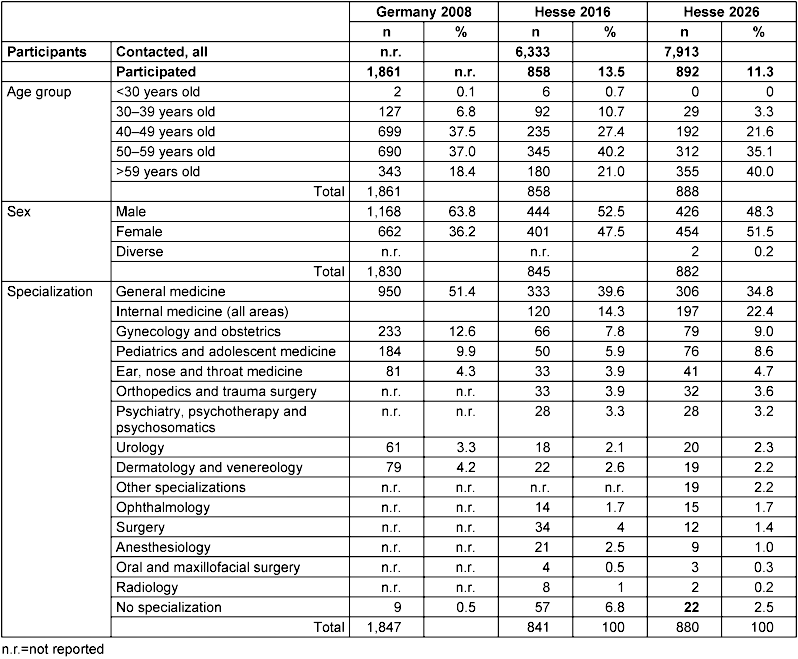
49.2% of participants reported making daily decisions about antibiotic therapy. This represents a decrease over figures reported in 2016 (54.2%) and 2008 (63.3%) (Table 2 [Tab. 2]).
Table 2: Frequency of decisions to start antibiotic therapy – comparison between Hesse in 2026, Hesse in 2016 [7], and Germany in 2008 [10]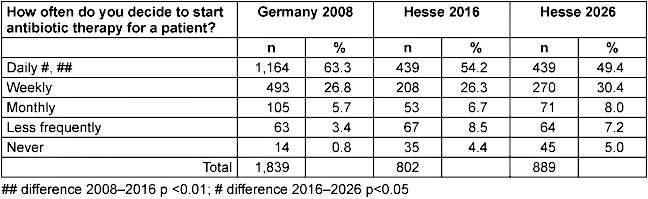
The most frequently cited non-medical reasons for initiating antibiotic therapy in 2026 (strongly agree + agree) were: to be on the safe side (19.1%), because a return visit would be difficult due to long travel distances (12.0%), fear of legal ramifications if antibiotic therapy is not initiated (11.2%), because the patient demands an antibiotic, or because the patient insists on continuing to work (7.8% each); other reasons were cited less frequently. There were clear decreases compared to 2008: to be on the safe side (down from 27% to 19%), because the patient insists on continuing to work (down from 19.1% to 7.8%), out of fear of legal ramifications (down from 15.4% to 11.2%), and because the doctor thought that the patient would feel better if an antibiotic were to be prescribed (down from 12.9% to 4.4%). The decreases were generally much larger between 2008 and 2016 than between 2016 and 2026. In contrast, there was no downward trend among the more organizational reasons; the mention of reduced workload for staff actually increased from 2008 to 2026: from 1.3% to 2.9% (Table 3 [Tab. 3]).
Table 3: Factors influencing antibiotic prescriptions – comparison between Hesse in 2026, Hesse in 2016 [7], and Germany in 2008 [10]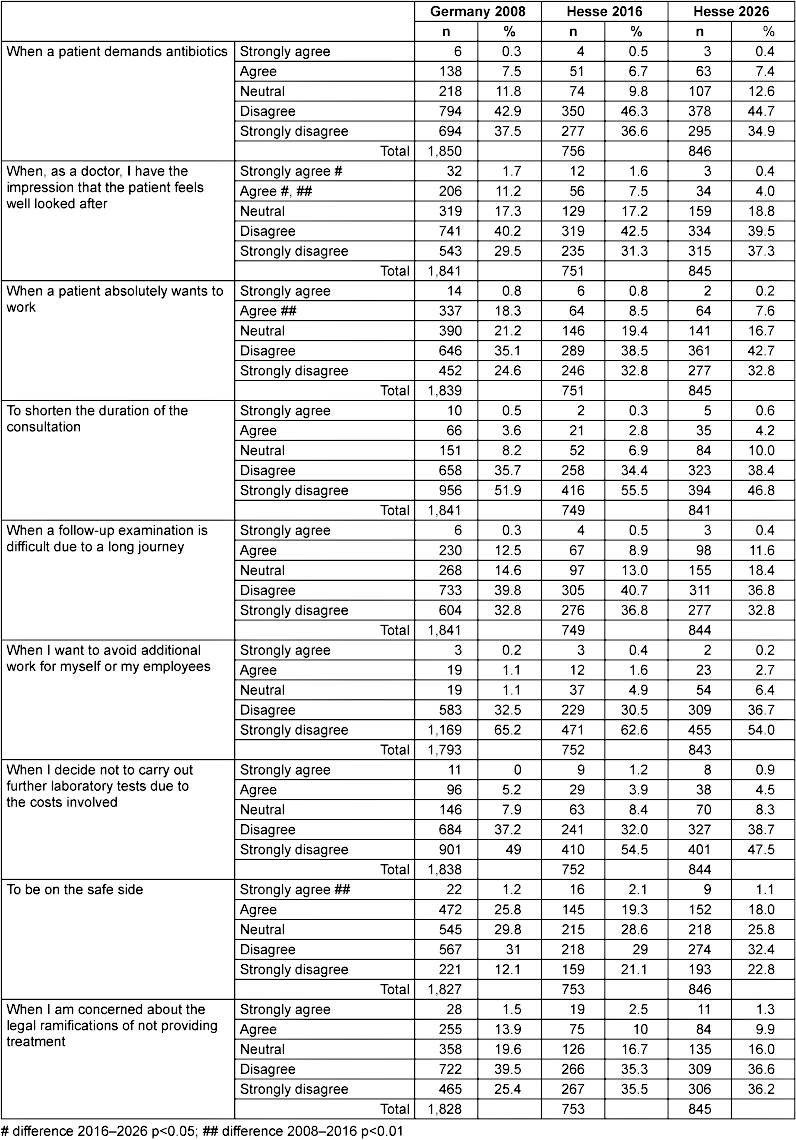
The perception that antibiotic resistance is relevant to one’s workplace increased from 66.8% to 84.4% between 2008 and 2016, after which no further increase was observed (2026: 82.8%). Similarly, the perception that one’s own prescribing behavior influenced regional resistance increased from 51.1% in 2008 to 61.9% in 2016 and remained at that level thereafter (2026: 62%). The number of respondents who considered themselves to be well-informed about antibiotic therapy rose steadily from 78.8% in 2008 to 81.7% in 2016 and 84.9% in 2026. In every survey year, three-quarters of participants consistently reported having experienced treatment failure and to adhering to the relevant guidelines (Table 4 [Tab. 4]).
Table 4: Assessment of the problem of antibiotic resistance and appraisal of one’s own knowledge of antibiotic therapy – comparison between Hesse 2026, Hesse 2016 [7], and Germany 2008 [10]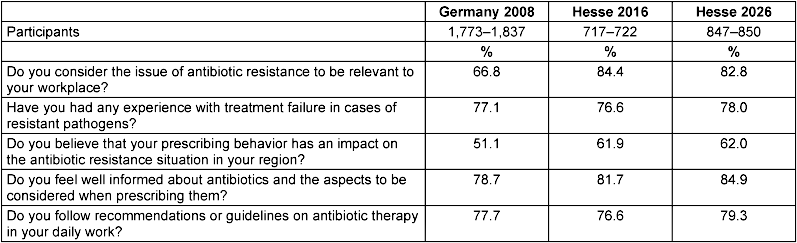
When asked for proposals for improvement, the most frequently cited suggestions were the monitoring of regional resistance patterns, guidelines for diagnosing and treating bacterial infections, and eliminating financial drawbacks for laboratory testing (Table 5 [Tab. 5]).
Table 5: Proposals for improving antibiotic therapy – comparison between Hesse 2026, Hesse 2016 [7] and Germany 2008 [10]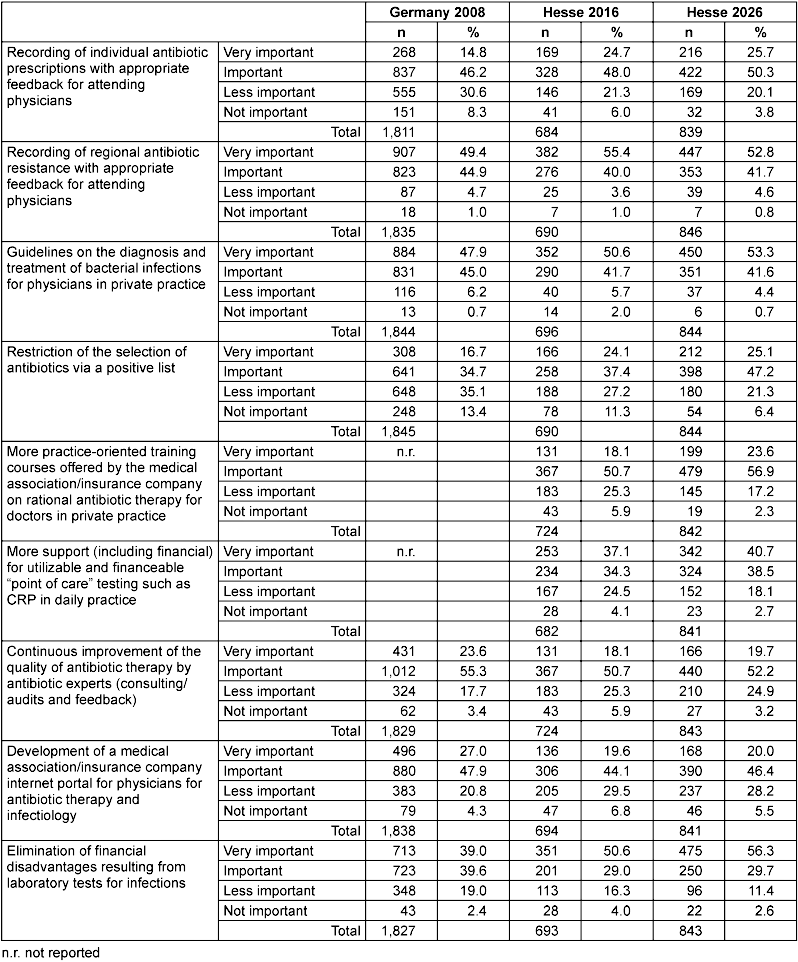
Discussion
The increase in the proportion of female physicians and physicians over the age of 60 among the participants reflects the general trend [12]. However, the gender distribution (48% male; 52% female) of the participants differed from the percentages of those who were contacted (57% male, 43% female).
Comparison of EVA studies from 2008 to 2026
In 2026, office-based physicians were found to make daily decisions about prescribing antibiotic therapy much less frequently than in 2008. This could be an indication that the information and training on antibiotic stewardship are beginning to bear fruit. However, since we have no data on these factors, we cannot draw this conclusion from our study; in particular, we cannot rule out that the increase in female and older participants may have, at least partially, influenced the reported decrease in prescriptions (see below). It also cannot be ruled out that, given the low response rate, the respondents were primarily physicians with a particular interest and expertise in antibiotic therapy, which may have led to a bias toward positive responses compared to the representative study conducted by the Robert Koch Institute in 2008. However, surveys on the use of antibiotics in the office-based physicians also show a decline in prescriptions over the years in Germany and in Hesse [13], [14], [15], [16], [17]. During the SARS-CoV-2 pandemic in 2020 and 2021, antibiotic prescriptions for people with public health insurance in Germany had decreased by approximately 30% compared to 2019 [15], [17]. However, starting in 2023, they rose again to nearly pre-pandemic levels [15], [17]. Since our survey took place in the spring of 2026, it no longer seems likely that the pandemic continues to influence prescriptions, although this cannot be ruled out with certainty.
In 2026, personal and psychological reasons for prescribing antibiotics (a desire to be on the safe side, fear of legal ramifications, the impression that patients feel they are receiving better treatment when antibiotics are prescribed, or because patients have a strong desire to return to work) were cited less frequently than in 2008, which could indicate greater certainty on the part of physicians on whether or not to prescribe treatment. In contrast, organizational reasons (difficulty in conducting follow-up examinations due to long travel distances, shortening consultation time) remained the same or even increased (workload reduction for staff). This could indicate an increase in work pressure in medical practices.
In 2026, the perceived importance of resistant pathogens and one’s own behavior on regional resistance development, as well as the perception of being well-informed about antibiotic therapy was higher than in 2008. Adherence to guidelines remained largely unchanged among three-quarters of the physicians over this period. No conclusions or hypotheses regarding the causes can be drawn from on our survey alone.
The most frequently cited proposals for improvement (>90%) across all years included guidelines for the diagnosis and treatment of bacterial infections as well as the monitoring of regional resistance patterns. Several guidelines have been published in Germany since 2016 (i.e. [18], [19], [20], [21]). In particular, the Guidelines on Urinary Tract Infections were imparted in a practice-oriented way by DEGAM [21]. RKI has been operating the Antibiotic Resistance Surveillance and Antibiotic Use Surveillance systems for many years [22], [23]. Resistance data can be accessed interactively for inpatient and outpatient settings, in some cases by specialty groups (general practice, internal medicine, ENT, pediatrics, urology); however, queries are only possible for aggregated regions in Germany (northeast, northwest, southeast, southwest), i.e., no regional resistance data (ARE) are available. For office-based physicians, the interactive online query on the resistance situation (https://amr.rki.de/Content/Datenbank/ARS/ResistanceOverview.aspx) appears to be both very time-consuming and relatively ineffective due to the lack of more detailed, regional data. Here, office-based physicians should be provided with simple, up-to-date information on the most common infections and their typical pathogens, e.g., through the medical associations or the state associations of panel physicians.
Over the years, eliminating the financial drawbacks associated with laboratory tests has been mentioned more and more frequently; in 2026, this ranked third among the top wishes. According to the Association of Panel Physicians Hesse (KV Hessen), this may be the result of a misunderstanding, as office-based physicians do not incur any direct financial costs for laboratory tests related to infections; at most, they lose the laboratory bonus of 90 cents per patient. According to the current guideline on the treatment of adult patients with community-acquired pneumonia, microbiological diagnostic testing is generally not required for mild cases of pneumonia that can be treated on an outpatient basis [18]. Similarly, if clinical symptoms are clear, microbiological testing is not required for uncomplicated, non-recurrent, and non-treatment-resistant cystitis in non-pregnant premenopausal women without other relevant comorbidities [19].
The request for more practice-oriented training increased significantly between 2016 and 2026. The online courses on Rational Antibiotic Therapy through Information and Communication [24], [25] were unfortunately only sparsely attended in 2020 due to the SARS-CoV-2 pandemic, and the accompanying planned in-person courses had to be cancelled. (The course is still available on the MRE-Netz Rhein-Main website: https://www.mre-rhein-main.de). The Academy for Advanced Medical Training and Continuing Education of the Medical Association of Hesse has so far offered ABS courses primarily for hospital physicians, but it has expressed an interest in organizing ABS courses for office-based physicians as well. Another good option would be to address the topic in networks and quality circles.
Over the years, improvement proposals such as tracking individual antibiotic prescriptions and limiting the range of prescribed antibiotics have increased. However, the Association of Statutory Health Insurance Physicians in Hesse has been regularly providing its members with their individual prescription data—including on antibiotics—on a quarterly basis for years. It is likely that these individual quarterly reports are too comprehensive or too confusing, resulting in insufficient awareness and use among physicians. A concise, visual illustration of antibiotic prescriptions could potentially enhance their utility.
Comparison with external studies and reviews
Our data on the influence of non-clinical—i.e., psychosocial and organizational—factors on prescribing antibiotics can be compared with a major review published in 2024 [26]. Its authors included 35 articles from 23 countries, three of which were from Germany. They examined personal and psychological factors such as work experience, knowledge, use of guidelines, and uncertainty avoidance, as well as organizational factors such as time and work pressure, and diagnostic tests/follow-up. However, most studies involving office-based physicians had significantly fewer than 50 participants [26]. In an international comparison, the representative EVA study conducted by RKI in 2008, involving 3,492 physicians (including 1,861 office-based physicians), was the second-largest study [10], [11], and the German study by Salm et al., with 340 participants, was the third largest [24]. In comparison, our study involving 892 participants, was quite extensive, although it was not representative of Hesse, and given the overall low participation rate, we are unable to rule out participation bias.
The studies in the review were published between 2002 and 2023 and no apparent temporal trend showed up in the results of the review [26]. Our study, however, found an overall decrease in the frequency of antibiotic prescriptions and in the influence of (non-clinical) psychological factors, as well as a slight increase in the influence of organizational factors on prescribing behavior.
Person-related factors: In various studies, older physicians tended to prescribe fewer antibiotics than younger ones. In many studies, approximately 70% of physicians reported that antibiotic resistance affected their work (see [26]); the figure in our survey was 82.8%. In the German study by Salm et al. [24], older physicians with longer clinical experience were less likely to believe that their prescribing behavior influenced the resistance situation than younger physicians. In the same study, adherence to guidelines among those under 40 was nearly four times higher than among those over 60 [24]. Since we were not provided with individually identifiable data on age and gender, we are unfortunately unable to make any statements on this matter in our study.
Psychological factors: Avoiding uncertainty was most frequently cited in both our survey and in the studies. Non medically necessary antibiotic therapy was initiated “to be on the safe side”, or broad-spectrum antibiotics were prescribed. In contrast, the perceived pressure from patients or their parents to prescribe antibiotics varied greatly across the different countries; there was also a tendency for this pressure to be greater among physicians working in outpatient settings than in hospitals [26].
Organizational factors: Many other studies have shown that organizational factors, such as time pressure and stress, lead to more antibiotic prescriptions, whereas easier access to rapid diagnostic testing and the possibility of a short-term follow-up can lead to fewer antibiotic prescriptions [26].
Improvements were achieved through more personalized training as well as feedback on individual antibiotic use [26]. The authors generally recommended a multifaceted strategy to improve the prescribing of antibiotics that encompassed “education, self-reflection, and systemic support, e.g., minimizing perceived time pressure and optimizing the availability of rapid diagnostic testing” [26].
In Germany, there are various projects to improve the use of antibiotics in outpatient care: CHANGE-3 focuses on respiratory tract infections [27], RedAres addresses uncomplicated urinary tract infections in women [28], [29], [30], RAI uses the “One Health” approach [24], [25], ABS networks/projects of the Association of Statutory Health Insurance Physicians, and AnTiB with a focus on pediatrics [31]. The AnTiB project is characterized by an interdisciplinary bottom-up approach. It consists of a network that develops regional antibiotic guidelines while taking into account the aforementioned organizational and psychological aspects. Given its success, the project has since been rolled out to the Association of Statutory Health Insurance Physicians Westphalia-Lippe and the pediatric section ABSaP (Antibiotic Stewardship in Ambulatory Pediatrics). It has even been adopted nationwide by the BVKJ (Professional Association of Pediatricians) [32]. Delayed prescribing of antibiotics has proven to be especially effective [33].
Strengths and limitations
One strength of our survey is its high number of participants compared to a review of 35 studies from 23 countries [26]. Another strength is that it was conducted using the same methodology as previous surveys, allowing for a comparison of data over the years in terms of psychological and organizational factors, as well as problem assessment and suggestions for improvement. We are unaware of any other study that provides this. Our study is based on a comprehensive survey of all office-based physicians in Hesse—both those in public settings and in private practices; however, the response rate was very low at just over 10%, so response bias cannot be ruled out and must even be assumed. In contrast to the first EVA study in Germany [10], [11], our study thus is not representative. Another limitation is that, for data protection reasons, no individual data on age and gender were provided for further analysis, so the impact of these individual factors could not be examined.
Conclusion
Our study shows that office-based physicians in Hesse, Germany, are less likely to prescribe antibiotic therapy to their patients on a daily basis than in previous surveys (2016 and 2008). The decline in the reporting of psychological factors, such as the desire to be on the safe side or fear of legal ramifications for not prescribing antibiotics, can be interpreted as an indication of growing confidence among office-based physicians in prescribing antibiotics. In contrast, the increasing number of mentions of organizational factors, such as saving time or lack of time, should be viewed critically. Suggestions for improvement, such as the publication of regional resistance data, (better) feedback about individual prescribing data, and information on antibiotic use and continuing education programs on this topic, etc., should be implemented and their impact should be evaluated further.
Notes
Ethics statement
Approval by an ethics committee was not necessary for a study which does not involve patient and personal data.
Funding
The authors declare that financial support was received for this work and/or its publication. Funding for the project was provided by a grant from INSTAND e.V, Düsseldorf, Germany.
Competing interests
The authors declare that they have no competing interests.
References
[1] GBD 2021 Antimicrobial Resistance Collaborators. Global burden of bacterial antimicrobial resistance 1990-2021: a systematic analysis with forecasts to 2050. Lancet. 2024 Sep 28;404(10459):1199-226. DOI: 10.1016/S0140-6736(24)01867-1[2] Willy C, Bröcker F. Gesundheitsökonomische Bedeutung antimikrobieller Resistenzen [Health economic significance of antimicrobial resistance]. Bundesgesundheitsblatt Gesundheitsforschung Gesundheitsschutz. 2025 Jun;68(6):584-92. DOI: 10.1007/s00103-025-04061-1
[3] Bundesministerium für Gesundheit, et al. Deutsche Antibiotika-Resistenzstrategie. Berlin: BMG; 2011 Apr. Available from: https://www.bundesgesundheitsministerium.de/fileadmin/Dateien/5_Publikationen/Gesundheit/Abschlussberichte/Bericht_DART_Deutsche_Antibiotika-Resistenzstrategie.pdf
[4] Bundesministerium für Gesundheit, et al. Deutsche Antibiotika-Resistenzstrategie 2030. 2023 Apr. Available from: https://www.bundesgesundheitsministerium.de/themen/praevention/antibiotika-resistenzen/dart-2030
[5] Steul K, Scherer M, Benfer C, Heudorf U. „Weniger ist mehr“, „Wenn, dann richtig“ und „Wenn möglich ohne“ – Die Flyer-Familie des MRE-Netz Rhein-Main zum verantwortungsvollen Umgang mit Antibiotika ist komplett. Umweltmed – Hygiene – Arbeitsmed. 2018;23(6):381-6.
[6] Tessmann R. Regionale Aktivitäten im Kampf gegen multiresistente Bakterien. Antibiotic-Stewardship-Arbeitsgruppe (ABS-AG) im Rahmen des MRE Netz Rhein-Main. Hessisches Ärzteblatt. 2016;77:514-5.
[7] Hausemann A, Zolg A, Heudorf U. Einflussfaktoren auf die Verordnung von Antibiotika (EVA). Teil I: Ergebnisse der Befragung niedergelassener Ärzte in Hessen 2016 im Vergleich zur bundesweiten Befragung 2008. Hessisches Ärzteblatt. 2016;77:512-3.
[8] Hausemann A, Zolg A, Heudorf U. Einflussfaktoren auf die Verordnung von Antibiotika (EVA). Teil II: Antworten der Teilnehmer in Hessen 2016 nach Facharztweiterbildung. Hessisches Ärzteblatt. 2016;77:634-5.
[9] Hausemann A, Zolg A, Heudorf U. Einflussfaktoren auf die Verordnung von Antibiotika (EVA). Teil III: Antibiotikatherapie bei Atemwegserkrankungen. Hessisches Ärzteblatt. 2017;78:24-7.
[10] Robert Koch-Institut. Abschlußbericht des Bundesministeriums für Gesundheit. Einflüsse auf die ärztliche Verschreibung von Antibiotika in Deutschland (EVA-Studie).
[11] Velasco E, Espelage W, Faber M, Noll I, Ziegelmann A, Krause G, Eckmanns T. A national cross-sectional study on socio-behavioural factors that influence physicians’ decisions to begin antimicrobial therapy. Infection. 2011 Aug;39(4):289-97. DOI: 10.1007/s15010-011-0137-1
[12] Kassenärztliche Bundesvereinigung. Vertragsärztinnen und -ärzte. Alter und Geschlecht. Available from: https://www.kbv.de/infothek/zahlen-und-fakten/gesundheitsdaten/alter-und-geschlecht
[13] Holstiege J, Schulz M, Akmatov MK, Steffen A, Bätzing J. Update: Die ambulante Anwendung systemischer Antibiotika in Deutschland im Zeitraum 2010 bis 2018 – Eine populationsbasierte Studie. Versorgungsatlas-Bericht Nr. 19/07. Berlin: Zentralinstitut für die kassenärztliche Versorgung in Deutschland (Zi); 2019. DOI: 10.20364/VA-19.07
[14] Holstiege J, Schulz M, Akmatov MK, Kern WV, Steffen A, Bätzing J. The Decline in Outpatient Antibiotic Use. Dtsch Arztebl Int. 2020 Oct 9;117(41):679-86. DOI: 10.3238/arztebl.2020.0679
[15] Holstiege J, Tillmann R, Meyer Sauteur PM, Hartmann M, Klimke K, Akmatov MK, Kohring C, Müller D, Below M. Age-Specific Trends in the Prescription of Systemic Antibiotics, 2010-2024. Dtsch Arztebl Int. 2026 Jan 1;123(2):59-60. DOI: 10.3238/arztebl.m2025.0146
[16] Heudorf U, Warlich R, Schäfer V, Tessmann R. Antibiotika-Verordnungen in der ambulanten Versorgung in Hessen 2013-2019. Hessisches Ärzteblatt. 2020;81:610-2.
[17] Heudorf U, et al. Entwicklung der ambulanten Antibiotika-Abgaben insgesamt sowie der Leitlinien-gerechten Antibiotika-Abgaben bei Harnwegsinfektionen in Hessen, 2013–2025. Deutsches Ärzteblatt. Forthcoming 2026.
[18] Deutsche Gesellschaft für Pneumologie und Beatmungsmedizin e.V. (DGP), et al. S3-Leitlinie Behandlung von erwachsenen Patienten mit ambulant erworbener Pneumonie. Version 4.0. AWMF-Registernr. 020-020. Berlin: AWMF; 2021 Apr 24. Available from: https://register.awmf.org/assets/guidelines/020-020l_S3_Behandlung-von-erwachsenen-Patienten-mit-ambulant-erworbener-Pneumonie__2021-05.pdf
[19] Deutsche Gesellschaft für Urologie e.V. (DGU), et al. S3-Leitlinie Epidemiologie, Diagnostik, Therapie, Prävention und Management unkomplizierter, bakterieller, ambulant erworbener Harnwegsinfektionen bei Erwachsenen (HWI). Version 3.0. AWMF-Registernr. 043-044. Berlin: AWMF; 2024 Apr 09. Available from: https://register.awmf.org/assets/guidelines/043-044k_S3_Epidemiologie-Diagnostik-Therapie-Praevention-Management-Harnwegsinfektionen-Erwachsene-HWI_2024-09.pdf
[20] Deutsche Gesellschaft für Hals-Nasen-Ohren-Heilkunde, Kopf- und Hals-Chirurgie e.V. (DGHNO-KHC), et al. S2k-Leitlinie Antibiotikatherapie bei HNO-Infektionen. Version 5.1. AWMF-Registernr. 017-066. Berlin: AWMF; 2025 May 13. Available from: https://register.awmf.org/de/leitlinien/detail/017-066
[21] Deutsche Gesellschaft für Allgemeinmedizin und Familienmedizin e.V. (DEGAM). Harnwegsinfektionen. DEGAM-Anwenderversion als Addendum zur S3 Leitlinie Epidemiologie, Diagnostik, Therapie, Prävention und Management unkomplizierter, bakterieller, ambulant erworbener Harnwegsinfektionen bei Erwachsenen (HWI) und S2k-Leitlinie Harnwegsinfektionen im Kindesalter – Diagnostik, Therapie und Prophylaxe. AWMF-Register-Nr. 043-044 und AWMF-Register-Nr. 166-004. DEGAM: Berlin, 2025 Aug. Available from: https://www.degam.de/files/Inhalte/Leitlinien-Inhalte/Dokumente/Beteiligungen%20Leitlinien/043-044_Harnwegsinfektionen/oeffentlich/degam-ll-harnwegsinfekt-anwender-251025.pdf
[22] Robert Koch-Institut. Antibiotika-Resistenz-Surveillance. Available from: https://amr.rki.de/Content/ARS/Main.aspx
[23] Robert Koch-Institut. Antibiotika-Verbrauchs-Surveillance. Available from: https://amr.rki.de/Content/AVS/Main.aspx
[24] Salm F, Schneider S, Schmücker K, Petruschke I, Kramer TS, Hanke R, Schröder C, Heintze C, Schwantes U, Gastmeier P, Gensichen J; RAI-Study Group. Antibiotic prescribing behavior among general practitioners - a questionnaire-based study in Germany. BMC Infect Dis. 2018 May 4;18(1):208. DOI: 10.1186/s12879-018-3120-y
[25] Petruschke I, Salm F, Kaufmann M, Freytag A, Gensichen J, Behnke M, Kramer TS, Hanke R, Gastmeier P, Schneider S; RAI Study Group. Evaluation of a multimodal intervention to promote rational antibiotic use in primary care. Antimicrob Resist Infect Control. 2021 Apr 6;10(1):66. DOI: 10.1186/s13756-021-00908-9
[26] Lansink C, Sinha B, Meessen N, Dekkers T, Beerlage-de Jong N. Why Do Physicians Prescribe Antibiotics? A Systematic Review of the Psycho-Socio-Organisational Factors Related to Potentially Inappropriate Prescribing of Antimicrobials in Europe. Infect Dis Rep. 2024 Jul 25;16(4):664-83. DOI: 10.3390/idr16040051
[27] Feldmeier G, Löffler C, Altiner A, Wollny A, Garbe K, Kronsteiner D, Köppen M, Szecsenyi J, Leyh M, Voss A, Kamradt M, Poß-Doering R, Wensing M, Kaufmann-Kolle P. Optimizing Antibiotic Prescribing for Acute Respiratory Tract Infections in German Primary Care: Results of the Regional Intervention Study CHANGE-3 and the Nested cRCT. Antibiotics (Basel). 2023 May 4;12(5):850. DOI: 10.3390/antibiotics12050850
[28] Gágyor I, Greser A, Heuschmann P, Rücker V, Maun A, Bleidorn J, Heintze C, Jede F, Eckmanns T, Klingeberg A, Mentzel A, Schmiemann G. REDuction of Antibiotic RESistance (REDARES) in urinary tract infections using treatments according to national clinical guidelines: study protocol for a pragmatic randomized controlled trial with a multimodal intervention in primary care. BMC Infect Dis. 2021 Sep 23;21(1):990. DOI: 10.1186/s12879-021-06660-0
[29] Schuster A, Tigges P, Grune J, Kraft J, Greser A, Gágyor I, Böhme M, Klingeberg A, Eckmanns T, Maun A, Mentzel A, Schmiemann G, Heintze C, Bleidorn J. Self-reported acceptability and feasibility of a multimodal intervention to reduce antibiotic prescriptions for urinary tract infections in primary care: a process evaluation of the RedAres trial among general practitioners and medical practice assistants. BMC Health Serv Res. 2025 Aug 30;25(1):1160. DOI: 10.1186/s12913-025-13218-2
[30] Schuster A, Tigges P, Grune J, Kraft J, Greser A, Gágyor I, Boehme M, Eckmanns T, Klingeberg A, Maun A, Menzel A, Schmiemann G, Heintze C, Bleidorn J. GPs' Perspective on a Multimodal Intervention to Enhance Guideline-Adherence in Uncomplicated Urinary Tract Infections: A Qualitative Process Evaluation of the Multicentric RedAres Cluster-Randomised Controlled Trial. Antibiotics (Basel). 2023 Nov 24;12(12):1657. DOI: 10.3390/antibiotics12121657
[31] Bornemann R, Tillmann R. Antibiotische Therapie in Bielefeld (AnTiB) – Ein lokales Projekt zur Förderung der rationalen Verordnung von Antibiotika in der ambulanten Kinder- und Jugendheilkunde [Antibiotic therapy in Bielefeld (AnTiB)-a local project for the promotion of rational antibiotic prescribing in the outpatient pediatric sector]. Bundesgesundheitsblatt Gesundheitsforschung Gesundheitsschutz. 2019 Aug;62(8):952-9. DOI: 10.1007/s00103-019-02978-y
[32] Soler Wenglein J, Bornemann R, Hartmann J, Hufnagel M, Tillmann R. Changing Antibiotic Prescribing Cultures: A Comprehensive Review of Social Factors in Outpatient Antimicrobial Stewardship and Lessons Learned from the Local Initiative AnTiB. Antibiotics (Basel). 2025 Oct 24;14(11):1068. DOI: 10.3390/antibiotics14111068
[33] Stuart B, Hounkpatin H, Becque T, Yao G, Zhu S, Alonso-Coello P, Altiner A, Arroll B, Böhning D, Bostock J, Bucher HC, Chao J, de la Poza M, Francis N, Gillespie D, Hay AD, Kenealy T, Löffler C, McCormick DP, Mas-Dalmau G, Muñoz L, Samuel K, Moore M, Little P. Delayed antibiotic prescribing for respiratory tract infections: individual patient data meta-analysis. BMJ. 2021 Apr 28;373:n808. DOI: 10.1136/bmj.n808