[Eine Restrukturierung der triadischen Beziehung: Reflexionen über moderne und postmoderne Theorien in der deutschen Kunsttherapieausbildung]
Judith Revers 11 Medical School Hamburg (MSH), Campus Arts and Social Change, University of Applied Sciences and Medical University, Hamburg, Germany
Zusammenfassung
Zielsetzung: Die kunsttherapeutische Triade gilt seit Langem als grundlegendes Konzept der kunsttherapeutischen Theorie und Praxis. Trotz ihrer anhaltenden Relevanz wird dieses Modell zunehmend von kritischen Stimmen hinterfragt, insbesondere im Hinblick auf die Reproduktion von Machthierarchien – eine Kritik, die sich mit postmodernen Fragestellungen zu Subjektivität, Originalität sowie patriarchalen und kolonialen Strukturen verbindet. Ziel dieses Artikels ist es, zu untersuchen, welchen Stellenwert Terminologie und Theorie der kunsttherapeutischen Triade in der akademischen Lehre in Deutschland innerhalb eines sich stetig wandelnden künstlerischen und kulturellen Diskurses der Gegenwart einnehmen.
Methodik: Mittels einer explorativen Umfrage (n=63), durchgeführt in deutscher Sprache und bestehend aus quantitativen Fragen sowie offenen qualitativen Antwortmöglichkeiten, wurden Daten von Kunsttherapeut:innen in Deutschland erhoben. Diese empirischen Ergebnisse werden mit einer theoretischen Analyse zentraler Begriffe und Konzepte der kunsttherapeutischen Triade verknüpft.
Ergebnisse: Die Umfragedaten zeigen, dass nahezu alle Teilnehmenden im Rahmen ihrer kunsttherapeutischen Ausbildung mit dem Modell vertraut gemacht wurden. Kritische Auseinandersetzungen mit zugrunde liegenden Machtstrukturen fanden jedoch in den meisten Curricula kaum statt. Gleichwohl wird die Triade von den Teilnehmenden hoch geschätzt und es besteht eine deutliche Befürwortung für ihre fortwährende Integration in die kunsttherapeutische Ausbildung.
Schlussfolgerungen: Im Bemühen um eine diversere und inklusivere Gesellschaft hat sich die postmoderne Theorie als Weiterentwicklung der Moderne herausgebildet. Sie fordert zur Auseinandersetzung mit impliziter Voreingenommenheit und inhärenten strukturellen Machtverhältnissen auf. Die Ergebnisse der vorliegenden Umfrage legen nahe, dass postmoderne Theorie bislang noch nicht in ausreichendem Maße in der kunsttherapeutischen Lehre in Deutschland reflektiert wird.
Schlüsselwörter
Kunst, Kunsttherapie, Moderne, Postmoderne, kunsttherapeutische Triade, akademische Lehre, Intersektionalität
1 Introduction
The model of the triangular relationship between service user, art therapist, and artwork is generally considered a pillar of art-therapy practice and teaching. Referring to it, the phenomenon of looking together has been discussed by Isserow [1]; Schaverien [2] proposed three categories that align with art therapy, art psychotherapy, and analytical art psychotherapy; Springham and Huet [3] linked the attachment system to the model; Bragge and Fenner [4] developed it into an interactive square; Schulze-Stampa [5] adapted it for group art-therapy documentation; Haywood and Grant [6] expanded it into a two-dimensional hexagon to depict processes in virtual art therapy; and Dannecker [7] published a version that includes conscious, pre-conscious, and unconscious horizontal levels of communication in art therapy. Critical voices have nonetheless pointed to limitations in the model’s terminology and theory. German artists and art therapists Behfeld and Sinapius [8] argue that it entrenches a hierarchical structure in which “patients are being classified as blind, therapists as seeing” (p. 43). They regard the model as rooted in a modernist worldview in which a “knowing” art therapist leads service users towards the expression of an original and true self.
In academic discourse, the relevance of social, cultural, and relational experience for understanding aesthetic phenomena is emphasized by Jones [9] and Krauss [10] in art theory; Nochlin [11] in art history; Vergès [12] in political sciences; Bertram [13], Buber [14], Rosa [15], and Seel [16] in sociology; Beudt and Jacobsen [17] as well as Montuori and Purser [18] in psychology; and Alter-Muri and Klein [19], Behfeld and Sinapius [8], as well as Skaife [20] in art therapy. Since World War II postmodern ideas have formed their own theoretical framework, questioning the modernist doctrine of originality [10], examining how context shapes meaning and how the viewer becomes a creator [9], criticizing museums as institutions “born out of colonial expeditions” ([12], p. 4).
In psychotherapy, systemic and constructivist approaches have challenged modernist doctrines by highlighting the importance of service user’s social context, families, and occupational situation ([21], p. 29). Psychotherapist Carl Rogers [22] understood the self not as a fixed entity but as a process of becoming, and Natalie Rogers [23] carried these concepts into Expressive Arts Therapy, developing process-led practices. Systemic thinkers such as Paul Watzlawick [24]—originally trained as a Jungian psychotherapist—pointed out that not only a patient’s reality is constructed by societal, cultural, and linguistic norms but also the therapist’s, leaving reality as an entity that constitutes itself between individuals as a result of communication. More recently, psychotherapist Paul L. Wachtel [25] has sought to integrate postmodern developments—such as systemic psychotherapy and deconstructionism—into the psychodynamic approach (pp. 3).
Within a constantly evolving contemporary artistic and cultural landscape, this article aims to examine how the core terminology and theory of the triangular relationship in German art-therapy education relate to modern and postmodern developments. Therefore, the first part presents the methods and results of an informative, questionnaire-based survey, conducted in German, that investigates how the model is taught in art-therapy programs. In the second part, relevant theoretical concepts linked to the questionnaire are discussed with regard to their modern and postmodern entanglements.
2 A quantitative questionnaire-based survey
An informative, mainly quantitative, questionnaire-based survey was conducted digitally in spring 2025. Academically and equivalently educated art therapists in Germany were invited to report on their understanding of the triangular relationship, its practical application within their day-to-day practice, and how its content had been conveyed during their art-therapy education.
2.1 Method
The online survey was conducted in German using SoSci Survey [26]. Data from a pre-test were collected between 13 and 23 March 2025. The main survey was accessible between 4 April and 30 May 2025. Participation was enabled through an online link promoted with the help of Germany’s largest professional body for art therapy, the Deutsche Fachverband für Kunst- und Gestaltungstherapie (DFKGT).
The questionnaire consisted of five initial questions that collected demographic data (DD01–DD05), followed by twelve items on the model of triangular relationship in art therapy (TD01-TD12). Most questions could be answered with the following options: “yes,” “no,” or “I am not sure,” and included an additional field for free, qualitative recollection of topic related information (Attachment 1 [Att. 1]). Two weeks before the main survey, a pre-test with five participants was conducted successfully. After thorough assessment, no changes in wording or structure were deemed necessary, so the pre-test data were included in the overall analysis (Attachment 2 [Att. 2], Attachment 3 [Att. 3], Attachment 4 [Att. 4]). In total, 63 art therapists completed the questionnaire and submitted their responses (n=63). The data were analysed with Microsoft Excel, version 16.97.2 (25052611) (Attachment 5 [Att. 5]). Diagrams were created using ChatGPT 4.1 (Attachment 6 [Att. 6]).
3 Results
Demographic data show that 85.7% of participants identified as female, 9.5% as non-binary or another gender, 1.6% as male, and 3.2% preferred not to say (DD05). Regarding age, 55.6% were 20–39 years old, 25.4% were 40–59 years old, and 19.0% were 60 years or older at the time of data collection (DD04). Concerning educational background, 40.0% held an MA in art therapy, 27.7% a BA in art therapy, 20.0% had completed a diploma in art therapy, 3.1% held a PhD or equivalent, and 9.2% reported other situations—for example, still studying or holding alternate degrees (DD01; Figure 1 [Fig. 1]).
Figure 1: Diagrams of Demographic Data, questionnaire items DD01, DD05, DD04_1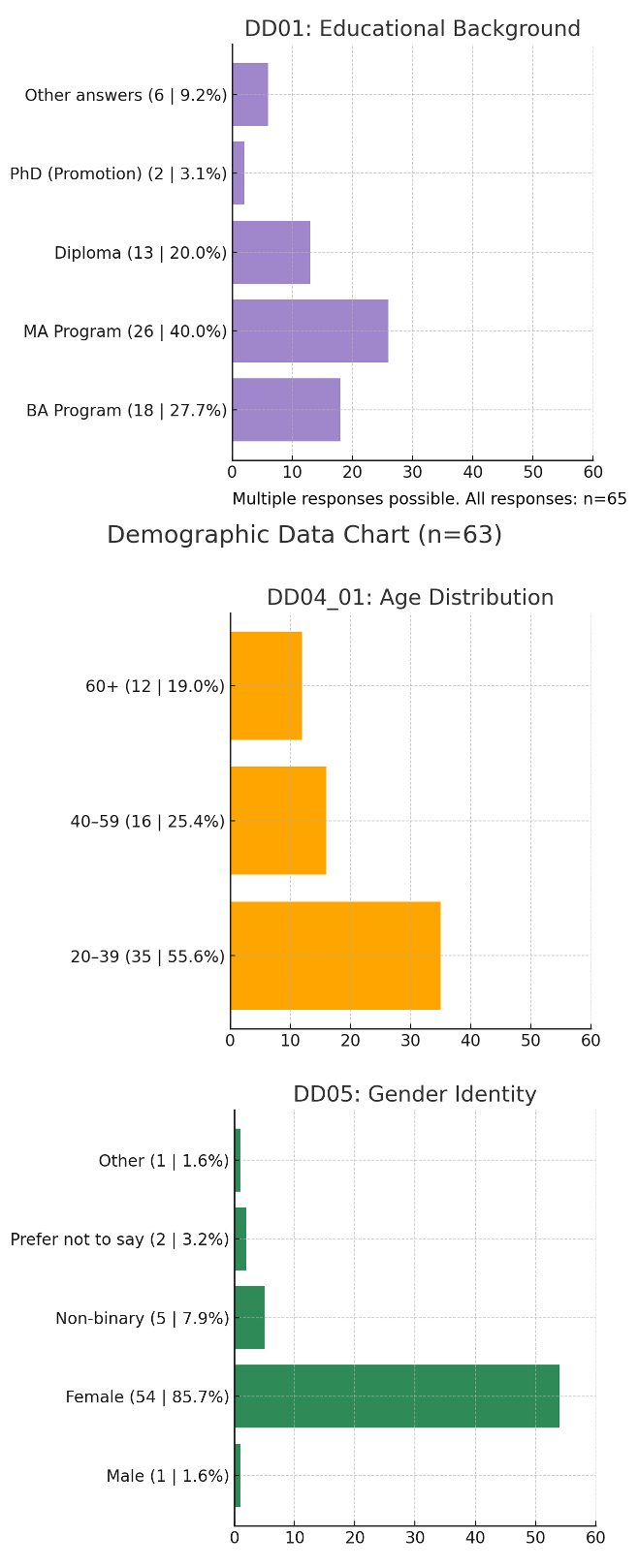
When focussing on the topic related data, 88.9% of participating art therapists (TD11) reported that the triangular relationship is useful in their daily practice, and 84.1% (TD12) answered “yes” when asked whether the model should remain part of academic art-therapy education (Figure 2 [Fig. 2]).
Figure 2: Diagrams of questionnaire items TD11, and TD12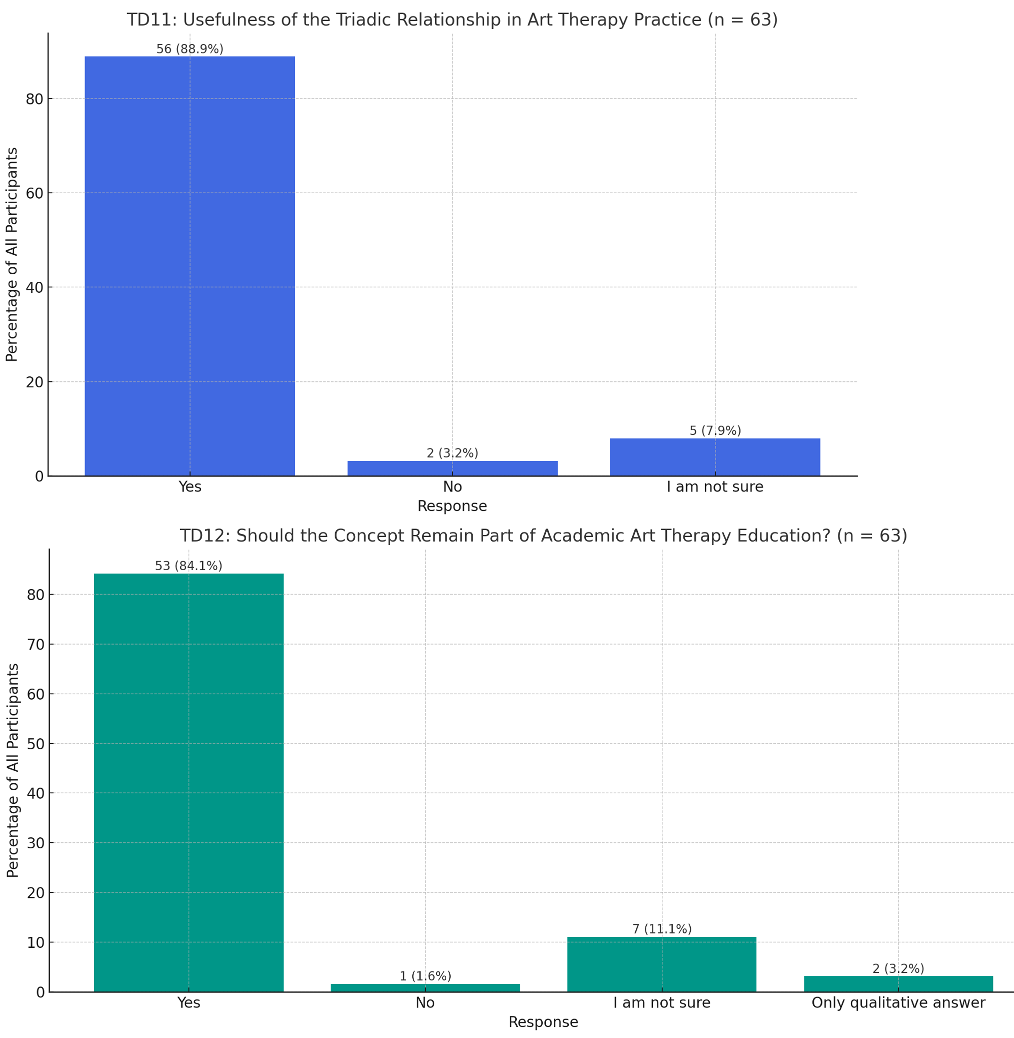
93.7% of participants answered “yes” when asked whether the model of the triangular relationship had been introduced during art-therapy education (TD01). Another question, TD02, inquired if patriarchal structures and colonial continuities were critically discussed in connection with the triangular relationship; 82.5% responded with “no” (Figure 3 [Fig. 3]).
Figure 3: Diagrams of questionnaire items TD01, and TD02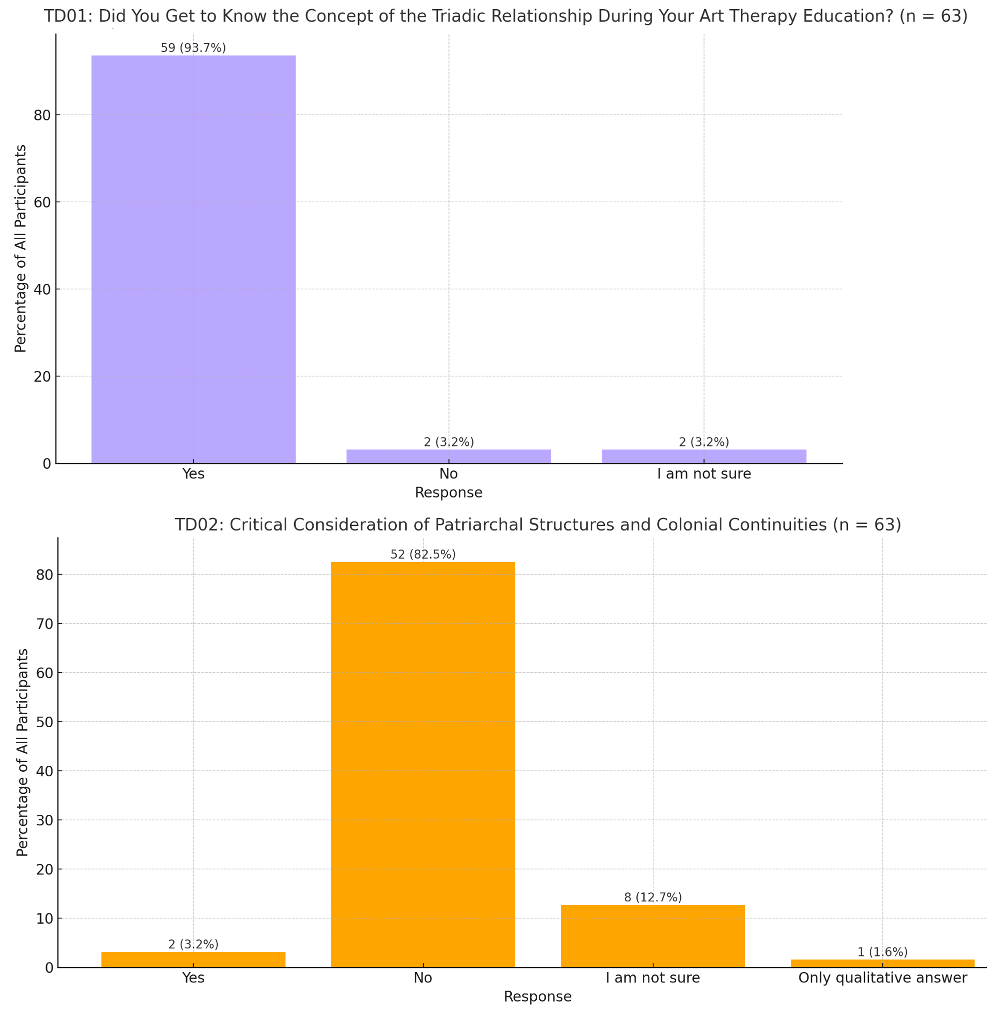
TD03 asked whether the concept of “genius” had been discussed critically; 74.6% of participants answered “no”. TD06 inquired if art was presented as genuine expression of the self, which 65.1% answered with “yes,” while 25.4% were unsure whether this understanding had been part of their art-therapy education. In the qualitative response field for TD06, it was noted that genuine expression was conveyed as one aspect of art, but not its only component (Figure 4 [Fig. 4]).
Figure 4: Diagrams of questionnaire items TD03, and TD06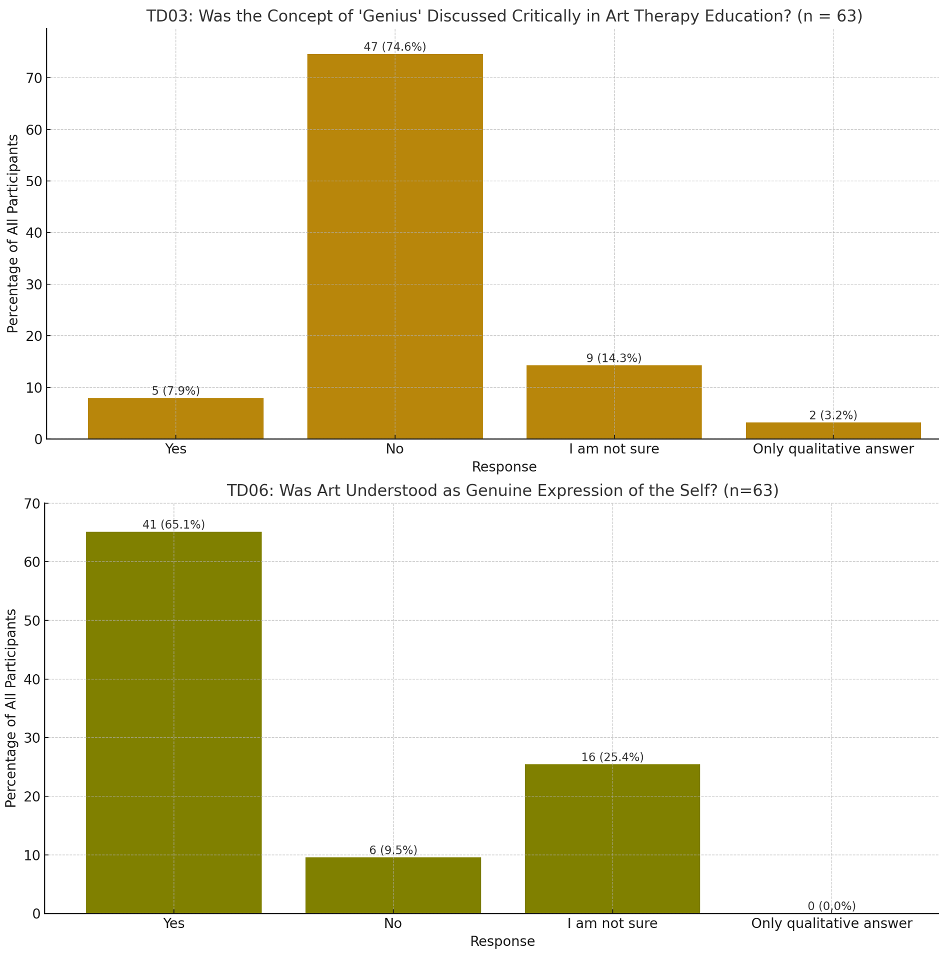
TD04 asked whether art-therapy education had included discussions about what constitutes an artwork in relation to postmodern theory (“Auflösung des Werkbegriffs”); 49.2% answered “yes,” 27.0% answered “no,” and 22.2% were unsure if they had learned about it during their training. TD05 asked whether art was understood as a social and cultural practice arising from an individual’s relationship with the environment; 87.3% of participants answered “yes” (Figure 5 [Fig. 5]).
Figure 5: Diagrams of questionnaire items TD04, and TD05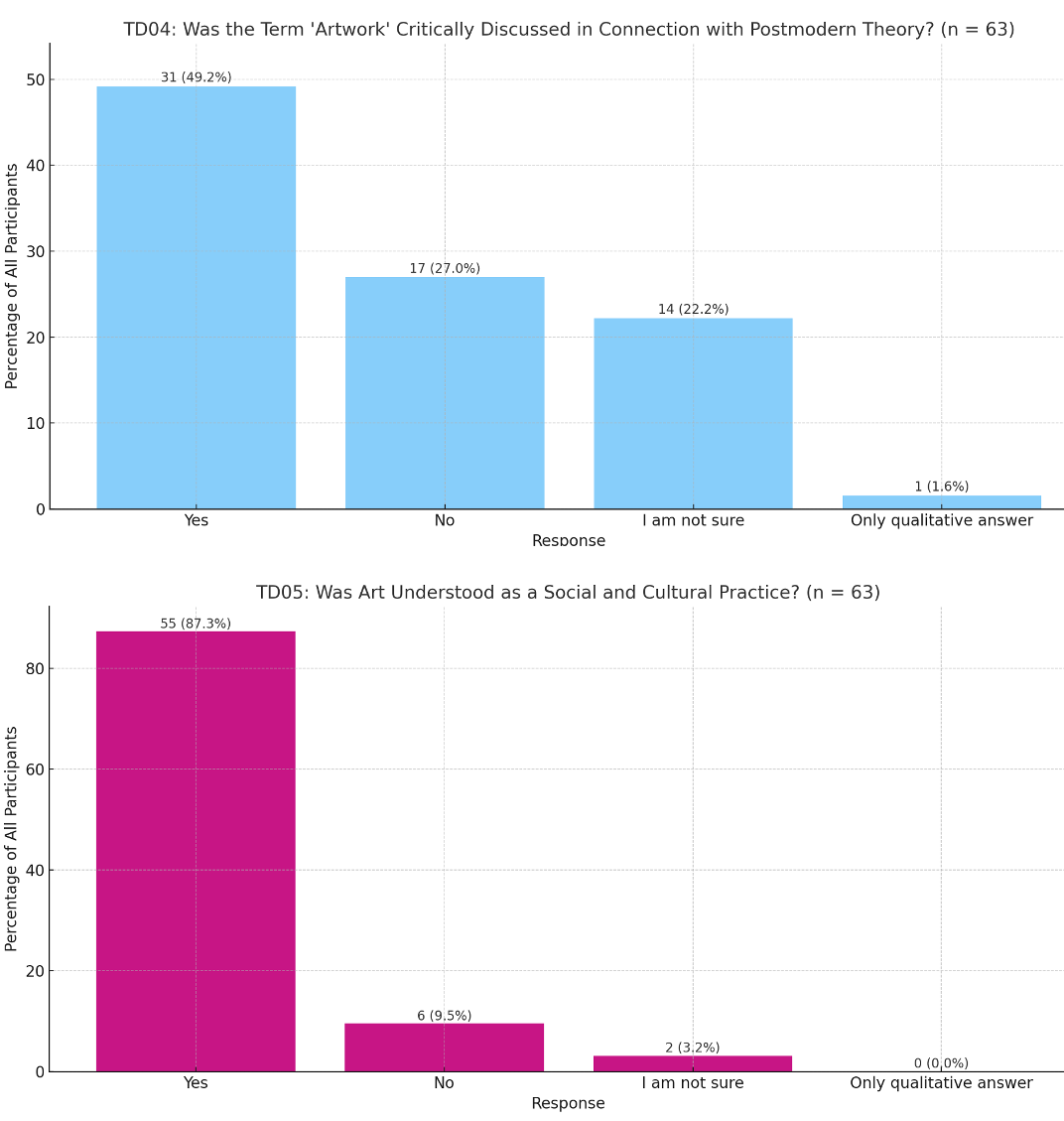
In TD07, participants were asked if they had been introduced to specific models of the triangular relationship during their studies—such as those of Schaverien [2], Bragge and Fenner [4], Schulze-Stampa [5], or Haywood and Grant [6]; 28.6% answered with “yes,” 34.9% answered “no,” and 33.3% could not recall (Figure 6 [Fig. 6]).
Figure 6: Diagram of questionnaire item TD07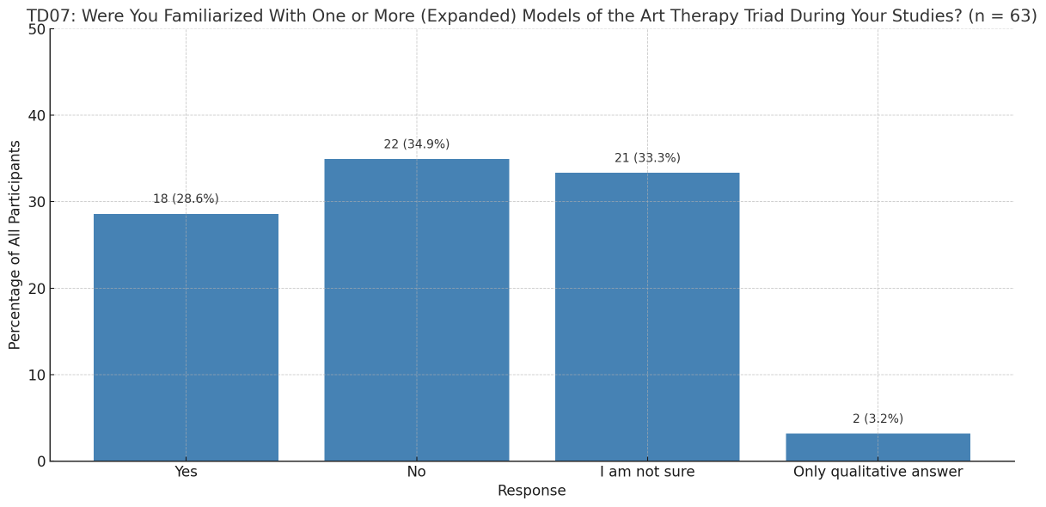
Lastly, TD08 invited participants to name, in an open-ended format, aspects of the triangular relationship in art therapy that had not been covered in the survey. Paolo Knill’s concept of “the Third,” arising from the relationship between service user/artist, art therapist, and artistic process [27], was cited, as were considerations on the aesthetics of the therapeutic relationship by Peter Sinapius ([28][, [29]). Other literature mentioned by survey participants included Luzzatto and Gabriel [30], Rosemarie Tüpker [31], Shaun McNiff [32], Gruber et al. [33], and Peter Petersen [34].
Qualitative answers provided by participants affirmed the continued relevance of the triangular-relationship model in art therapy, particularly for its utility in clinical documentation, interdisciplinary communication, and as a framework for understanding the dynamic interplay between therapist, service user, and artwork, noting that the model supports the establishment and maintenance of therapeutic relationships. However, several practitioners emphasized the model’s limitations, especially in group settings, where therapeutic dynamics often exceed the simplicity of a triadic structure. Further, participating art therapists called for a more nuanced and critical approach to teaching the model. They recommended incorporating historical context, performative dimensions, and theoretical developments that have emerged from the original model. Participants also stressed the need to address the model’s limitations—particularly its reductive nature—and to examine its applicability across diverse cultural frameworks, where concepts of individuality, artistic expression, and relational context may differ significantly.
In summary, the demographic data show that most participants hold a BA, MA, or PhD in art therapy (70.8%); more than half are between 20 and 39 years old (55.6%); and a large number identify as female (74.6%). Turning to the topic-related data, nearly all participants learned about the triangular relationship during their art therapy education (93.7%), yet the majority report that they did not critically examine its possible inherent patriarchal structures and colonial continuities (82.5%). A similarly large share state that they never scrutinised the concept of “genius” in their studies (85.7%), and more than half recall that in their programs they attended art was understood as “genius expression of the self” (65.1%). At the same time, however, the great majority say that art was presented to them as a social and cultural practice developing from the relationship an individual holds with their environment (87.3%). Roughly half of participants remember discussing the concept of artwork in relation to postmodern theory (“Auflösung des Werkbegriffs”), and most do not recall being familiarised with specific variants of the triangular relationship in art therapy during their studies (68.2%). Overall, an overwhelming majority considers the concept useful in their daily practice (88.9%) and believe it should stay part of art-therapy education (84.1%).
4 Discussion
As the qualitative comments left in the survey suggest that greater knowledge of the triangular relationship’s development and history would benefit art-therapy students in Germany, this discussion begins by offering basic information on the model. The concept seems to arise mainly out of theoretical developments in psychotherapy. Case [35], Dalley et al. [36], Isserow [1], and Skaife ([37], [20]), note that, as art therapy emerged as its own discipline, the need for a distinct model separating it from other—particularly verbal—forms of therapy surfaced. Art therapy literature names as main sources psychoanalyst Winnicott’s concept of potential space and his relationship triangle of mother, infant, and “transitional object” [38]; psychoanalyst Christopher Bollas’s idea of the “transformational object” and its evocative potential ([35], p. 49); as well as analytical psychologist C. G. Jung’s theories, which frame the art medium as a third entity that enables a transformation of transference through archetypal imagery [39]. Along with Jung, psychoanalyst Melanie Klein [40] is also mentioned as an influence. Schwarz et al. [41] point out that, while early psychoanalysts initially viewed the therapist's personality and emotions (countertransference) as a hindrance, clinicians such as Klein—despite maintaining the classical neutral stance—acknowledged and further developed the idea that countertransference offers cues to the client's psyche and can serve as an important therapeutic tool. This paved the way for the expansion of (counter)transference phenomena onto art ([42], pp. 17).
These roots in psychoanalysis, analytical psychology, and psychodynamic psychotherapy highlight the relevance of the concept of transference for the model. The following sections discuss how modernist and postmodernist tensions shape the theory and terminology underlying the triangular relationship in art therapy.
4.1 Transference
Survey data suggest a present empirical tension: Though a great majority of participants (88.9%) praise the model of triangular relationship and find it useful in their daily practice (TD11), qualitative responses criticise its reductive nature and indicate insufficient introduction to alternative frameworks, with 68.2% unable to recall being familiarized with specific models (TD07).
Most triadic designs understand transference and countertransference as basic constituents, the best-known example being the model developed by analytical art psychotherapist Schaverien [2]. She regards the tip of the triangular relationship—what she calls “the picture”—as an “object of transference” that evokes aesthetic countertransference developing from both therapist and service user. In Schaveriens’ view though, this picture can be considered an object of transference only when it is created as an embodied image—that is, not merely a pictographic “aid” for communication with the therapist but an image that “conveys a feeling state for which no other mode of expression can be substituted” ([2], p. 59). According to Schaverien, only such an embodied picture is able to transform the service user by activating all points of the triangle, thereby leading to the creation of a dynamic field. Although she states that these two categories of images—the pictographic and the embodied one—are distinct, Schaverien also notes that much of the art created by her service users during art therapy, to one extent or another, carries aspects of both. Schaverien further emphasises that different art-therapeutic settings—art therapy, art psychotherapy, and analytical art psychotherapy—can lead to the production of distinctive creative aesthetics and forms. Another concept Schaverien [42] introduces is “scapegoat transference,” a phenomenon that emerges only from the creation of an embodied artwork. This form of transference develops between an artist and their art image/object, generating transformational power that stems from the relationship between artist and artwork.
Mirroring data from the informative survey, in which participants criticize the model for its reductive nature, art therapist Caroline Case, in another design, introduces her own theory of “refractive transference,” where “projections and transference hit the surface of the therapy room/therapist and refract in all directions” ([35], p. 17). Case suggests that art-therapy sessions create a dynamic and complex field of transference and countertransference where not one occurs after the other but, rather, multiple projections are taking place at the same time. On a similar note, Vaculik and Orlans state that Integrative Arts Therapy has come to the conclusion that the concepts of transference and countertransference cannot be separated, nor is such a separation supported by research in the fields of affective neuroscience and interpersonal neurobiology ([43], p. 66). Chilton et al. add that, due to the inherent interdisciplinary nature of the profession, “in art therapy truth is represented through multiple realities” ([44], p. 7). In his person-centred approach, psychotherapist Carl Rogers already suggested that congruent relationships can develop only beyond the hierarchies of transference when therapist and service user meet on equal grounds in a field of countertransference [22]. His colleague, Paul L. Wachtel, holds a critical view on transference theory as well. Though considering it a valuable contribution to psychotherapy, he sees it as only one source amongst many for the creation of understanding and meaning in therapeutic settings ([25], p. 96). Wachtel cites psychoanalyst K. A. Frank, who stated back in 2001 that, if transference is used as the main source of information about a patient, it can lead to the neglect of “outside interactions” and, in the worst case, to an enforcement of the therapist’s understanding of reality on the patient ([25], p. 243).
A strong stance against applying the psychotherapeutic concept of transference onto art and art therapy in general comes from art therapist Sally Skaife. She reflects doubtfully on the idea that the artwork in art therapy “is an expression of the transference or the transference itself” ([37], p. 121). In another publication from the year 2001, Skaife states further that the profession might be held back by parts of psychoanalytical language and “better advanced by a shift to a theoretical frame which puts forward an intersubjective position in which art is seen as a material, communicative gesture outside any individual consciousness” ([20], pp. 41). Suggesting moving towards an intersubjective understanding, based on Merleau-Ponty’s theory, she points out that the psychoanalytic framework—including Jungian archetypes, Lacanian desire, Winnicott's potential space, and group interaction—often regards an artwork as symbolic of something beyond itself, thus neglecting the inherent physicality and specificity of art materials and objects.
The above outlined considerations represent the Intersubjective Turn, which is taking place across diverse academic disciplines, moving toward emphasizing the relational, dialogical, and interactive foundations of human consciousness, identity, meaning-making, and social reality. Edmund Husserl first introduced the term “intersubjectivity” as part of his theory of phenomenology, describing it as a phenomenon not actively and consciously produced by individuals but rather as an inherent and fundamental structure of human experience and existence: "If a mental being is to exist, have objective existence, the conditions for the possibility of intersubjective givenness must be fulfilled" ([45], p. 95). Intersubjectivity therefore implies that humans are constantly part of a network of communication, trying to create meaning from what is continuously communicated to them. Art is part of this intersubjective field of sentient existence. It communicates with its creator as well as its recipient. Both construct meaning about this communication from their previous experiences, explaining why the same artwork can evoke a range of diverse affects and feelings within different individuals. If humans cannot not communicate, as suggested by psychotherapist Paul Watzlawick [46], the art those humans create must underly the same train of logic. Language can therefore be understood as a form of interpretation of artistic communication, with different cultures having developed distinctive jargons to talk about the affects and feelings creative phenomena evoke. Psychologist Batja Mesquita [47] argues that whilst in some cultures—mainly western, educated, industrialized, rich, democratic (WEIRD) cultures—emotions are understood to be fixed entities that emerge inside an individual, in most other’s they are believed to develop in-between people as a result of interaction with one another.
Other theoretical frameworks further developing the triangular relationship in art therapy draw from both transference theory as well as intersubjectivity. Building on Schaverien’s model, Isserow’s concept of joint attention integrates psychoanalytic views of transference with the Oedipal complex, suggesting that the ability to engage triadically in art therapy (looking together at the art object with the therapist) is predicated on the successful navigation of early developmental stages in childhood, including the internal processing of primary relationships and the recognition of others' separate minds and relationships [1]. Springham and Huet [3] connect the triadic understanding with the Ostensive Communication System, highlighting that “all intersubjectivity is at some level mediated through triangular relationships” (p. 9). To include considerations about “the involvement of the therapist in the art making process,” Bragge and Fenner [4] extend the triangle into a square able to depict five types of interaction, based on an intersubjective approach (p. 19). In their two-dimensional hexagonal shape, Haywood and Grant [6] “draw on relational and embodied processes of transference and countertransference,” trying to depict processes arising in virtual art therapy (p. 144). Karin Dannecker [7] further elaborates the original design by adding three sub-triangles, each one portraying “art,” “patient,” and “art therapist,” including their conscious, preconscious, and unconscious horizontal levels of communication in art therapy, as well as the intensity of their communication, focussing on the “dense connectedness between the unconscious of the therapist and the patient” (p. 8). Finally, Schulze-Stampa [5] carries the two-dimensional triangle into the third dimension, creating an interaction field (IF) between group, single patient, art therapist, and artwork, with the aim to document processes in group art therapy more accurately.
Returning back to the collected survey data, with only one third of respondents remembering to have learned about alternative variants of the triangular relationship, a possible lag in theoretical diversification in German art-therapy curricula seems to become apparent.
4.2 Art as expression of a genius self
74.6% of survey respondents report that the concept of “genius” was not critiqued in their training (TD03), and 65.1% remember being taught that art can be understood as “genius expression of the self” (TD06). These data could suggest that—despite postmodern critiques—in German art-therapy curricula, modernist narratives about the “genius” persist.
Sociologist Karl-Siegbert Rehberg traces the history of the concept of genius expression in art, outlining how a romanticised understanding of the renaissance artist—viewed as a superior being, able to channel the divine powers of creation from an almighty god through generating works of universal beauty—was transformed in modernity into artists themselves becoming genius individuals, in possession of a raw core of creative energy in danger of inhibition by the norms of religion, culture, and society. Only by renouncing those norms and diving into the depth of one’s unconscious core could an artist hope to find an authentic connection to their innermost “true” self, which—once uncovered—offered the power of pure creation ([48], pp. 51). Though the longing for a fresh start of art, independent of cultural and historical baggage, can be understood from a historical perspective, postmodernity points out the inherent obliviousness of this modernist endeavour. Art theorist Rosalind Krauss portrays the idea of avant-garde originality as “conceived as a literal origin, a beginning from ground zero, a birth (…) The self as origin is safe from contamination by tradition because it possesses a kind of originary naiveté“ ([10], p. 53). Dannecker summarizes ideas on art from a psychodynamic perspective, noting that Freud considered artists more capable of overcoming drive impulses and barriers of repression, with Austrian psychoanalyst and art historian Ernst Kris having been convinced that artists could control regression through a strong ego, thus releasing creativity ([7], p. 6). These ideas in psychoanalysis mirror modern understandings of art, romanticising and idealising the artist, their creative process, and their artworks.
Modern ideas about art also materialise in art therapy. Having been taught by her teacher Friedl Dicker-Brandeis (herself a student at The Bauhaus between 1919–1923, studying with Johannes Itten among others), art therapist Edith Kramer’s theory divides creative activity into five categories, of which the first four do not resemble “creative expression or art in the true sense of the word.” Only the fifth category can be understood as: “The creation of symbolic forms that are both an expression of the self and a communication to the environment” ([49], p. 65). Although Kramer points out that most creative processes consist of some or all five of her categories and should therefore not be used to establish a “rigid system” ([49], p. 74), by categorizing art as genuine and “true,” Kramer simultaneously creates a classification of “fake” art. In her approach, the art therapist is able to lead the amateur to their innermost original creative self-expression, freeing them from inhibitions enforced by societal and cultural expectations and norms. This notion, though, carries the risk of replacing one hierarchical structure with another: that of an inhibiting society with the authority of an idealized art therapist.
The concept of "genius" in art has since undergone significant transformation, moving toward a more contextual, social, and deconstructed understanding in postmodern thinking. The myth of the lone (often male) mastermind has been criticized, arguing that ideas do not develop from the creative core of one single talent but rather cultivate within a network of individuals. Art historian Linda Nochlin [11] calls out the dominance of a white male power elite in art and art history in her influential 1971 essay, Why Have There Been No Great Women Artists? In her view, our understanding of what constitutes art becomes distorted when individuals who do not fit the stencil of the white male genius are excluded. On the same note, systemic scientist Montuori and psychologist Purser argue that “a reductionistic individualistic modernist conception of creativity creates a virtual blind spot when it comes to the social dimensions of creativity” ([18], p. 75).
As a majority of survey participants report that they did not critically discuss the concept of “genius” during their studies, with more than half recording that art was conveyed as genius expression of the self, further incorporation of this blind spot, identified by postmodern thinking, seems to be of relevance for art therapy education in Germany.
4.3 What constitutes an artwork
While just half of participants (49.2%) recall engaging in discussions on what constitutes an artwork (“Auflösung des Wekbegriffs”) (TD04), a majority (87.3%) remember being introduced to art as a socio-cultural practice (TD05). Qualitative answers additionally call for more insight on the performative dimensions of the underlying theory and terminology of the triangular relationship in art therapy. Together with the Linguistic, Iconic, and Intersubjective Turn, contemporary art experiences the Performative Turn. These developments manifest in the linguistics of the profession: while publications on the triangular relationship in art therapy in the 1990s and 2000s often use the terms “image,” “picture,” and “art object” ([1], [2], [35], [42]), later ones tend to use the terminology of “art,” “work,” and “artwork” ([4], [5], [7], [8]).
But what constitutes a work of art? Alter-Muri & Klein point out that media and performance artist Allan Kaprow distinguished between “art like art” and “life like art” during the 1960s and 1970s, with the former separating art from daily life and the latter serving it, emphasising that art can take place and be experienced at any moment and place in time, even the most mondain: “By moving art out of the traditional ‘high-art’ world into life, therapeutic change can occur. Art therapists do this all the time” ([19], p. 83). Scholars such as Judith Butler [50], Erika Fischer-Lichte [51], and Richard Schechner [52] describe performance as a fundamental phenomenon through which individuals, in exchange with their culture, shape reality, identity, and meaning. Additionally, art theorist Elizabeth Jones criticises the understanding of art-as-an-object, pointing out that art constitutes as a shared experience in which spectator and artist generate meaning on equal footing within a joint act ([9], p. 207). Philosophers such as Georg W. Bertram have developed these thoughts further, highlighting that the artistic process can be understood as a reflective social practice stemming from human interaction rooted in a shared lived reality ([13], p. 12). Using an intermedial approach, performance art has become the space of postmodernity where traditional boundaries between art genres, media, “high” and “low” art, as well as traditional ideas about societal male and female norms, are strongly critiqued, transversed, dissolved, and transformed ([53], p. 87). When it comes to art-therapy practice, the Performative Turn ignites questions about the performative status of the therapy setting, the therapist as well as the service user, and the artwork created. If art is understood as a socially and culturally shaped practice, with mondain daily experiences able to be viewed as artworks, mustn’t an art therapy session be comprehended as a performative arts space as well? Pamela Whitaker formulates her idea of “Art Therapy Performance,” combining art-therapy practice with performance and live art: “Essentially art therapy and performance art cultivate the art of asking questions from both a personal and social standpoint” ([54], p. 32). Further connections to performance art particularly highlight the transformative qualities present in Marina Abramovic’s work, bearing relevance for psychotherapy [55] and art-therapy practice ([56], [57]).
While the survey data show that art-as-social-practice was taught to a broad majority of participants, comments within the qualitative data suggest that discussions on the impact of performative perspectives—as presented in this subsection—might still be under-represented in German art-therapy curricula.
4.4 Patriarchal structures and colonial continuities
As the demographic data of the informative survey show, with 85.7% of participants associating themselves with the female gender, art therapy in Germany is a profession mainly practiced by women. This ties in with Savneet Talwar, who already critiqued, back in 2010, that the American Art Therapy Association (AATA) has traditionally been a “largely middle class” and “white, women’s organization” ([58], p. 15).
As art therapy has started to become a profession practiced internationally, the theory shifts outlined in this article represent attempts to move away from a genius-driven, Western view of how humans create and define art. They also question static ideas about the self, transference, and countertransference, as well as the authority of the white male therapist in general, striving for equal and diverse encounters between individuals. Art therapists Goodman-Casanova and Sánchez-Aranegui remind readers that “historically, psychiatry has been shaped by systemic inequalities, discrimination, and bias, particularly towards women and other marginalised groups”, which has led to “the perpetuation of unequal power dynamics within therapeutic relationships…” ([59], pp. 1). To recognize and address inequalities, they suggest looking at art therapy from an intersectional viewpoint, taking into consideration how overlapping systems of oppression shape lived experience. Chioma Anah [60] points out that art-therapy practice can only be applied successfully when art therapists are able to acknowledge the historical influence colonial thinking and oppression has had—and still have—on people of colour and their communities. Also, Eastwood, McDonald, Turner, and Vernon argue that art therapists need to untangle and examine their “own psychological and social aesthetic subjectivity” to support “robust and continual questioning of existing certainties" ([61], p. 3).
In the qualitative answering section, participants mention the model’s limitations when it comes to critically examining its applicability across diverse cultural frameworks, where concepts of individuality, artistic expression, and relational context can differ significantly.
Additionally, 82.5% of participating art therapists reported to not have critically discussed patriarchal and colonial underpinnings of the triangular relationship (TD02) during their art therapy studies. This suggests significant headspace for further critical self-reflection about the history, theory, and practice of a profession coming from a mainly white and western background within German art-therapy curricula.
4.5 Limitations
With its 63 participants, the results of the informative survey presented in this article cannot be considered representative of art-therapy education and practice in Germany. Further, due to its focus on Germany, results are not culturally transferable, as training contexts differ between countries. As participants were mainly self-selected members recruited with the help of a professional body, their views may additionally over-represent those already engaged in theoretical discourse. Another limitation might be the possibility that alumni could misremember curricular content or report what seems professionally desirable. Additionally, yes/no/unsure items might limit nuance. In future studies, research triangulation, including observations and curricula analyses, could further validate the self-report data. Lastly, coming from a background in fine arts, intermedial arts therapy, and humanistic psychology, the researcher’s own theoretical and practical stance might have shaped the framing of the survey questions as well as their interpretation.
5 Conclusions
This article has attempted to enquire how the model of the triangular relationship is being included within German art-therapy curricula, considering its relationship to underlying modernist and postmodern theory. Data collected through an informative survey provide mixed impressions, suggesting that, while almost every respondent encountered the model during training (93.7%) and still relies on it in art-therapy practice (88.9%), far fewer recall critically discussing its historical roots in modern concepts questioned by postmodern theory.
Four in five art-therapy graduates participating in the survey never examined its patriarchal or colonial relations (82.5%), and three in four do not recall deconstructing the concept of “genius” (74.6%)—despite two thirds, mentioning that art was framed as expression of genius self (65.1%). Similarly, although the vast majority were taught to view artmaking as a socio-cultural practice (87.3%), only half remember engaging with postmodern ideas on what constitutes a work of art (49.2%), with developments in performance art underrepresented.
Though the model’s simple design continues to make it a valuable tool, at the same time its minimalism is criticized—in survey data as well as art-therapy literature—for not capturing the complex, multi-layered experiences occurring during art-therapy practice.
But while current literature on developments of the model exists—addressing its shortcomings—fewer than one in three participants remembers having heard of any of them during their studies (28.6%), with 68.2% unable to name alternatives.
The findings of the survey data analysed in this article suggest that postmodern theory has not yet been sufficiently included in art-therapy curricula in Germany. Through integrating current literature on the triangular relationship, developments in postmodern theory, alternative relational concepts—including social, cultural, and intersectional dimensions—the model’s practical relevance could be preserved while equipping future art therapists to work with the more complex and diverse realities of twenty-first-century practice.
Notes
Competing interests
The author declares that she has no competing interests.
AI declaration
The AI tool ScholarGPT was used for proofreading, including checks for spelling, punctuation, and the accuracy of the reference list. It was also used to translate the abstract from English into German. All generated text was carefully reviewed, edited, and validated by the author to ensure accuracy and scientific integrity.
References
[1] Isserow J. Looking together: Joint attention in art therapy. Int J Art Ther. 2008;13(1):34-42. DOI: 10.1080/17454830802002894[2] Schaverien J. The triangular relationship and the aesthetic countertransference in analytical art psychotherapy. In: Gilroy A, McNeilly G, editors. The changing shape of art therapy: new developments in theory and practice. London: Jessica Kingsley Publishers;2000. p. 55-83.
[3] Springham N, Huet V. Art as relational encounter: an ostensive communication theory of art therapy. Art Ther. 2018;35(1):4-10. DOI: 10.1080/07421656.2018.1460103
[4] Bragge A, Fenner P. The emergence of the 'interactive square' as an approach to arttherapy with children on the autistic spectrum. Int J Art Ther. 2009;14(1):17-28. DOI: 10.1080/17454830903006323
[5] Schulze-Stampa C. Die andere(n) Seite(n) der Gesundheit. In: Herschbach M, Klein A, editors. Facetten der Kunsttherapie. München: utzverlag; 2021. p. 59-65. DOI: 10.5771/9783831676453-59
[6] Haywood S, Grant B. Reimagining art therapy for the digitally mediated world: a hexagonal relationship. Int J Art Ther. 2022;27(3):143-50. DOI: 10.1080/17454832.2022.2084124
[7] Dannecker K. Why do some people see the unseen? GMS J Art Ther. 2024;6:Doc01. DOI: 10.3205/jat000034
[8] Behfeld M, Sinapius P. Handbuch künstlerischer Therapien: Kritik und Philosophie der therapeutischen Praxis. Göttingen: Vandenhoeck & Ruprecht; 2021. DOI: 10.13109/9783666407796
[9] Jones E. The case against objectifying art. Creativity Research Journal. 1997;10(23):207-14. DOI: 10.1207/s15326934crj1002&3_9
[10] Krauss R. The originality of the avant-garde: a postmodernist repetition. October. 1981;18:47-66. DOI: 10.2307/778410
[11] Nochlin L. Why have there been no great women artists? In: Nochlin L, editor. Why have there been no great women artists? 50th anniversary ed. London: Thames & Hudson; 2021. p. 20-81.
[12] Vergès F. Decolonizing the museum: a programme of absolute disorder. London: Pluto Press; 2024. DOI: 10.2307/jj.13286024
[13] Bertram GW. Kunst als menschliche Praxis: eine Ästhetik. Berlin: Suhrkamp; 2014.
[14] Buber M. Das dialogische Prinzip: Ich und Du. Zwiesprache. Die Frage an den Einzelnen. Elemente des Zwischenmenschlichen. Zur Geschichte des dialogischen Prinzips. Gütersloh: Gütersloher Verlagshaus; 1999.
[15] Rosa H. Resonanz: Eine Soziologie der Weltbeziehung. Berlin: Suhrkamp; 2016.
[16] Seel M. Ästhetik des Erscheinens. München-Wien: Carl Hanser Verlag; 2000.
[17] Beudt S, Jacobsen T. On the role of mentalizing processes in aesthetic appreciation: an ERP study. Front Hum Neurosci. 2015;9:600. DOI: 10.3389/fnhum.2015.00600
[18] Montuori A, Purser RE. Deconstructing the lone genius myth: toward a contextual view of creativity. J Humanist Psychol. 1995;35(3):69-112. DOI: 10.1177/00221678950353005
[19] Alter-Muri S, Klein L. Dissolving the boundaries: postmodern art and art therapy. Art Ther. 2007;24(2):82-86. DOI: 10.1080/07421656.2007.10129584
[20] Skaife S. Making visible: art therapy and intersubjectivity. Int J Art Ther. 2001;6(2):40-50. DOI: 10.1080/17454830108414030
[21] Hoff P, Maatz A, Vetter JS. Diagnosis as dialogue: historical and current perspectives. Dialogues Clin Neurosci. 2020;22(1):27-35. DOI: 10.31887/DCNS.2020.22.1/phoff
[22] Rogers C. On Becoming a Person: A Therapist's View of Psychotherapy. Robinson; 2004.
[23] Rogers N. The Creative Connection, Expressive Arts as Healing. Palo Alto: Science & Behaviour Books; 1993.
[24] Watzlawick P. Wie wirklich ist die Wirklichkeit? Wahn, Täuschung, Verstehen. 3rd ed. München: Piper; 1976.
[25] Wachtel PL. Making room for the disavowed: Reclaiming the self in psychotherapy. New York: Guilford Publications; 2023.
[26] Leiner DJ. SoSci Survey. München: SoSci Survey GmbH; 2025. Available from: https://www.soscisurvey.de
[27] Knill PJ. Das unvermittelbare Heilmittel oder das Dritte in der Kunsttherapie. In: Petersen P, editor. Ansätze kunsttherapeutischer Forschung. Berlin Heidelberg: Springer; 1990. p. 87-116. DOI: 10.1007/978-3-642-75919-2_9
[28] Sinapius P. „ich Ist Ein Anderer“ – Über Die Ästhetik Therapeutischer Beziehungen. Internationale Zeitschrift Für Philosophie Und Psychosomatik. 2011; 1.
[29] Sinapius P. "Wahrnehmen heißt antworten" - Ästhetik therapeutischer Beziehungen. In: Jahn H, Sinapius P, editors. Transformation Künstlerische Arbeit in Veränderungsprozessen Grundlagen und Konzepte. Hamburg-Potsdam-Berlin: University Press; 2016. p. 39-48.
[30] Luzzatto P, Gabriel B. Art psychotherapy. Psychooncology. 1998;7:743-57.
[31] Tüpker R. Auf der Suche nach angemessenen Formen wissenschaftlichen Vorgehens in kunsttherapeutischer Forschung. In: Ansätze Kunsttherapeutischer Forschung. Berlin, Heidelberg: Springer; 1990. p. 71-86. DOI: 10.1007/978-3-642-75919-2_8
[32] McNiff S. Art therapy is a big idea. Art Therapy. 2000;17(4):252-54. DOI: 10.1080/07421656.2000.10129758
[33] Gruber H, Frieling E, Weis J. Kunsttherapie: Entwicklung und Evaluierung eines Beobachtungsinstruments zur systematischen Analyse von Patientenbildern aus der Onkologie und der Rheumatologie. Forsch Komplementmed Klass Naturheilkd. 2002;9(3):138-46. DOI: 10.1159/000064263
[34] Petersen P. Der Therapeut als Künstler: ein integrales Konzept von Psychotherapie und Kunsttherapie. Paderborn: Junfermann; 1994.
[35] Case C. Our Lady of the Queen: Journeys around the maternal object. In: Gilroy A, McNeilly G, editors. The changing shape of art therapy: New developments in theory and practise. London and Philadelphia: Jessica Kingsley Publishers; 2000. p. 15-54.
[36] Dalley T, Rifkind G, Terry K. Three Voices of Art Therapy: Image, Client, Therapist. London: Routledge; 1993.
[37] Skaife S. Keeping the Balance: Further Thoughts on the Dialectics of Art Therapy. In: Gilroy A, McNeilly G, editors. The changing shape of art therapy: New developments in theory and practice. London: Jessica Kingsley Publishers; 2000. p. 115-42.
[38] Winnicott DW. Playing and Reality. London-New York: Routledge Classics; 2005.
[39] Granot A, Regev D, Snir S. Jungian theory and its use in art therapy in the viewpoints of Israeli Jungian art therapists. Int J Art Ther. 2018;23(2):86-97. DOI: 10.1080/17454832.2017.1360371
[40] Klein M. The Psycho-Analysis of Children. London: Vintage; 1932.
[41] Schwarz N, Snir S, Regev D. The Therapeutic Presence of the Art Therapist. Art Ther. 2018;35(1):11-18. DOI: 10.1080/07421656.2018.1459115
[42] Schaverien J. The Revealing Image: Analytical Art Psychotherapy in Theory and Practice. Jessica Kingsley Publishers; 1991.
[43] Vaculik CL, Orlans V. The six therapeutic relationships and the arts: An integrative approach to using theory, research, and the creative arts in practice. In: Vaculik CL, Nash G, editors. Integrative arts psychotherapy: Using an integrative theoretical frame and the arts in psychotherapy. London: Taylor & Francis; 2022. p. 60-76. DOI: 10.4324/9781003155676-7
[44] Chilton G, Gerber N, Scotti V. Towards an aesthetic intersubjective paradigm for arts-based research: An art therapy perspective. UNESCO Obs Multidiscip J Arts. 2015;5(1):1-27.
[45] Husserl E. Ideen zu einer reinen Phänomenologie und phänomenologischen Philosophie Zweites Buch: Phänomenologische Untersuchungen zur Konstitution. [Original work published 1912-1928]. Biemel M, editor. 2nd ed. 1995.
[46] Watzlawick P. Pragmatics of Human Communication: Study of Interactional Patterns, Pathologies and Paradoxes. New York: W.W. Norton; 1967.
[47] Mesquita B. Between us: How cultures create emotions. New York: W. W. Norton; 2022.
[48] Rehberg KS. Kunstautonomie als (historische) Ausnahme und normative Leitidee. In: Karstein U, Zahner NT, Hrsg. Autonomie der Kunst? Zur Aktualität eines gesellschaftlichen Leitbildes. Wiesbaden: Springer Fachmedien Wiesbaden; 2017. p. 51–65. DOI: 10.1007/978-3-658-10406-1_2
[49] Kramer E. Kunst als Therapie mit Kindern. München, Basel: Reinhardt; 1991.
[50] Butler J. Gender Trouble: Feminism and the Subversion of Identity. New York: Routledge; 1990.
[51] Fischer-Lichte E. Ästhetik des Performativen. Frankfurt am Main: Suhrkamp; 2004.
[52] Schechner R. Performance Theory. New York: Routledge; 1988.
[53] Renz M. Intermedialität als Grenzverschiebung. In: Herschbach M, Klein A, Hrsg. Facetten der Kunsttherapie. München: utzverlag GmbH; 2021. S. 85-90. DOI: 10.5771/9783831676453-85
[54] Whitaker P. Moving Art, Moving Worlds Performing the Body in Visual Arts and Art Therapy. Can Art Ther Assoc J. 2005;18(2):27-34. DOI: 10.1080/08322473.2005.11432276
[55] Simões L, Passos MC. The Performance Art of Marina Abramovic as a Transformational Experience. Psychology. 2018;9:1329-39. DOI: 10.4236/psych.2018.96081
[56] Revers J. The Art(Therap)ist Is Present. HPB University Press; 2019.
[57] Paton J, Linnell S. 'The art therapist is present': Embedding arts therapy practice and education in the praxis of contemporary art. Aust N Z J Art Ther. 2018;13(1):101-11.
[58] Talwar S. An Intersectional Framework for Race, Class, Gender, and Sexuality in Art Therapy. Art Ther. 2010;27(1):11-17. DOI: 10.1080/07421656.2010.10129567
[59] Goodman-Casanova JM, Sánchez-Aranegui MD. An art room of one's own! A feminist art therapy group. Int J Art Ther. 2025;29:1-11. DOI: 10.1080/17454832.2025.2500931
[60] Anah C. Art Therapy for Racial Trauma, Microaggressions and Inequality: Social Justice and Advocacy in Therapy Work. Jessica Kingsley Publishers; 2024.
[61] Eastwood C, McDonald A, Turner D, Vernon P. Intersectionality and art therapy. Int J Art Ther. 2023;28(1-2):2-6. DOI: 10.1080/17454832.2023.2221517