
Mobilized colistin-resistant gene (MCR-1) in extended-spectrum beta-lactamase-producing clinical isolates of Escherichia coli in Abuja, Nigeria
Muhammad Abdullahi 1,2,3,4,5Aisha Shehu Adamu 2,3,6
Lawan Adamu 2
Rebecca Olajumoke Bolaji 1
Jimoh Olanrewaju 7
Busayo Olalekan Olayinka 1
1 Department of Pharmaceutical Microbiology, Faculty of Pharmaceutical Sciences, Ahmadu Bello University, Zaria, Nigeria
2 Department of Microbiology, Federal Medical Centre, Jalingo, Taraba State, Nigeria
3 Department of Pharmacy, Federal Medical Centre, Jalingo, Taraba State, Nigeria
4 Department of Planning, Research and Statistics, Nigeria Centre for Disease Control and Prevention (NCDC), HQ Office, Abuja, Nigeria
5 Health Research Division: Golden Bricks Inc., Nigeria
6 The Management, Federal Medical Centre, Jalingo, Taraba State, Nigeria
7 Department of Medical Microbiology, Ahmadu Bello University Teaching Hospital, Zaria, Nigeria
Abstract
Introduction: The global increase in reports of transferable colistin resistance has become a significant public health concern. In Nigeria, only a limited number of studies have documented the presence of mobilized colistin resistance genes (MCR) in isolates derived from both human and animal sources.
Aim: This investigation aimed to detect the presence of the mobilized colistin-resistant gene (MCR-1) in multiple drug-resistant, extended-spectrum beta-lactamase-producing clinical isolates of Escherichia (E.) coli and Klebsiella (K.) pneumoniae obtained from selected hospitals in Abuja, Nigeria.
Materials and method: A total of 115 consecutive, non-duplicate presumptive clinical isolates of E. coli and K. pneumoniae were collected over three months from two hospitals in Abuja: Garki Hospital Abuja and Nisa Hospital Abuja. These isolates were identified employing rapid identification kits. Antimicrobial susceptibility testing was conducted using the agar disc diffusion method, while phenotypic detection of ESBLs was performed via double-disc synergy tests. The MIC of colistin was determined using the broth microdilution method. Molecular characterization of the ESBL and MCR-1 genes was achieved through PCR analysis.
Results: Out of 115 clinical isolates, 49 (42.6%) were identified as E. coli and K. pneumoniae, with 36 (73.5%) of these being multidrug-resistant (MDR). Among the MDR isolates, 15 demonstrated phenotypic resistance to third-generation cephalosporins (primary indicators for TEM and SHV-derived ESBLs), e.g., cefpodoxime. These 15 isolates were selected for ESBL screening. Seven isolates tested positive and were subsequently subjected to double-disc synergy testing. Notably, five out of these seven isolates were confirmed as phenotypic ESBL producers. The result of PCR analysis revealed that 3/5 harbored multiple ESBL genes; E. coli harbored blaSHV and blaCTX-M or blaSHV and blaTEM, K. penumoniae harbored blaSHV, blaTEM, and blaCTX-M. None of the investigated isolates harbored the blaOXA gene. A total of 8 isolates comprising the 3 genotypic ESBL-positive isolates, the 2 phenotypic colistin-resistant isolates, and 3 borderline phenotypic colistin-resistant isolates were molecularly analyzed to detect MCR-1 genes. One out of /8 isolates of E. coli isolated from a patient’s urine sample harbored the MCR-1 gene.
Conclusion: This study is, to the best of our knowledge, the first report of MCR-1 gene detection from a human clinical sample in Abuja, the capital city of Nigeria. The increasing emergence of mobilized colistin resistance genes in isolates of clinical significance as such, calls for an urgent need to preserve the efficacy of our last resort antibiotics through the institutionalization and adequate implementation of antibiotic stewardship.
Keywords
multiple drug resistance, extended-spectrum beta-lactamase (ESBL), mobilized colistin resistance gene (MCR-1 gene), antimicrobial resistance, antimicrobial stewardship, Nigeria
Introduction
In the past decade, the World Health Organization has included colistin (Polymyxin E) on its list of essential medicines [1]. Now, in 2026, colistin remains a critical last-resort antibiotic for the treatment of life-threatening infections caused by multidrug-resistant (MDR) Gram-negative bacteria [2]. The global escalation of carbapenem-resistant Enterobacteriaceae (CRE) and extended-spectrum beta-lactamase (ESBL)-producing pathogens, combined with a stagnant pipeline for novel antibiotics, has led to a resurgence in colistin use [3]. However, its clinical utility is increasingly challenged by the rapid global dissemination of both chromosomal and plasmid-mediated resistance [4].
Today, the challenge is further complicated by the rapid spread of plasmid-mediated resistance genes (MCR-1 to MCR-10), which facilitate horizontal transmission across clinical, environmental, and agricultural sectors (one health) at a global scale [5]. In Nigeria, in the past decade, only a handful of studies have described colistin resistance across the one-health spectrum. This research study aimed at investigating the presence of the mobilized colistin-resistant gene (MCR-1) in multiple-drug-resistant, ESBL-producing clinical isolates of E. coli and Klebsiella pneumoniae from some hospitals in Abuja, Nigeria.
A significant component of surveillance studies for the control of antimicrobial resistance is, of course, ongoing surveillance to characterize circulating resistance phenotypes and detect new resistance genes and their spread in important human pathogens. This will help in policy making to combat antimicrobial resistance.
Materials and methods
Settings and study design
The clinical isolates analyzed in this descriptive epidemiological study were collected between June and August 2018 at the Garki Hospital, Abuja (GHA), and Nisa Hospital, Abuja (NHA) in Nigeria. The Federal Capital Territory Health Research Ethics Committee (FCT HREC) reviewed and granted ethical clearance for this research (FHREC/2018/01/22/02-03-18).
Sample collection and identification
115 non-duplicate clinical isolates of E. coli and K. pneumonia obtained from urine and stool samples of patients attending the two hospitals were collected for this study. These isolates were cultured and preliminarily identified using the standard microbiological techniques (colony morphology, Gram stain, oxidase, and various biochemical tests). The identity of the isolates was confirmed using the rapid identification kit Microgen GN-ID (product code: MID-64CE, Microgen GN-ID A, UK).
ESBL
The susceptibility of the identified isolates to commonly prescribed antibiotics was determined using the modified Kirby-Bauer disc diffusion method as described in the 2018 EUCAST guideline [6]. The following antibiotics were used in this study: ampicillin (10 µg), amoxi-clav (20:10 µg), cefotaxime (30 µg), cefpodoxime (10 µg), ceftazidime (30 µg), colistin (150 mg), imipenem (10 µg), aztreonam (30 µg), gentamicin (10 µg), ofloxacin (5 µg) and nitrofurantoin (300 µg). The minimum inhibitory concentration (MIC) of colistin was determined by the micro-broth dilution method, as previously described [6]. The isolates presumptively identified as ESBL producers by their resistance to ceftazidime, cefotaxime, and cefpodoxime were subjected to a confirmatory double-disc synergy test as described by the European Committee on Antimicrobial Susceptibility Testing [7]. Briefly, the dual-disc synergy test (DDST) was performed by placing amoxycillin/clavulanic acid (AMC) discs at the center of a Mueller–Hinton agar plate inoculated with a 0.5 McFarland standard turbidity suspension of the test organism. Then, ceftazidime (30 µg) and cefotaxime (30 µg) discs were placed around the AMC disc (20 mm apart, center-to-center). The plate was then inverted and incubated at 37°C for 16–18 hours. The DDST was considered positive when the inhibition zone of either antibiotic expanded toward the centrally placed AMC.
Molecular detection of ESBL and MRC genes
The phenotypically ESBL-positive isolates and isolates with reduced susceptibility to colistin were screened for the common ESBL (blaSHV, blaTEM, blaCTX-M, and blaOXA) and mobilized colistin resistance (MCR-1) genes using the conventional polymerase chain reaction technique.
DNA extraction
The genomic DNA was extracted from an overnight culture of the test isolates using the Zymo Research Bacterial DNA Miniprep Kit (Zymo Research, Irvine, CA) following the manufacturer’s instructions. The obtained DNA was then subjected to 1% agarose gel electrophoresis to ascertain its quality.
PCR technique
The PCR reactions was carried out in a GeneAmp1 PCR System 9700 thermocycler (Thermo Fisher Scientific) set to a pre-optimized condition [8]. After the PCR cycles, 5 mL of the resulting PCR products were subjected to 2% agarose gel electrophoresis, stained with 10 mg/ml ethidium bromide. and were then visualized by ultraviolet trans- illumination. A 1-kb DNA Ladder (Thermo Fisher Scientific) was used as a molecular weight marker during electrophoresis. The primers used in this study are listed in Table 1 [Tab. 1].
Table 1: Names and sequences of the primers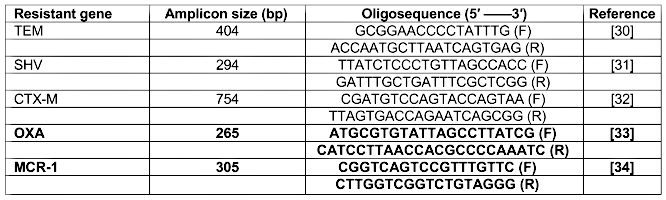
Data analysis
The data collected were analyzed using IBM SPSS software, version 26. Descriptive analysis, including frequencies and percentages, was used.
Results
Isolation rates of the clinical isolates
The distribution of the 115 presumptive clinical isolates comprising 77 presumptive Escherichia (E.) coli and 38 K. pneumoniae was obtained from patients attending the two hospitals (Table 2 [Tab. 2]).
Table 2: Distribution of the 77 presumptive E. coli and 38 K. pneumoniae isolates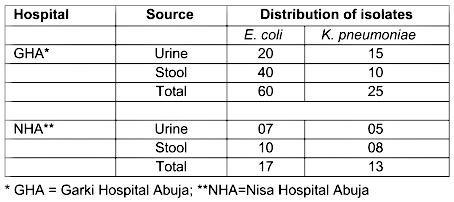
Biochemical identification of the clinical isolates
The percentage distribution of the 49/115 (42.6%) identified E. coli and K. pneumoniae clinical isolates obtained from the two hospitals (Table 3 [Tab. 3]).
Table 3: Distribution of identified E. coli and K. pneumoniae isolates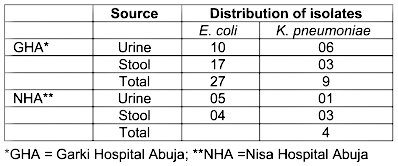
Antimicrobial susceptibility testing
36/49 of the clinical isolates subjected to antibiotic susceptibility testing were multidrug-resistant isolates and were therefore categorized according to Magiorakos et al. [9] as multiple drug-resistant (MDR, n=18), extremely drug-resistant (XDR, n=6), and pan-drug-resistant (PDR, n=2) (Figure 1 [Fig. 1]).
Figure 1: Electrophoretogram of CTX-M (754bp), TEM (404bp), SHV (295bp), and OXA (265bp) genes amplified from MDR E. coli and K. pneumoniae isolates.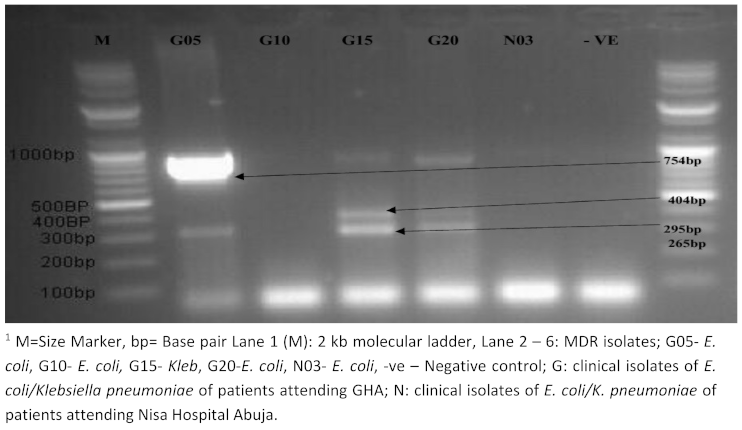
Antibiotic resistance profile of the MDR clinical isolates
The E. coli strains obtained from the Garki Hospital Abuja were mainly resistant to ceftazidime, cefpodoxime, ofloxacin, nitrofurantoin, and cefotaxime. In the Nisa Hospital Abuja the proportion of resistant E. coli strains were higher (Table 4 [Tab. 4]). For K. pneumoniae, there was no notable difference in resistance between the isolates from the two hospitals (Table 4 [Tab. 4]).
Table 4: Antibiotic resistance profile of the MDR clinical isolates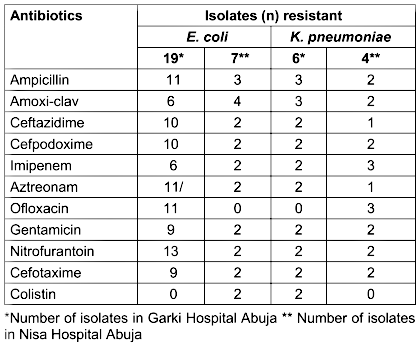
MIC results for the clinical isolates: Two of 49 colistin-resistant isolates had MIC values above the 4.0 µg/ml threshold. Three of 49 other isolates had MIC values at exactly 2.0 µg/ml and hence were termed “borderline colistin-resistant isolates” (Table 5 [Tab. 5]).
Table 5: MIC results of the clinical isolates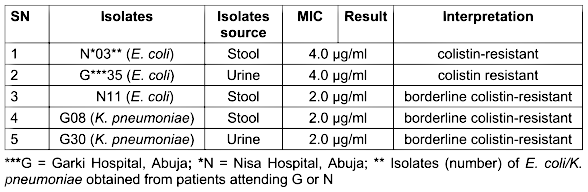
Phenotypic detection of ESBL in MDR clinical isolates
Fifteen of 36 MDR isolates of E. coli and K. pneumoniae obtained from GHA and NHA – comprising 12 isolates from GHA and 3 from NHA that have shown phenotypic resistance to the third-generation cephalosporins such as ceftazidime and cefotaxime (the best indicator for TEM and SHV-derived ESBL) and cefpodoxime (the best indicator for all ESBL types) – were selected for ESBL screening. Seven of 15 of clinical isolates tested for ESBL preliminary disc screening were positive. However, when further subjected to the phenotypic confirmatory DDST, Five of 7 were phenotypically confirmed ESBL producers (Table 6 [Tab. 6]).
Table 6: Distribution of phenotypic MDR, ESBL-producing clinical isolates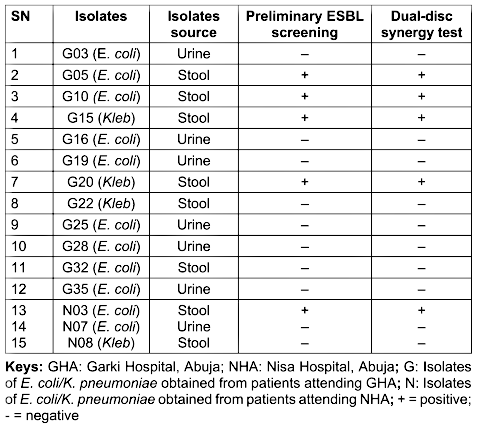
The five identified MDR phenotypically extended ESBL-producing clinical isolates of E. coli and K. pneumoniae obtained in the two hospitals are shown in Table 7 [Tab. 7].
Table 7: The five identified MDR, phenotypically ESBL -producing clinical isolates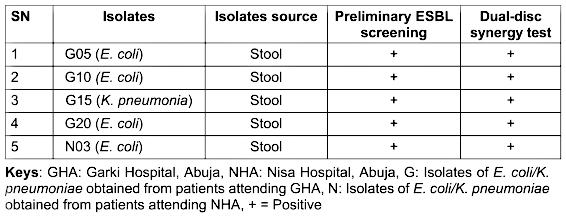
Molecular characterization of these ESBL genes (SHV, TEM, CTX-M, and OXA)
The five identified MDR phenotypically ESBL-producing clinical isolates were further subjected to a conventional PCR for the molecular characterization of some of the most common clinically significant ESBL genes (TEM, SHV, OXA, and CTX-M). The molecular detection of these ESBL genes (SHV, TEM, CTX-M, and OXA) via multiplex PCR reveals that 3 of 5 isolates were positive for the SHV genes, 2 of 5 harbored the TEM genes, and 2 of 5 were positive for CTX-M genes with at 295 bp, 404 bp and 754 bp, respectively. The OXA gene was not detected in any of the isolates (Figure 1 [Fig. 1] and Table 8 [Tab. 8]).
Table 8: Molecular detection of ESBL genes in MDR E. coli and K. pneumoniae isolates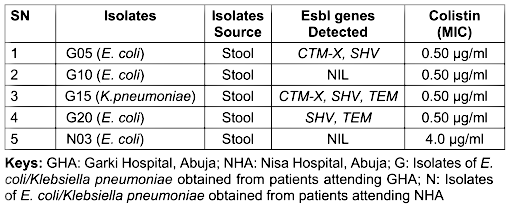
Molecular characterization of the mobilizing colistin resistance gene (MCR-1 gene)
Isolates harboring the ESBL genes (G5, G15, and G20), colistin-resistant isolates (N03 and G35), and all the borderline colistin-resistant isolates (G8, N11, and G30) were analyzed.
Resolution of the amplification products by agarose gel electrophoresis revealed that the plasmid-encoded colistin resistance gene (MCR-1) evaluated in this study was present in only 1/8 (12.5%), G35, out of a total number of 8 isolates analyzed (Figure 2 [Fig. 2] and Table 9 [Tab. 9]).
Figure 2: Electrophoretic gel of MCR-1 (305 bp) gene amplified from MDR, ESBL-producing clinical isolates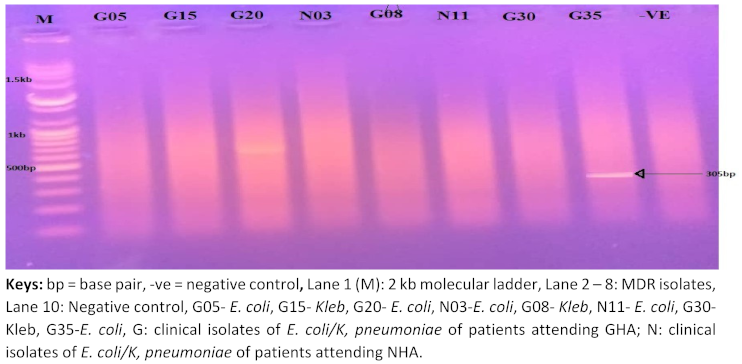
Table 9: Detection of MCRr-1 genes in MDR ESBL-producing clinical isolates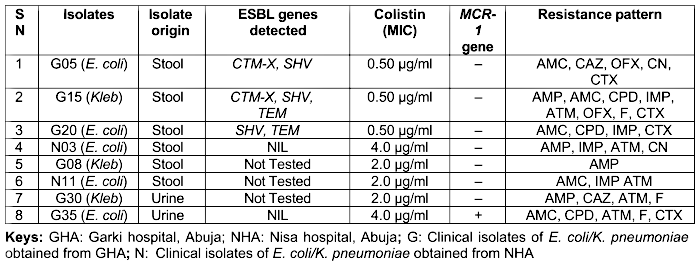
Discussion
The detection of resistant genes is a global public health issue. Surveillance studies such as this, aimed at identifying specific resistant genes, are key in combating antimicrobial resistance. It is well documented that β-lactam antibiotics are the most-prescribed antibiotics in Nigeria [10]. The majority of the isolates exhibited high resistance to β-lactam antibiotics. This may be due to therapeutic dependence on β-lactam antibiotics owing to their high tolerability and efficacy [11].
Moreover, easy over-the-counter access to this important class of antibiotics and the attendant tendency toward misuse make the emergence of β-lactam-resistant Gram-negative bacteria inevitable. The imipenem resistance observed in this study may be due to the expression of metallo-beta-lactamase enzymes [12]. Previous reports have established the occurrence of metallo-beta-lactamase-producing isolates in various regions of Nigeria, even among patients who have not previously received carbapenem treatment [12], [13].
As witnessed in this study, the detection of ESBL genes among MDR clinical isolates of human origin is worrisome. The incidence of infections caused by third-generation cephalosporin-resistant organisms, particularly members of the Enterobacteriaceae family producing various ESBL enzymes, has increased in recent years [14], [15]. This study's finding is consistent with previous studies in Abuja, where clinical and non-clinical bacterial isolates similarly harbor ESBL genes [16], [17].
The detection of an E. coli isolate bearing the MCR-1 gene in this study is cause for concern, because the continued spread of the plasmid-borne MCR-1 gene will compromise the clinical usefulness of polymyxins [18]. With no new antibiotics in the pipeline, colistin has been recently classified by the World Health Organization as a critically important antibiotic for human medicine [19]. This is due to the position of colistin as the last-resort antibiotic for treating infections caused by MDR Gram-negative bacteria. The gradual emergence of colistin resistance among Gram-negative bacteria portends an imminent threat of therapeutic failure in human and veterinary health care, and thus substantial additional morbidity and mortality [20]. Previous studies have reported both plasmid and chromosomal resistance mechanisms of colistin in Nigeria [21], [22], [23], [24]. Similarly, MCR genes have been detected in both clinical and non-clinical bacterial isolates in several African countries, including Algeria [25], Tunisia [26], South Africa [27], and Egypt [28]. To the best of our knowledge, this is the first report of plasmid-mediated colistin resistance in Abuja, the capital city of Nigeria.
The finding of this study is alarming because of the localization of both ESBL and MCR genes on conjugative plasmids, which may harbor other resistant determinant genes. In Tunisia, for example, an isolate of E. coli co-harboring MCR-1 and blaCTX-M-1 genes alongside other antibiotic-resistant genes on an IncHI2 plasmid has been reported [29]. This makes intra- and inter-species transfer highly likely, with the possibility of a nosocomial outbreak of infections due to these MDR bacterial pathogens. Efforts should therefore be made to strengthen infection control practices in hospitals.
Conclusion
Coordinated antimicrobial stewardship across one health is paramount in the fight against antimicrobial resistance. The findings concerning the increasing rate of MDR-ESBL genes among isolates of clinical significance, such as E. coli and K. pneumoniae, is cause for global health concern. This study also reported the first detection of the MCR-1 gene in an MDR clinical isolate of E. coli in Abuja, Nigeria.
Notes
Author’s ORCID:
- Abdullahi M: https://orcid.org/0009-0003-5414-7841
Ethical approval
The study protocol was reviewed and approved by the Federal Capital Territory Health Research Ethics Committee, FCTA-Abuja, Nigeria [Ethical Approval No: FHREC/2018/01/22/02-03-18].
Funding
None.
Acknowledgments
The authors appreciate the management and the entire staff of the Faculty of Pharmaceutical Sciences, Ahmadu Bello University and Teaching Hospital, Zaria, Kaduna State, Nigeria; the management, pharmacy and microbiology departments of Federal Medical Centre, Jalingo, Taraba State, Nigeria; and the management and microbiology department of Garki Hospital, Abuja and Nisa Hospital, Abuja, Nigeria, for their support.
Competing interests
The authors declare that they have no competing interests.
References
[1] World Health Organization. The selection and use of essential medicines: report of the WHO Expert Committee 2017. Geneva: WHO; 2017.[2] Zeb S, Nazir A, Hameed MF, Ikram S, Haider Naqvi SZ, Shoaib M, Butaye P, Wang Z, Li R, Lu X. Colistin Resistance in Gram-Negative Bacteria: Mechanisms, Transmission, and Novel Intervention Strategies. Microorganisms. 2026 Jan 13;14(1):173. DOI: 10.3390/microorganisms14010173
[3] Kardos N. Carbapenem-resistant Enterobacteriaceae (CRE) and the globalization of antimicrobial resistance: problems and solutions. SunText Rev Biotechnol. 2020 Jan;1:103. DOI: 10.51737/2766-5097.2020.003
[4] Azzam A, Salem H, Nazih M, Lotfy EM, Hassan FE, Khaled H. Prevalence, trends, and molecular insights into colistin resistance among Gram-negative bacteria in Egypt: a systematic review and meta-analysis. Ann Clin Microbiol Antimicrob. 2025 May 10;24(1):32. DOI: 10.1186/s12941-025-00799-3
[5] Wu L, Zhang X, Oelschlaeger P, Brem J, Wang D, Chen C. Natural-product-derived antimicrobial adjuvants to reverse plasmid-mediated bacterial resistance. J Agric Food Chem. 2026 Feb 4;74(4):3290-315. DOI: 10.1021/acs.jafc.5c13090
[6] European Committee on Antimicrobial Susceptibility Testing (EUCAST). EUCAST guidelines. 2018. Available from: v_8.0_EUCAST_QC_tables_routine_and_extended_QC-ORYGINAL.pdf
[7] European Committee on Antimicrobial Susceptibility Testing (EUCAST). EUCAST guidelines for detection of resistance mechanisms and specific resistances of clinical and/or epidemiological importance. Microsoft Word - EUCAST detection of resistance mechanisms_170711. Available from: https://www.eucast.org/fileadmin/src/media/PDFs/EUCAST_files/Resistance_mechanisms/EUCAST_detection_of_resistance_mechanisms_170711.pdf
[8] Olowo-Okere A, Ibrahim YKE, Olayinka BO. Molecular characterisation of extended-spectrum β-lactamase-producing Gram-negative bacterial isolates from surgical wounds of patients at a hospital in North Central Nigeria. J Glob Antimicrob Resist. 2018 Sep;14:85-89. DOI: 10.1016/j.jgar.2018.02.002
[9] Magiorakos AP, Srinivasan A, Carey RB, Carmeli Y, Falagas ME, Giske CG, Harbarth S, Hindler JF, Kahlmeter G, Olsson-Liljequist B, Paterson DL, Rice LB, Stelling J, Struelens MJ, Vatopoulos A, Weber JT, Monnet DL. Multidrug-resistant, extensively drug-resistant and pandrug-resistant bacteria: an international expert proposal for interim standard definitions for acquired resistance. Clin Microbiol Infect. 2012 Mar;18(3):268-81. DOI: 10.1111/j.1469-0691.2011.03570.x
[10] Umar LW, Isah A, Musa S, Umar B. Prescribing pattern and antibiotic use for hospitalized children in a Northern Nigerian Teaching Hospital. Ann Afr Med. 2018 Jan-Mar;17(1):26-32. DOI: 10.4103/aam.aam_44_17
[11] Bush K, Bradford PA. β-Lactams and β-Lactamase Inhibitors: An Overview. Cold Spring Harb Perspect Med. 2016 Aug 1;6(8):a025247. DOI: 10.1101/cshperspect.a025247
[12] Bonomo RA, Burd EM, Conly J, Limbago BM, Poirel L, Segre JA, Westblade LF. Carbapenemase-Producing Organisms: A Global Scourge. Clin Infect Dis. 2018 Apr 3;66(8):1290-1297. DOI: 10.1093/cid/cix893
[13] Brinkac LM, White R, D'Souza R, Nguyen K, Obaro SK, Fouts DE. Emergence of New Delhi Metallo-β-Lactamase (NDM-5) in Klebsiella quasipneumoniae from Neonates in a Nigerian Hospital. mSphere. 2019 Mar 13;4(2):e00685-18. DOI: 10.1128/mSphere.00685-18
[14] Tanko N, Bolaji RO, Olayinka AT, Olayinka BO. A systematic review on the prevalence of extended-spectrum beta lactamase-producing Gram-negative bacteria in Nigeria. J Glob Antimicrob Resist. 2020 Sep;22:488-496. DOI: 10.1016/j.jgar.2020.04.010
[15] Musa BM, Imam H, Lendel A, Abdulkadir I, Gumi HS, Aliyu MH, Habib AG. The burden of extended-spectrum β-lactamase-producing Enterobacteriaceae in Nigeria: a systematic review and meta-analysis. Trans R Soc Trop Med Hyg. 2020 Apr 8;114(4):241-248. DOI: 10.1093/trstmh/trz125
[16] Olowo-Okere A, Abdullahi MA, Ladidi BK, Adeiza SS, Nuhu T, et al. Emergence of metallo-β-lactamase-producing Gram-negative bacteria in northwest Nigeria. Ife J Sci. 2019 May;21(2):323-31. DOI: 10.4314/ijs.v21i2.6
[17] Aworh MK, Kwaga J, Okolocha E, Mba N, Thakur S. Prevalence and risk factors for multi-drug resistant Escherichia coli among poultry workers in the Federal Capital Territory, Abuja, Nigeria. PLoS One. 2019 Nov 21;14(11):e0225379. DOI: 10.1371/journal.pone.0225379
[18] Schwarz S, Johnson AP. Transferable resistance to colistin: a new but old threat. J Antimicrob Chemother. 2016 Aug;71(8):2066-70. DOI: 10.1093/jac/dkw274
[19] World Health Organization. Critically important antimicrobials for human medicine. 6th revision. Geneva: WHO; 2018. Available from: https://www.who.int/publications/i/item/9789241515528
[20] Mendelson M, Brink A, Gouws J, Mbelle N, Naidoo V, Pople T, Schellack N, van Vuuren M, Rees H; South African One Health Stewardship Sub-Committee of the Ministerial Advisory Committee on Antimicrobial Resistance. The One Health stewardship of colistin as an antibiotic of last resort for human health in South Africa. Lancet Infect Dis. 2018 Sep;18(9):e288-e294. DOI: 10.1016/S1473-3099(18)30119-1
[21] Abdullahi M, Bolaji RO, Olayinka BO, Olowo-Okere A, Ogbonnaya G. The emergence of mobilized colistin-resistant gene (mcr-1) in MDR, ESBL-producing clinical isolate of Escherichia coli in Abuja, Nigeria. OIRT J Sci Res. 2022 Jul_Aug;2(4):20-8. DOI: 10.53944/ojsr-2215
[22] Olowe OA, Olowe RA, Oluremi AS, Adefioye OJ. Colistin-resistant Escherichia coli carrying mcr-1 gene from animal and human fecal samples in Nigeria. Pan Afr J Life Sci. 2018;1:7-10. DOI: 10.36108/pajols/8102/10(0120)
[23] Otokunefor K, Tamunokuro E, Amadi A. Molecular detection of of mobilized colistin resistance (mcr-1) gene in Escherichia coli isolates from Port Harcourt, Nigeria. J Appl Sci Environ Manag. 2019 Apr 9;23(3):401-5. DOI: 10.4314/jasem.v23i3.5
[24] Olaitan AO, Diene SM, Kempf M, Berrazeg M, Bakour S, Gupta SK, Thongmalayvong B, Akkhavong K, Somphavong S, Paboriboune P, Chaisiri K, Komalamisra C, Adelowo OO, Fagade OE, Banjo OA, Oke AJ, Adler A, Assous MV, Morand S, Raoult D, Rolain JM. Worldwide emergence of colistin resistance in Klebsiella pneumoniae from healthy humans and patients in Lao PDR, Thailand, Israel, Nigeria and France owing to inactivation of the PhoP/PhoQ regulator mgrB: an epidemiological and molecular study. Int J Antimicrob Agents. 2014 Dec;44(6):500-7. DOI: 10.1016/j.ijantimicag.2014.07.020
[25] Nabti LZ, Sahli F, Hadjadj L, Ngaiganam EP, Lupande-Mwenebitu D, Rolain JM, Diene SM. Autochthonous case of mobile colistin resistance gene mcr-1 from a uropathogenic Escherichia coli isolate in Sétif Hospital, Algeria. J Glob Antimicrob Resist. 2019 Dec;19:356-357. DOI: 10.1016/j.jgar.2019.10.006
[26] Hassen B, Saloua B, Abbassi MS, Ruiz-Ripa L, Mama OM, Hassen A, Hammami S, Torres C. mcr-1 encoding colistin resistance in CTX-M-1/CTX-M-15- producing Escherichia coli isolates of bovine and caprine origins in Tunisia. First report of CTX-M-15-ST394/D E. coli from goats. Comp Immunol Microbiol Infect Dis. 2019 Dec;67:101366. DOI: 10.1016/j.cimid.2019.101366
[27] Poirel L, Jayol A, Nordmann P. Polymyxins: Antibacterial Activity, Susceptibility Testing, and Resistance Mechanisms Encoded by Plasmids or Chromosomes. Clin Microbiol Rev. 2017 Apr;30(2):557-596. DOI: 10.1128/CMR.00064-16
[28] Zafer MM, El-Mahallawy HA, Abdulhak A, Amin MA, Al-Agamy MH, Radwan HH. Emergence of colistin resistance in multidrug-resistant Klebsiella pneumoniae and Escherichia coli strains isolated from cancer patients. Ann Clin Microbiol Antimicrob. 2019 Dec 12;18(1):40. DOI: 10.1186/s12941-019-0339-4
[29] Saidani M, Messadi L, Mefteh J, Chaouechi A, Soudani A, Selmi R, Dâaloul-Jedidi M, Ben Chehida F, Mamlouk A, Jemli MH, Madec JY, Haenni M. Various Inc-type plasmids and lineages of Escherichia coli and Klebsiella pneumoniae spreading blaCTX-M-15,blaCTX-M-1 and mcr-1 genes in camels in Tunisia. J Glob Antimicrob Resist. 2019 Dec;19:280-283. DOI: 10.1016/j.jgar.2019.05.007
[30] Olesen I, Hasman H, Møller Aarestrup F. Prevalence of β-lactamases among ampicillin-resistant E. coli and Salmonella from food animals in Denmark. Microb Drug Resist. 2004 Winter;10(4):334-40. DOI: 10.1089/mdr.2004.10.334
[31] Arlet G, Rouveau M, Philippon A. Substitution of alanine for aspartate at position 179 in the SHV-6 extended-spectrum β-lactamase. FEMS Microbiol Lett. 1997 Jul 1;152(1):163-7. DOI: 10.1016/s0378-1097(97)00196-1
[32] Hirakata Y, Matsuda J, Miyazaki Y, Kamihira S, Kawakami S, Miyazawa Y, Ono Y, Nakazaki N, Hirata Y, Inoue M, Turnidge JD, Bell JM, Jones RN, Kohno S; SENTRY Asia-Pacific Participants. Regional variation in the prevalence of extended-spectrum beta-lactamase-producing clinical isolates in the Asia-Pacific region (SENTRY 1998-2002). Diagn Microbiol Infect Dis. 2005 Aug;52(4):323-9. DOI: 10.1016/j.diagmicrobio.2005.04.004
[33] Pitout JD, Gregson DB, Church DL, Elsayed S, Laupland KB. Community-wide outbreaks of clonally related CTX-M-14 beta-lactamase-producing Escherichia coli strains in the Calgary health region. J Clin Microbiol. 2005 Jun;43(6):2844-9. DOI: 10.1128/JCM.43.6.2844-2849.2005
[34] Liu YY, Wang Y, Walsh TR, Yi LX, Zhang R, Spencer J, Doi Y, Tian G, Dong B, Huang X, Yu LF, Gu D, Ren H, Chen X, Lv L, He D, Zhou H, Liang Z, Liu JH, Shen J. Emergence of plasmid-mediated colistin resistance mechanism MCR-1 in animals and human beings in China: a microbiological and molecular biological study. Lancet Infect Dis. 2016 Feb;16(2):161-8. DOI: 10.1016/S1473-3099(15)00424-7