
Current infection control measures regarding Heater Cooler Units (HCU) in Germany after the mycobacteria chimaera outbreak 2014–2026
Sebastian Schulz-Stübner 1,2,31 German Consulting Center for Infection Prevention and Control (BZH GmbH), Freiburg i. Brsg., Germany
2 Department of Anesthesiology and Critical Care Medicine, University of Freiburg, Faculty of Medicine, Freiburg im Brsg., Germany
3 Institute for Public Health and Health Research at the Freiburg University of Education, Freiburg im Brsg., Germany
Abstract
Introduction: The 2014–2016 outbreak of cardiac surgery–associated infections with non-tuberculous mycobacteria (NTM) linked to heater-cooler units (HCUs) led to widespread implementation of environmental monitoring and technical/organizational control measures in Germany. We aimed to describe current infection prevention practices, with a focus on ongoing water and air surveillance related to HCUs in German cardiac surgery centres.
Method: An anonymous online survey was distributed to directors of all German cardiac surgery departments by the Deutsche Gesellschaft für Thorax-, Herz- und Gefäßchirurgie e.V. (DGTHG). The survey collected administrative information on procedure volumes, HCU types and placement, disinfection practices, and the use and frequency of routine microbiological water sampling for NTM and air sampling in the operating room. No patient-level data were collected.
Results: Twelve departments responded, ranging from small (≈300 cardiopulmonary bypass procedures/year) to very large centres (≈2,800/year), and representing major HCU manufacturers used in Germany. During the outbreak phase, all centres introduced routine NTM water sampling (monthly to yearly) and 4/12 also performed routine air sampling every 3–6 months. By 2026, two centres had discontinued water sampling, and most of the others reduced sampling frequency; air sampling was not implemented or was later abandoned in most institutions (only 3/12 continued). Between 2014 and 2016, 4/12 of centres detected NTM in water and 1/12 reported NTM in air samples; in the most recent 12 months, no positive water or air samples were reported. The proportion of centres positioning HCUs outside the operating room increased from 4/12) during the outbreak phase to 5/12 in 2026.
Discussion: German cardiac surgery departments report a clear de-escalation of environmental monitoring for HCUs since the initial outbreak response, particularly for air sampling, while technical measures such as positioning exhaust away from the surgical field and, where feasible, locating HCUs outside the operating room have increased. Given persistent reports of HCU water colonization in the literature, continued water monitoring appears reasonable, with reduced intervals (e.g., every 3–6 months) in centres with consistently negative results, and targeted air sampling primarily when NTM are detected in water to support risk assessment and device management.
Keywords
heater cooler unit, mycobacterium chelonae, water contamination, water disinfection, cardiac surgery
Introduction
At the beginning of 2015 In Switzerland, the Netherlands, and Germany, 10 patients were diagnosed with endocarditis and foreign-body infections caused by Mycobacterium (M.) chimaera, a non-tuberculous mycobacterium (NTM) of the M. avium complex group. Epidemiological and microbiological studies linked these infections to intraoperatively used heater cooler units (HCU) via aerosol formation originating from contaminated water in the cooler system in cases with heart-lung machine (HLM) use [1], [2].
The exact diagnosis with corresponding microbiological detection of the pathogen was made in the affected patients after a relatively long latency period of 1.5 to 3.6 years since NTM are slow-growing and because in cases of suspected endocarditis specific microbiological diagnostics targeted at NTM are not routinely performed.
A corresponding risk assessment was published by the European Center for Disease Prevention and Control (ECDC) on April 30, 2015 [3], triggering a response for strict infection control measures and introduction of water and air sampling by cardiac surgery centres throughout Germany, often with strict regulation by local authorities responsible for medical product control, based mainly on preliminary recommendations by the Swiss national health authority (Bundesamt für Gesundheit, BAG), which have evolved since then [4].
We sought to determine the current state of environmental sampling in German cardiac surgery departments with a survey.
Methods
The anonymous survey was distributed online to all directors of German cardiac surgery departments using the membership directory of the German Society for Thoracic and Cardiovascular Surgery e.V. (DGTHG). Only administrative data and no patient information was collected, so the survey is not considered human research.
Results
12/78 departments filled in the survey. However, the distribution of responses ranged from small (300 procedures with HLM use) to very large centres (2,800 procedures with HLM use) and included types of HCU from the major manufacturers on the German market.
During the outbreak phase between 2014 and 2026 all departments introduced routine water sampling for NTM (ranging from monthly to yearly intervals) and 4/12 departments routine air sampling every 3–6 months. Two departments abandoned water sampling completely in 2026, and one institution prolonged the frequency of testing.
Air sampling was abandoned by one of the four departments originally employing it, and the frequency was extended from 6 to 12 months by one unit and maintained by the remaining two.
From 2014 to 2016, NTM were found by 4/12 departments in water samples and in one department in air samples. In 2025 no positive water or air samples were reported.
The number of centres with the HCU positioned outside the OR increased from 4/12 during the outbreak phase to 5/12.
Table 1 [Tab. 1] shows the summary of the survey’s responses. Additional free text comments remarked that
Table 1: Summary of the survey questions and results (n=12 hospitals)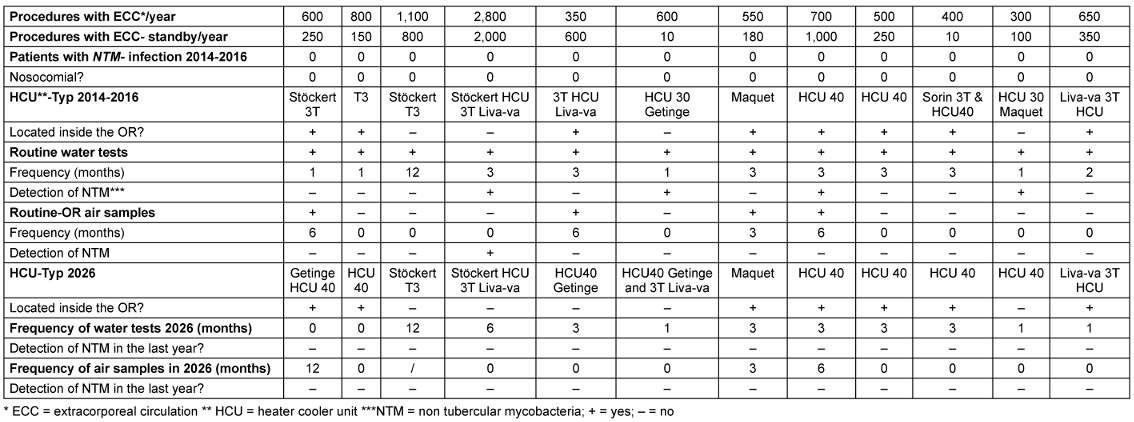
- “after switching to HCU 40, indoor air sampling became obsolete”,
- “we had no outbreaks between 2014 and 2016. Following the new construction, there are no longer any HCUs directly in the operating rooms, so we no longer conduct regular indoor air sampling for mycobacteria there”,
- “we had very small amounts of atypical mycobacteria in the drinking water, but we already had a hygiene protocol in place and cleaned the hypothermia devices regularly. Therefore, we never had a serious hygiene problem, just a lot of hassle”.
Discussion
Schreiber et al. [5] in 2021 reviewed the literature related to the outbreak and found nine studies in which M. chimaera isolates from LivaNova (former Sorin) heater-cooler units (HCU) had a high level of genetic similarity but were genetically distant from isolates from HCUs produced by other manufacturers. Except for a single study, the remaining eight studies reported a high level of genetic proximity between the majority of M. chimaera isolates derived from cardiac surgery-associated patients and LivaNova HCUs. In-depth analysis revealed involvement of three distinct M. chimaera subgroups in the outbreak (1.1, 1.8, 2.1), with 1.1 suggested as causative of the outbreak. Samples taken at the LivaNova production site supported contamination with strains of subgroups 1.1 and 1.8. In the combined analysis of 526 publicly available whole genome sequencing (WGS) data sets, nearly all isolates from cardiac surgery-associated patients contained strain 1.1 (50/52), and at least one of the outbreak strains was found in almost all LivaNova HCUs (241/257, 93.8%), with strain 1.1 present in 198/257 (77.0%).
Schreiber et al. [6] further investigated the longitudinal development of NTM in water samples from five Liva Nova HCUs. Non-tuberculous mycobacteria were isolated in 319 (48.0%) of a total of 665 water samples. 21 water samples grew more than one mycobacterial species. The most frequently detected species were M. chimaera (n=247/319, 77.4%), M. gordonae (46/319, 14.4%) and M. paragordonae (34/319, 10.7%). Detection rates increased prospectively for any NTM (odds ratio (OR) per year in use: 1.60, 95% confidence interval (CI) 1.17–2.24, P<0.001) and for M. chimaera (OR per year in use: 1.67, 95% CI 1.11–2.57, P<0.01).
However, colonization with M. chimaera and other NTM has been reported for HCUs produced by several manufacturers.
Dittomaso et al. [7]) describe ongoing problems with the disinfection procedures recommended by the manufacturer. A total of 308 HCU water samples (264 samples from 17 Stockert 3T HCUs and 44 samples from 12 Maquet HCU40 devices) were analysed in their study, 65.5% of which yielded NTM. The most frequently colonized device with NTM was the Stoeckert 3T (88.2%), with a frequency of positive samples of 59.5% (157/264). The Maquet HCU40 devices less frequently yielded NTM (33.3%), with a frequency of positive water samples of 6/44. Disinfection procedures were effective in reducing bacteria except for NTM species. NTM were detected in both pre-disinfection (50.1%) and post-disinfection (55.7%) samples, and no significant association was found between disinfection and NTM results both in Stoeckert 3T and Maquet HCU40 devices.
Schlotthauer et al. [8] confirmed this impression and presented data on the occurrence of M. chimaera and other mycobacterial pathogens in different HCUs from one surgical center in Germany over a 42-month period. Water samples and swabs from seven different HCUs were taken between 2015 and 2018, and mycobacteria were detected in 50.6% (78/154) of water samples and in 4/19 of swabs. M. chimaera accounted for the most detected pathogen (77/83 isolates in water samples), but other species such as M. gordonae were also found. Despite strict adherence to an intensified, regular manufacturer recommended disinfection procedure, the majority of HCUs remained positive for mycobacteria until the end of the study.
Kuster et al. [9] reported the results of their surveillance measures including water and air sampling. Since 01/2016, four Maquet HCU40 (Getinge) HCUs have been in operation at the University Hospital Basel. Monthly water cultures for Gram-negative bacteria and mycobacteria were performed, including samples from two filling lines equipped with 0.2 µm water filters. Intermittent monthly air sampling for mycobacteria was conducted. Between 01/2016 and 05/2018, various non-fermenting bacteria were cultured. M. chelonae was first isolated in 06/2018 from HCU water tanks. Mycobacteria cultures from the filling lines remained negative. The first air sample positive for M. chelonae was collected in 12/2019. Despite intensified disinfection measures from 01/2022 onwards, M. chelonae could be cultured in air samples, collected at 30 cm and 120 cm height adjacent to three of the four running HCUs in 07/2022. Whole genome sequencing identified a cluster of isolates differing by a maximum of four single nucleotide polymorphisms. Despite extensive investigations, the source of M. chelonae remains undetermined. To date, no infections with M. chelonae have been related to the contaminated HCUs at the authors institution.
In our survey positive results of water samples (3/12) and air samples (1/12) were only reported during the outbreak phase and not over the last 12 months. The frequency of sampling was reduced by most institutions, and air sampling not introduced or later abandoned by the majority.
With these observations from the literature, it seems that preventive measures to reduce the chance of NTM intake into a HCUs water system are of utmost importance (especially at the manufacturers site), but NTM water contamination is not completely preventable and can only be mitigated once contamination of a HCU has occurred. It therefore seems reasonable to continue microbiological monitoring of water samples, but the frequency can be safely reduced to 3–6 months when results are negative. Air samples are only indicated if NTM are found in the water samples and can then be used to determine whether a HCU needs replacement.
Positioning of the HCUs vent exhaust away from the surgical field is mandatory, when HCUs are positioned within the operating room, according to the recommendation of the Commission for Hospital Hygiene and Infection Prevention (KRINKO) at the Robert Koch Institute [10].
Limitation
The small sample size is the major limitation of this study.
Notes
Author’s ORCID
- Schulz-Stübner S: https://orcid.org/0000-0001-5210-9364
Ethical approval
Participants agreed to participate in the voluntary anonymous survey by activating the online survey tool.
Funding
This work was funded by the German Consulting Center for Infection Prevention and Control.
Acknowledgments
The author thanks the German Society for Thoracic and Cardiovascular Surgery e.V. for its support and the distribution of the survey to the cardiac surgery departments in Germany.
Competing interests
The authors declare that they have no competing interests.
AI usage statement
DEEPL was used for assistance with the English language.
References
[1] Sax H, Bloemberg G, Hasse B, Sommerstein R, Kohler P, Achermann Y, Rössle M, Falk V, Kuster SP, Böttger EC, Weber R. Prolonged Outbreak of Mycobacterium chimaera Infection After Open-Chest Heart Surgery. Clin Infect Dis. 2015 Jul 1;61(1):67-75. DOI: 10.1093/cid/civ198[2] Sommerstein R, Schreiber PW, Diekema DJ, Edmond MB, Hasse B, Marschall J, Sax H. Mycobacterium chimaera Outbreak Associated With Heater-Cooler Devices: Piecing the Puzzle Together. Infect Control Hosp Epidemiol. 2017 Jan;38(1):103-8. DOI: 10.1017/ice.2016.283
[3] ECDC. Rapid risk assessment: Invasive cardiovascular infection by Mycobacterium chimaera potentially associated with heater‐cooler units used during cardiac surgery. 2015 Apr 30 [last access 2026 Sep 02]. Available from: https://www.ecdc.europa.eu/sites/default/files/media/en/publications/Publications/mycobacterium-chimaera-infection-associated-with-heater-cooler-units-rapid-risk-assessment-30-April-2015.pdf
[4] Bundesamt für Gesundheit. Infektion mit Mycobacterium chimaera nach Chirurgie am offenen Herzen. [last access 2026 Apr 26]Available from: https://www.bag.admin.ch/de/healthcare-assoziierte-infektionen
[5] Schreiber PW, Kohl TA, Kuster SP, Niemann S, Sax H. The global outbreak of Mycobacterium chimaera infections in cardiac surgery-a systematic review of whole-genome sequencing studies and joint analysis. Clin Microbiol Infect. 2021 Nov;27(11):1613-20. DOI: 10.1016/j.cmi.2021.07.017
[6] Schreiber PW, Zihlmann R, Schärer V, Hasse B, Imkamp F, Schulthess B, Sander P, Zingg W. Longitudinal increase in the detection rate of Mycobacterium chimaera in heater-cooler device-derived water samples. J Hosp Infect. 2023 Jan;131:190-3. DOI: 10.1016/j.jhin.2022.11.003
[7] Ditommaso S, Giacomuzzi M, Memoli G, Zotti CM. Failure to eradicate non-tuberculous mycobacteria upon disinfection of heater-cooler units: results of a microbiological investigation in northwestern Italy. J Hosp Infect. 2020 Nov;106(3):585-93. DOI: 10.1016/j.jhin.2020.08.023
[8] Schlotthauer U, Hennemann K, Gärtner BC, Schäfers HJ, Becker SL. Microbiological surveillance of heater-cooler units used in cardiothoracic surgery for detection of Mycobacterium chimaera. Thorac Cardiovasc Surg. 2024 Jan;72(1):59-62. DOI: 10.1055/s-0042-1756630
[9] Kuster S, Urwyler P, Capoferri G, Von Rotz M, Ragozzino S, Kuehl R, Tesoro C, Reuthebuch O, Zenklusen U, Scheifele S, Eckstein F, Keller PM, Schlaepfer P, Tschudin-Sutter S. Aerosolization of Mycobacterium chelonae from heater-cooler-devices: a continuing risk of exposure during cardiac surgery. Antimicrob Resist Infect Control. 2025 Oct 8;14(1):117. DOI: 10.1186/s13756-025-01635-1
[10] Prävention postoperativer Wundinfektionen: Empfehlung der Kommission für Krankenhaushygiene und Infektionsprävention (KRINKO) beim Robert Koch-Institut. Bundesgesundheitsblatt Gesundheitsforschung Gesundheitsschutz. 2018 Apr;61(4):448-73. DOI: 10.1007/s00103-018-2706-2