
What is medical education research? An analysis and definition of subjects, objectives and types of research based on articles that have undergone a peer review process
Katrin Schüttpelz-Brauns 1Achim Schneider 2
Götz Fabry 3
Jan Matthes 4
Monika Himmelbauer 5
Beatrice Buss 6
Marianne Giesler 7
1 Heidelberg University, Medical Faculty Mannheim, Mannheim, Germany
2 University of Ulm, Medical Faculty, Ulm, Germany
3 University Freiburg, Medical Faculty, Freiburg i. Brsg., Germany
4 University of Cologne, Faculty of Medicine, Cologne, Germany
5 Medical University of Vienna, Vienna, Austria
6 Bern University of Applied Sciences, Department of Health, Bern, Switzerland
7 Freiburg i. Brsg., Germany
Abstract
Background: Medical education research (MER) seeks to contribute to the scientific knowledge in this area and to the further development of educational practice. However, the lack of relevance of the studies conducted in this field has been criticized for years. The present work therefore aims to clarify the tasks and objectives of MER and the nature of research in this area. To this end, the subjects, objectives, and types of research that are common to MER are analyzed and categories for these are developed.
Method: The categories for research subjects and research objectives were developed iteratively in three phases with multiple rounds based on samples of peer-reviewed articles. Depending on the round, two to six people were involved in the independent categorization, finding mutual consent, and further development of the categories. At the same time, research types were defined for MER.
Results: 169 articles were assessed. Eleven subject categories and eight categories of research objectives were identified, and four types of research were defined as relevant.
Discussion: The categories found for research subjects partly coincide with existing category systems but also broaden them. The research objectives identified are more specific than they have been before, which limits the scope for interpretation.
Conclusion: The category systems developed can help to define the subjects and objectives of medical education research more precisely and to differentiate between the research types and their significance. In addition, trends and temporary phenomena can also be depicted using the categories found.
Keywords
medical education research, medical education, basic research, applied research, use-inspired basic research
1. Introduction
Research in higher education originated in the United States in the 1920s [1]. In medicine, it became established there from the 1950s under the name medical education research [2], [3]. Medical education research was a reaction to various socio-historical factors, such as
For years, international journals have repeatedly criticized the lack of relevance of research in medical education research, which can be summarized as a lack of contribution to science in terms of knowledge gain and a lack of implications for practice. The criticism of the lack of scientific knowledge gain relates, e.g., to irrelevant topics or the lack of generalizability of results, the criticism of the lack of practical implications relates, e.g., to the applicability of the results to practice, but also to the measured outcomes. The criticisms are presented and explained in table 1 [Tab. 1].
Table 1: Points of criticism of studies in medical education research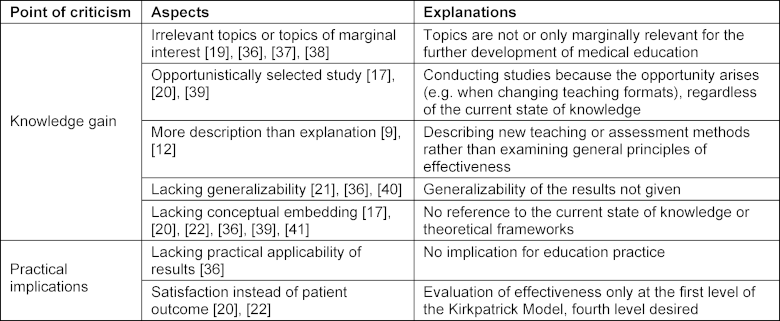
To understand how research projects in medical education research could contribute to scientific knowledge or how to further develop practice, it is worth taking a closer look at medical education research. The first question to ask is what specific topics or subjects are being researched in medical education research (research subjects). Also, of relevance is what types of research objectives are pursued (research objectives) and what types of research (research type) are conducted. These three areas of medical education research are examined in more detail in the following sections.
1.1. Subjects of medical education research
Looking at relevant textbooks, the wide range of subjects of medical education research becomes apparent [5], [6], [7], [8]. This diversity is also reflected in articles in which the subjects of medical education research studies are systematically analyzed and categorized [9], [10]. These categories are not always congruent. Moreover, since each research subject can be viewed or researched from different perspectives, a one-dimensional enumeration of the research subjects is difficult to achieve.
Since, to our knowledge, there is no generally accepted classification of research subjects in studies of medical education research, a structural model developed in educational psychology [11] could be helpful for future categorization of subjects in medical education research. In this model, the subjects of educational psychology research are arranged along three dimensions. These are the functional areas of research, counselling, prevention, intervention as well as monitoring and evaluation, the educational career, which covers the entire lifespan and thus emphasizes lifelong learning, and the activity levels (micro, meso, macro) at which the tasks are to be performed. Based on this model, the subjects of medical education research such as student selection, learning, teaching, examination, curriculum could be assigned to the dimension of functional areas, which could be scientifically analyzed at different levels (individual, group, organization), but also in relation to the educational career (undergraduate education, post-graduate education, further education).
1.2. Research objectives of medical education research
In medical education, there are two frameworks that address corresponding research objectives of medical education research. According to Cook et al., studies aim to describe (description, focus on observation), justify (justification, “How does an intervention work?”) or explain (clarification, “How does something work?”, “Why does something work?”) [12]. In their research compass, Ringsted et al. summarize the research objectives under the categories of modelling, justifying, predicting and implementing [13]. However, both papers focus on the type of data collection or study design to answer these questions. How the categories of research objectives were developed is left open.
1.3. Types of research in medical education
Looking at the literature on the classification of research types in medical education, there are several researchers who place them on a one-dimensional continuum. For example, Albert, who analyzed the discussions in medical education research from a sociological perspective using the field concept of Pierre Bourdieu, found that medical education research is conducted by two interest groups [14]. One group seeks to expand and deepen the knowledge of the research field (epistemic interest). This interest group represents basic research. Studies of this type of research aim to fundamentally understand general phenomena and their relationships [13], [15], [16]. The aim is to deepen the knowledge and understanding of learning and training within the framework of medical education research [13]. The focus here is on the question “Why does something work?” [13], [16]. The derivation of the research question must therefore be embedded in the existing knowledge on the topic and, if applicable, in a theoretical framework. The other interest group seeks to solve practical problems in medical education with the help of research [14] (application interest). This group represents applied research. Studies of this type of research aim to solve problems for practice [17]. These can concern both the effectiveness of measures on learning [18], as well as the effect of measures on society or patients [19], [20], [21], [22]. The relevance of research from the perspective of applied researchers is primarily concerned with the practical implications of research findings for improving medical education [13].
The one-dimensional view with the extremes of epistemic interest vs. application interest also exists in other research disciplines and has been described in detail by Stokes [23]. However, Stokes points out that the objectives of studies should be considered two dimensionally. These dimensions represent the presence or absence of the quest for fundamental understanding and considerations of use. In his two-dimensional quadrant model, three different types of research with different objectives can be distinguished [23]. Pure basic research is the study of phenomena in a scientific field in order to understand them. It is driven solely by trying to understand without thought of practical use [23]. Pure applied research is aimed at an individual, group- or society-related need or application. This is purely for the sake of application with no claim to gain knowledge [23]. The two-dimensional representation generates a third quadrant in which both quest for fundamental understanding and considerations of use are high. This quadrant represents use-inspired basic research. In this type of research, unknown basic principles are tested, and society-related needs are met [23].
Stokes gives concrete examples for three of the quadrants. Although the fourth quadrant is unnamed, it is by no means empty. Stokes assigns research to this quadrant that is not inspired by the goal of understanding nor by the goal of use, but instead systematically investigates certain phenomena [23], [24].
1.4. Aim and research questions
Previous attempts to describe medical education research in more detail on the basis of its subjects, objectives and types of research, in order to ultimately demonstrate the significance of its studies in terms of their contributions to knowledge and implications for practice, has revealed a number of gaps. For example, due to the diversity of topics and subjects, there are no uniform subject categories in medical education research. Similarly, there are no concrete categories of research objectives that are or should generally be pursued in medical education research. And even if the assignment of studies in medical education research to Stokes’ four possible categories appears to be feasible, there is no precise knowledge of the type of research conducted in medical education research. To fill these gaps, this study aims to clarify the subjects and objectives of medical education research and the nature of research in this area. To do this, we need to answer the following three questions:
- What subjects are researched in medical education?
- What are the objectives of medical education research?
- Which types of research listed in Stokes' quadrant model [23] can be derived for medical education research
2. Methods
It can be assumed that peer-reviewed medical education research articles reflect the possible range of research subjects, research objectives and types of research from the perspective of the authors, reviewers and editors. To test this assumption, a method based on document analysis [25] was chosen. In three phases with multiple reviews and samples, selected articles were categorized according to area of research subject, research objective and type of research. In phase 1 (inductive approach [26]), categories were developed for these areas to which the studies could be assigned. Phase 2 (deductive approach [26]) was used to revise the categories. In phase 3 (fine-tuning), the categories and their explanations were refined. Table 2 [Tab. 2] provides an overview of all phases.
Table 2: Overview of the phases and rounds of the study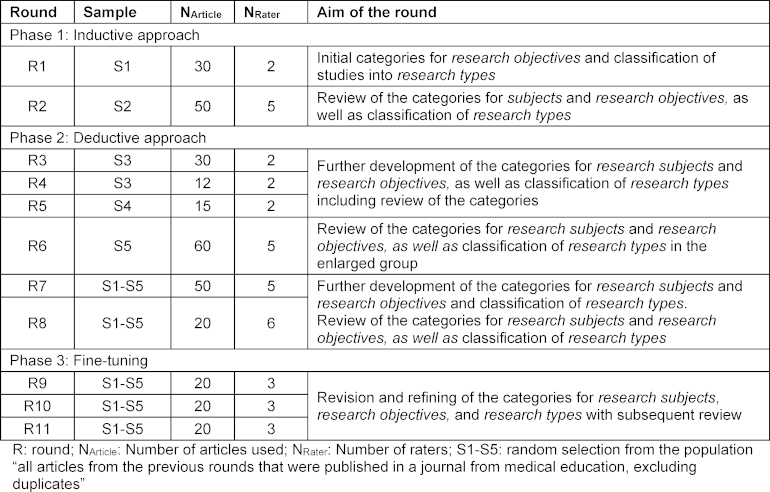
2.1. Samples
In total, there were five samples of articles (SP1 to S5) that differed in terms of source as well as inclusion and exclusion criteria.
The samples were drawn independently of each other to be able to cover as broad a field as possible when developing categories or reviewing them. Towards the end of the second phase, it became apparent that a further sampling of additional articles would not have led to any new findings, so the articles from S1 to S5 were transferred to a single file. Duplicate articles were identified using the DOI and removed. Articles were then randomly selected from the resulting file, excluding studies from purely medical journals. A detailed description of the sample selection can be found in attachment 1 [Att. 1].
2.2. Procedure
The categories were developed iteratively (see figure 1 [Fig. 1]) over several rounds (see table 2 [Tab. 2]). The categories for research subjects and research objectives were developed in terms of content, while the categories for the types of research according to Stokes [23] only had to be adapted for medical education.
Figure 1: An Iterative approach for the development of categories for subjects and objectives of medical education research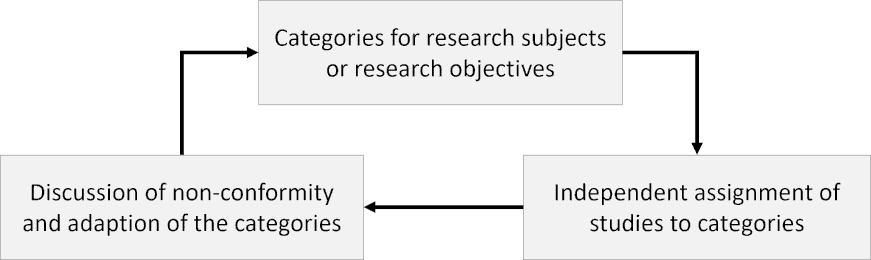
The professional background of four researchers involved in this study is psychology (MG, MH, AS, KSB), two researchers studied medicine (GF, JM) and one physiotherapy (BB).
2.2.1. Phase 1: Inductive approach (round 1 – round 2)
Round 1 aimed to find initial categories for research objectives and to assign articles to the research types according to Stokes [23] (see table 2 [Tab. 2]). For this purpose, two authors (MG, KSB) independently paraphrased the research objective of the article, the epistemic interest and the application interest. The research type was derived from the combination of epistemic and application interest. Discrepancies in the assignment of research objectives or research types addressed were discussed until agreement was reached. The inductive method was chosen to develop research objectives independently of the categories of Cook [12] and Ringsted [13] and, if necessary, to validate these with different methods in the sense of triangulation.
The aim of round 2 was to review the categories for research subjects, research objectives and research types by five independent researchers (BB, MH, JM, AS, KSB). The categories for subjects and objectives as well as the classification into research types were predetermined. The structural model of educational psychology described above [11] formed the basis for the development of the initial categories for subjects of medical education research. Each dimension of this model was assigned to the study subjects commonly used in medical education research (see table 3 [Tab. 3]). The categories for the research objectives were derived from the results of round 1. Since it was assumed that the research objectives could be assigned to the categories of the research types, the respective assignment of the research objectives to the research types was predetermined.
Table 3: Initial categories for subjects in medical education research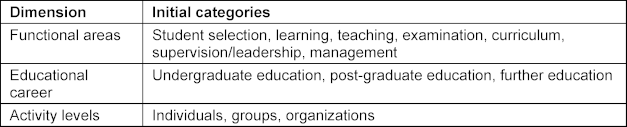
For reasons of research economy, the allocation of articles to be categorized was based on a balanced plan (see attachment 2 [Att. 2]).
Mismatches in the assignment to the categories were identified. If possible, the categories were subsequently reassigned, considering the comments on each subject or objective.
2.2.2. Phase 2: Deductive approach (round 3 – round 8)
Round 3 to round 5 were used to further develop the categories for research subjects, research objectives and classification into research types (see table 2 [Tab. 2]). The categories were predefined and derived from the results of the respective previous round. Two researchers (MG, KSB) independently assigned the articles to the categories. Non-matches between the categories were discussed, categories were renamed and reorganized if necessary, and explanations were added to each category.
The aim of round 6 was to review the categories agreed in round 5, including the explanations for subjects and objectives as well as the classification of research types. For this purpose, five researchers (MG, MH, JM, AS, KSB) independently assessed the articles. Again, for research economic reasons, a balanced plan was used to assign the articles. This plan is equivalent to the one in round 2, only that six articles were assessed in each cell instead of five.
In both round 7 and round 8, the categories were discussed and adjusted by MG, MH, JM, AS and KSB if they did not match. Prior to round 8, MG and GF respectively analyzed from a psychological and medical point of view, which articles were considered critical, i.e. those articles were reviewed that had an overlap of several types of research. The focus was on research objectives and their relationship to research types.
2.2.3. Phase 3: Fine-tuning (round 9 – round 11)
In the fine-tuning phase, the categories and explanations for research subjects, research objectives and research types were refined (see table 2 [Tab. 2]). Here, too, several rounds took place with discussion of non-agreement, revision resp. refining of the categories and independent assessment, each with three researchers (MG, AS, KSB).
2.3. Analysis of rater agreement
Kappa measures were calculated to determine rater agreement, which are to be regarded as adjusted for chance [27], [28]. Cohen’s kappa (κ) was calculated to determine the agreement of two raters and Fleiss κ to determine the agreement of more than 2 raters.
In phases 1 and 2, Cohen’s κ was calculated for the assessments of the ten and 18 pairs evaluated respectively. These were calculated for all categories of the research subjects, research objectives and research types. In a second step, the median of these values was determined for all areas as an estimate of the average agreement between all raters, as the median in this case is the measure that best characterizes the entire sample [27]. In phase 1, the results section does not state the significance, as the k values determined are based on the assessments of only five articles.
In phase 3, Fleiss κ was calculated, as the given items had to be assessed by three researchers. This measure can be used to determine not only the rater agreement of the entire category system, but also for each single category.
According to Landis and Koch, the following values are used to interpret the degree of agreement: κ<0.00 as poor, 0.00-0.20 as slight, 0.21-0.40 as fair, 0.41-0.60 as moderate, 0.61-0.80 as substantial and 0.81-1.00 as almost perfect [28]. In the assessments with three people, the assessment rounds were conducted until sufficient assessment agreement was achieved.
3. Results
3.1. Sample characteristics
In total, 197 articles were selected. Of these, 28 were included in two samples. Therefore, a total of 169 articles were assessed. During the assessment process, two articles were identified that did not meet the criteria for a study: One article presented a research method and its application in medical education. The other article was a letter to the editor. Both articles were excluded from further analysis.
Table 4 [Tab. 4] provides information on the articles in each sample.
Table 4: Description of the samples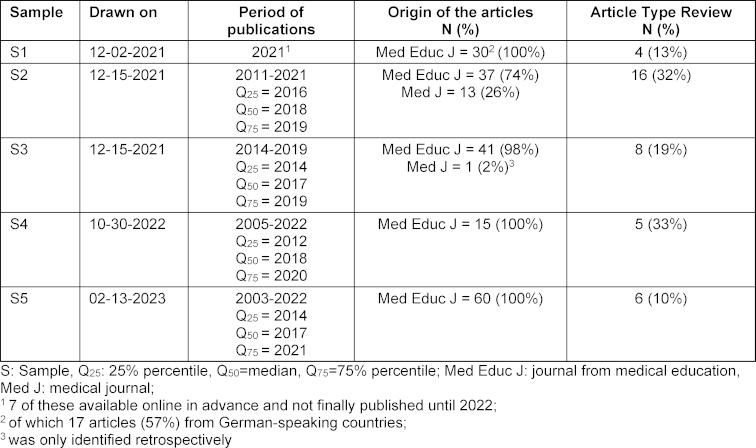
3.2. Development of the categories
As an iterative approach was adopted in this study, the results of each phase are not only reported in a descriptive manner, as is usual in scientific studies, but are also used to justify the further procedure.
At the end of phase 1, the following rater agreements were identified for ten rater pairs:
- Subject areas
- Functional areas category: κ=-0.111-0.737; κMd=0.143
- Educational career category: κ=-0.250-1.000; κMd=0.302
- Activity levels category: κ=-0.071-0.412; κMd=0.185
- Research objectives: κ=-0.087-0.800; κMd=0.243
- Research types: κ=-0.364-0.444; κMd=0.000.
During the inductive phase (phase 1), it became apparent that the research subjects assigned to the dimensions of the structural model of educational research (functional areas, educational career, activity levels) sometimes overlapped. For example, the subjects teaching, learning and curriculum could not always be clearly distinguished from one another. Additionally, some subjects could not be clearly assigned to the dimensions of activity level and educational career. Based on these overlaps, which may have partly caused the low level of rater-agreements, the concept of three dimensions was abandoned and all research subjects were grouped into one subject area. The categories for both the research subjects and the research objectives were gradually adapted in the consensus procedure in the rounds of phase 2. This concerned the categories themselves as well as the explanations for them. Reaching a consensus proved to be particularly difficult, as the researchers of this study had different ideas about science due to their different professional socialization. Additionally, there was a lack of clarity in the terms as well as missing and overlapping categories. It also became apparent that the dimensions quest for fundamental understanding and considerations of use in the quadrant model according to Stokes [23] can be interpreted differently. With the help of additional literature [23], [29], [30], [31], [32] and the discussion of specific studies, the research types were more clearly distinguished from one another.
For the final round of phase 2, the following Cohen's Kappa were calculated for 18 rater pairs:
- Research subjects: κ=-0.053-0.722; κMd=0.214
- Research objective: κ=-0.111-0.643; κMd=0.268
- Research type: κ=-0.176-1.000; κMd=0.354
While fine-tuning, the fourth quadrant was renamed background research as suggested by Bush [33]. This change was accompanied by higher level of rater agreement. At the end of this phase, the rater agreements were as follows: for research subject κFleiss=0.63, p<0.001, for research objective κFleiss=0.52, p<0.001 and for research type κFleiss=0.58, p<0.001. The results for each category are listed in attachment 3 [Att. 3], tables A1-A3.
3.3. Subjects, objectives and types of research in medical education research
After completion of the three phases, eleven research subject categories, eight categories of research objectives and explanations of the research types are now available (see table 5 [Tab. 5], table 6 [Tab. 6] and table 7 [Tab. 7]).
Table 5: Subjects of medical education research incl. explanations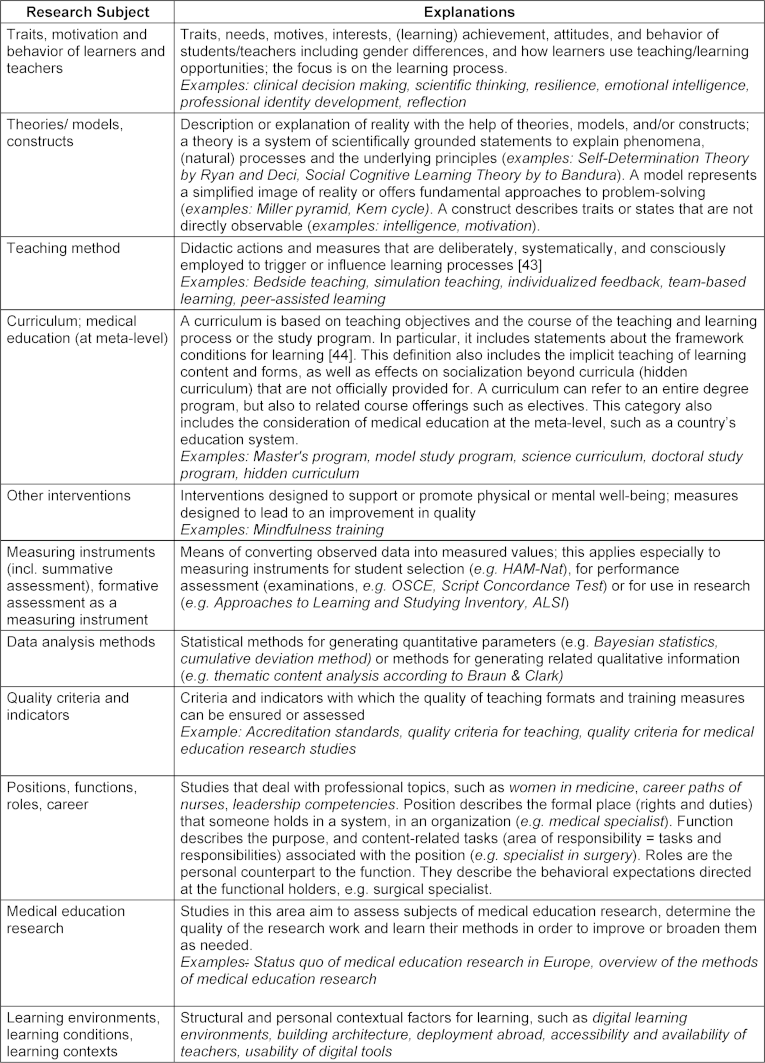
Table 6: Objectives of medical education research including explanations and examples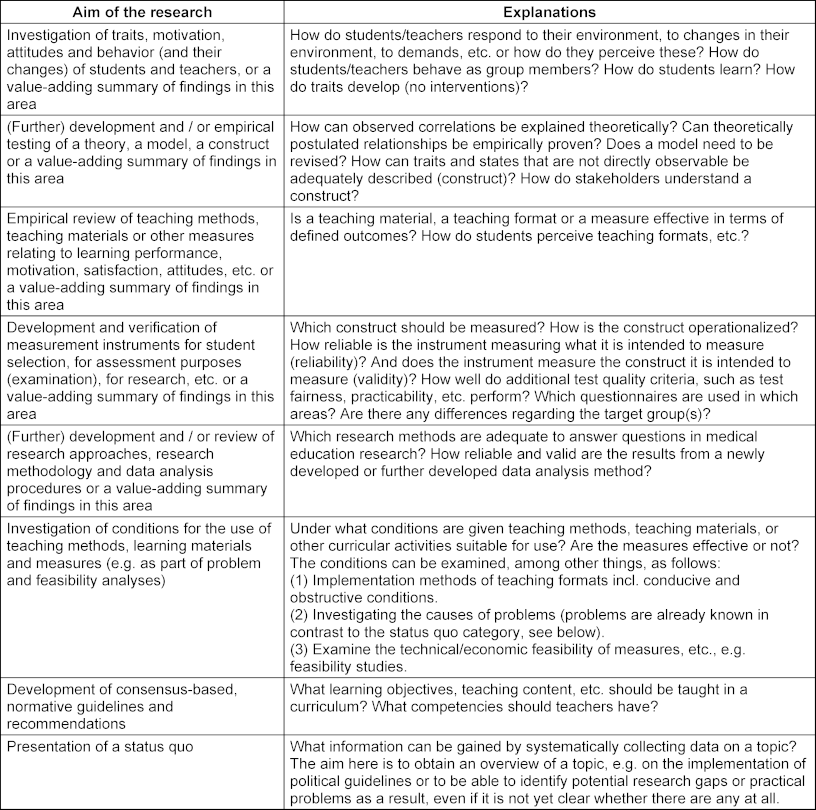
Table 7: Possible types of research in medical education including explanations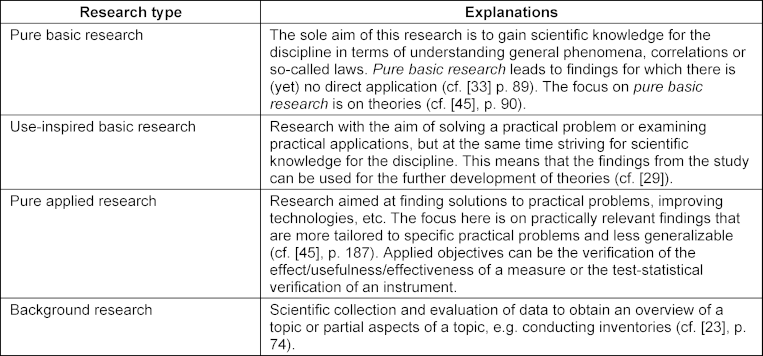
4. Discussion
The starting point for this study is the often-lamented lack of relevance of medical education research: Medical education research is often criticized for contributing little to the advancement of knowledge in this field or for producing findings that have little practical implication.
To better understand how research projects in medical education research can contribute to science in terms of gaining knowledge or further developing practice, the following questions were asked in this study:
- What subjects are researched in medical education?
- What are the objectives of medical education research?
- Which types of research listed in Stokes' quadrant model [23] can be derived for medical education research?
To answer these questions, research articles that have undergone peer-review were used and analyzed accordingly. This was done in an iterative process in which initial categories of each area were reviewed and adjusted. This process of independently reviewing and adjusting categories alternated until a satisfactory rater agreement was achieved.
The categories found for the research subjects partly correspond to previous categories. For example, Raes et al. [9] use similar categories with a slightly different sorting, but in our case, the teaching-learning methods of Raes et al. are divided into teaching methods and traits, motivation and behavior of learners and teachers. We were able to replicate all, but two of Raes et al.’s seven research subjects. In the present categorization, the research subject faculty development can be assigned to the category’s curriculum, quality criteria and indicators or positions, functions, roles, careers, depending on the topic. Correspondingly, the subject of social competence can be assigned to the category traits, motivation and behavior of students and teachers. Compared to the subject categories described by Rotgans [10], no matches could be found, as the categories we have developed are formulated in a more general way. For example, the research subjects listed by Rotgans, which are issues in student assessment, objective structured clinical examination, clinical competence assessment, can be assigned to the category with the heading of measuring instruments. The category system developed for research subjects in the present study therefore fits in well into previous categorization attempts but also broadens them and has the advantage that new research subjects can also be included in this categorization.
As far as the research objectives of medical education research are concerned, previous classifications leave room for interpretation. Both Cook [12] and Ringsted [13] list categories for research objectives. However, they neither explain how these research objectives are arrived at nor what they actually mean. Some of the studies we examined can be assigned to Cook’s [12] category description. For example, there are studies in which phenomena are described that cannot be explained by current theories. These studies provide a starting point for the further development and empirical testing of theories. On the other hand, other studies, which, for example, describe the spread of certain teaching or examination formats without any theoretical or practical implications, would also fall into the description category according to Cook et al.’s categorization. In the present categorization for research objectives, however, such studies are assigned to the category of presentation of a status quo.
In summary, the research objectives we have identified can be roughly categorized according to previous classifications. However, they are formulated so specifically that they are more likely to guarantee a clear classification, as the scope for interpretation has been largely restricted. Furthermore, additional research objectives were identified which relate to the (further) development and verification of measurement instruments and data analysis methods as well as the development of consensus-based, normative guidelines and recommendations.
Regarding the types of research considered relevant for medical education research, three types of research were derived in our study: use-inspired basic research, pure applied research and background research. However, a category of pure basic research could not be identified. Referring to the requirements of Eva and Ringsted, this result appears to be partially consistent, because according to their explanations, medical education research should relate to use-inspired basic research, i.e. address both quest for fundamental understanding and considerations of use. Ringsted writes: “Research in medical education seeks to deepen the knowledge and understanding of learning, teaching and education. It is neither about solving concrete, local problems nor about providing general, universal solutions” ([13], p.695). Eva is primarily concerned with understanding phenomena that are of practical relevance (“identify phenomena of interest (and practical relevance)”... “imperative of understanding”, [16], p.295). To understand these practically relevant phenomena, we need to examine the processes of learning, teaching and education. Since these processes are not directly observable, testable theories that can explain these processes come to the fore. However, these theories are the subject of pure basic research [34]. In medical education research, however, pure basic research is still carried out far too rarely. In their systematic review, Tolsgaard et al. assigned only 2% of randomized studies to the Bohr quadrant (=pure basic research) [35]. The rarity of the occurrence of such studies may therefore be one reason why no studies were found in the present investigation that can be assigned to pure basic research. Due to the importance of this category, as described above, the research types were supplemented with the category of pure basic research.
4.1. Strengths and weaknesses of the study
The strength of our study lies in the fact that previous classifications of research objectives have a strong focus on the research methodology. Yet the choice of research methodology should only take place after a relevant research question has been identified. However, research methodology did not play a role in our discussions and classifications, so we were able to identify the research objectives regardless of the choice of the “right” method. It should be emphasized that peer-reviewed articles, which were assumed to be representative of relevant research, were subject to a procedure based on document analysis. An iterative approach was used to develop the categories and their explanations, alternating between phases of finding mutual consent and verification of agreement. Additionally, researchers from different knowledge cultures were involved.
Through the iterative process of sampling, categorization, finding mutual consent, checking of rater agreement, revision of the categorization on further articles, etc., it was possible to develop categories that also withstand trends and time-limited topics. Thus, topics such as artificial intelligence or the COVID-19 pandemic are not literally listed in the categories, but are nevertheless implicitly present, e.g. as teaching or examination format or change in student motivation.
The study also has some weaknesses. Particularly in the fine-tuning phase (phase 3), some poorly designed studies complicated the categorization process because, for example, research subjects and research objectives were not explicitly named or were not stringently addressed in different parts of the articles (e.g. abstract vs. full text). These inconsistencies presumably had a negative effect on the rater agreements. Another problem was the different use of the terms theory and model in some articles. On the one hand, these terms were used to describe natural processes, which were then tested using empirical data (epistemic meaning). On the other hand, the terms theory and model were used without claiming to explain or describe behavior and experience. Instead, the aim of these studies was to agree on uniform guidelines (normative meaning). The classification of research types was also sometimes affected by shortcomings or ambiguities in the articles. Sometimes research objectives were described that could have been assigned to use-inspired basic research but could not be because of the lack of theoretical reference. In summary, such flaws can limit the extent of rater agreements.
Another possible weakness of the present study is that some categories were chosen less frequently to categorize the articles. This could be because studies that fit into these categories are actually less common. Furthermore, it cannot be ruled out that our explanations of these categories are still too imprecise. Our approach was focused on the development of the categories and their explanations, not on determining and considering the actual occurrence of the studies in the individual categories.
5. Conclusion
Our category systems can help define research subjects and research objectives of medical education research more precisely as well as better distinguish between the research types and their significance. This should make it possible to formulate relevant research questions and choose an approach in which explanatory theories play a role or in which the (general) problem of practice is in the foreground, depending on the type of research in question. The next step is to select the research methodology in such a way that the research question can be answered with the help of the data collected and analyzed. Additionally, the terms used, and in particular their meaning, should be discussed and agreed upon, so that those involved in future studies mean the same thing and their work can contribute more effectively to the gain of knowledge in medical education and ultimately to the further development of practice.
Acknowledgements
We would like to thank Olivia Steiger, cand. med. for her contributions to the literature.
Authors’ ORCIDs
- Katrin Schüttpelz-Brauns: [0000-0001-9004-0724]
- Achim Schneider: [0000-0002-8602-8535]
- Götz Fabry: [0000-0002-5393-606X]
- Jan Matthes: [0000-0003-2754-1555]
- Monika Himmelbauer: [0000-0001-5516-1993]
- Beatrice Buss: [0000-0001-7270-382X]
- Marianne Giesler: [0000-0001-9384-2343]
Competing interests
The authors declare that they have no competing interests.
References
[1] McKeachie WJ. Research on College Teaching: The Historical Background. J Educ Psychol. 1990;82(2):189-200. DOI: 10.1037/0022-0663.82.2.189[2] Norman G. Fifty years of medical education research: waves of migration. Med Educ. 2011;45(8):785-791. DOI: 10.1111/j.1365-2923.2010.03921.x
[3] Schmidt HH, Mamede S. How cognitive psychology changed the face of medical education research. Adv Health Sci Educ Theory Pract. 2020;25(5):1025-1043. DOI: 10.1007/s10459-020-10011-0
[4] Kuper A, Albert M, Hodges BD. The origins of the field of medical education research. Acad Med. 2010;85(8):1347-1353. DOI: 10.1097/ACM.0b013e3181dce9a7
[5] Swanwick T, Forrest K, O’Brien BC, editors. Understanding Medical Education: Evidence, Theory, and Practice, 3rd ed. Hoboken (NJ): Wiley Blackwell; 2018. DOI: 10.1002/9781119373780
[6] Dent J, Harden R, Hunt D, editors. A practical guide for medical teachers. 6th ed. London, UK: Elsevier; 2021.
[7] Norman GR, Vleuten CP, Newble DI, Dolmans DH, Mann KV, Rothman A, Curry L, editors. International Handbook of Research in Medical Education. Dordrecht: Springer; 2012.
[8] Fabry G. Medizindidaktik. Für eine kompetenzorientierte, praxisrelevante und wissenschaftlich fundierte Ausbildung. 2. vollst. überarb. Aufl. Bern: Hogrefe; 2023. DOI: 10.1024/85852-000
[9] Raes P, Bauer D, Schöppe F, Fischer MR. The active participation of German-speaking countries in conferences of the Association for Medical Education in Europe (AMEE) between 2005 and 2013: A reflection of the development of medical education research? GMS Z Med Ausbild. 2014;31(3):Doc28. DOI: 10.3205/zma000920
[10] Rotgans JI. The themes, institutions, and people of medical education research 1988-2010. Adv Health Sci Educ Theory Pract. 2012;17(4):515-527. DOI: 10.1007/s10459-011-9328-x
[11] Spiel C, Wagner P, Götz T, Lüftenegger M, Schober B. Bildungspsychologie: Konzeption, Strukturmodell, Stellenwert und Perspektiven. In: Spiel C, Götz T, Wagner P, Lüftenegger M, Schober B, editors. Bildungspsychologie – ein Lehrbuch. 2. vollst. überarb. Aufl. Göttingen: Hogrefe; 2022. p.11-30. DOI: 10.1026/03108-000
[12] Cook DA, Bordage G, Schmidt HG. Description, justification and clarification: a framework for classifying the purposes of research in medical education. Med Educ. 2008;42(2):128-133. DOI: 10.1111/j.1365-2923.2007.02974.x
[13] Ringsted C, Hodges B, Scherpbier A. 'The research compass': an introduction to research in medical education: AMEE Guide no. 56. Med Teach. 2011;33(9):695-709. DOI: 10.3109/0142159X.2011.595436
[14] Albert M. Understanding the debate on medical education research: a sociological perspective. Acad Med. 2004;79(10): 948-954. DOI: 10.1097/00001888-200410000-00009
[15] Eva K. Broadening the debate about quality in medical education research. Med Educ. 2009;43(4):294-296. DOI: 10.1111/j.1365-2923.2009.03342.x
[16] Eva K. Publishing during COVID-19: Lessons for health education research. Med Educ. 2021;55(3):278-280. DOI: 10.1111/medu.14450
[17] Albert M, Hodges B, Regehr G. Research in medical education: balancing service and science. Adv Health Sci Educ Theory Pract. 2007;12(1):103-115. DOI: 10.1007/s10459-006-9026-2
[18] Regehr G. It's NOT rocket science: rethinking our metaphors for research in health professions education. Med Educ. 2010;44(1):31-39. DOI: 10.1111/j.1365-2923.2009.03418.x
[19] Whitcomb ME. Research in medical education: what do we know about the link between what doctors are taught and what they do? Acad Med. 2002;77(11):1067-1068. DOI: 10.1097/00001888-200211000-00001
[20] Gruppen LD. Improving medical education research. Teach Learn Med. 2007l;19(4):331-335. DOI: 10.1080/10401330701542370
[21] Leif M, Semarad N, Ganesan V, Selting K, Burr J, Svec A, Clements P, Talmon G. The Quality Of Evidence In Preclinical Medical Education Literature: A Systematic Review. Adv Med Educ Pract. 2019;10:925-933. DOI: 10.2147/AMEP.S212858
[22] Colliver JA, McGaghie WC. The reputation of medical education research: quasi-experimentation and unresolved threats to validity. Teach Learn Med. 2008;20(2):101-103. DOI: 10.1080/10401330801989497
[23] Stokes DE. Pasteur’s Quadrant. Basic Science and Technological Innovation. Washington, D.C.: Brookings Institution Press; 1997.
[24] Jovanović M. Fußspuren in der Publikationslandschaft: Einordnung wissenschaftlicher Themen und Technologien in grundlagen- und anwendungsorientierte Forschung mithilfe bibliometrischer Methoden. Stuttgart: Frauenhofer-Verlag; 2011.
[25] Hoffmann N. Dokumentenanalyse in der Bildungs- und Sozialforschung. Überblick und Einführung. Weinheim: Beltz Juventa; 2017.
[26] Flick U. Qualitative Forschung. Theorie, Methoden, Anwendung in Psychologie und Sozialwissenschaften. 5. Aufl. Reinbek bei Hamburg: Rowohlt; 2000.
[27] Wirtz M, Caspar F. Beurteilerübereinstimmung und Beurteilerreliabilität. Methoden zur Bestimmung und Verbesserung der Zuverlässigkeit von Einschätzungen mittels Kategoriensystemen und Ratingskalen. Göttingen: Hogrefe; 2002.
[28] Landis RJ, Koch GG. The measurement of observer agreement for categorical data. Biometrics. 1977;33(1):159-174.
[29] Brüggemann A, Bromme R. Anwendungsorientierte Grundlagenforschung in der Psychologie: Sicherung von Qualität und Chancen in den Beurteilungs- und Entscheidungsprozessen der DFG. Psycholog Rundschau. 2006;57(2):112-118.
[30] Döring N, Bortz J. Forschungsmethoden und Evaluation in den Sozial- und Humanwissenschaften. 5. vollst. überarb. aktual. und erweit. Aufl. Berlin: Springer; 2016. DOI: 10.1007/978-3-642-41089-5
[31] Reinders H, Gräsel C, Ditton H. Praxisbezug Empirischer Bildungsforschung. In: Reinders H, Ditton H, Gräsel C, Gniewosz B, editors. Empirische Bildungsforschung. Gegenstandsbereiche. Wiesbaden: VS Verl. für Sozialwiss. 2011. p.221-233. DOI: 10.1007/978-3-531-93021-3_19
[32] Fischer F, Waibel M, Wecker C. Nutzenorientierte Grundlagenforschung im Bildungsbereich. Zeitschr Erzwiss. 2005;8(3):427-442.
[33] Bush V. Science: The Endless Frontier; A report to the President on a Program for Postwar Scientific Research. Reprint anlässlich des 75. Jahrestages. National Science Foundation; 2020. Zugänglich unter/available from: https://www.nsf.gov/about/history/EndlessFrontier_w.pdf
[34] Ellaway RH, Hecker KG. What role does basic research have in an applied field? Adv Health Sci Educ Theory Pract. 2022;27(2):289-292. DOI: 10.1007/s10459-022-10117-7
[35] Tolsgaard MG. Medical education research in obstetrics and gynecology. Am J Obst Gyn. 2019;220(1):121. DOI: 10.1016/j.ajog.2018.09.013
[36] Meyer HS, Durning SJ, Sklar DP, Maggio LA. Making the first cut: an analysis of academic medicine editors’ reasons for not sending manuscripts out for external peer review. Acad Med. 2018;93(3):464-470. DOI: 10.1097/ACM.0000000000001860
[37] Prystowsky JB, Bordage G. An outcomes research perspective on medical education: the predominance of trainee assessment and satisfaction. Med Educ. 2001;35(4):331-336. DOI: 10.1046/j.1365-2923.2001.00910.x
[38] Biesta GJJ, van Braak M. Beyond the medical model: Thinking differently about medical education and medical education research. Teach Learn Med. 2020;32(4):449-456. DOI: 10.1080/10401334.2020.1798240
[39] Norman G. Editorial - how bad is medical education research anyway? Adv Health Sci Educ Theory Pract. 2007;12(1):1-5. DOI: 10.1007/s10459-006-9047-x
[40] Lurie SJ. Raising the passing grade for studies of medical education. JAMA. 2003;290(9):1210-1212. DOI: 10.1001/jama.290.9.1210
[41] Bolander Laksov K, Dornan T, Teunissen PW. Making theory explicit - An analysis of how medical education research(ers) describe how they connect to theory. BMC Med Educ. 2017;17(1):18. DOI: 10.1186/s12909-016-0848-1
[42] Nichols TR, Wisner, PM, Cripe G, Gulabchand L. Putting the Kappa Statistic to Use. Qual Assur J. 2010;13:57-61. DOI: 10.1002/qaj.481
[43] Souvignier E, Gold A. Wirksamkeit von Lehrmethoden. In: Schweizer K, editor. Leistung und Leistungsdiagnostik. Berlin: Springer; 2006. p.146-166. DOI: 10.1007/3-540-33020-8_10
[44] Tenorth HE, Tippelt R, editors. Lexikon Pädagogik. Weinheim: Beltz; 2007. p.137f.
[45] Döring N. Forschungsmethoden und Evaluation in Sozial- und Humanwissenschaften. 6. Aufl. Berlin: Springer; 2023. DOI: 10.1007/978-3-662-64762-2